An oral medicine for anaemia caused by chronic kidney disease
Roxadustat
An oral treatment for the anaemia of chronic kidney disease that mimics the body's response to low oxygen, offering an alternative to injections.
What is Roxadustat?
Roxadustat is a medicine used to treat anaemia (low haemoglobin) in people with chronic kidney disease, where the kidneys cannot make enough of the hormone that drives red blood cell production. It works by switching on the body's natural response to low oxygen, prompting it to make more red blood cells and use iron better. Unlike older treatments it is taken by mouth as a tablet rather than by injection. Because raising haemoglobin too quickly or too high carries risks such as blood clots and raised blood pressure, the haemoglobin level is monitored and kept within a target range.
Education and reference only. This is a plain-language guide to Roxadustat — it deliberately contains no doses. Doses depend on the person, the brand and the reason for treatment, and belong with your prescriber. Always check the BNF, the product labelling (SmPC) and follow medical advice.
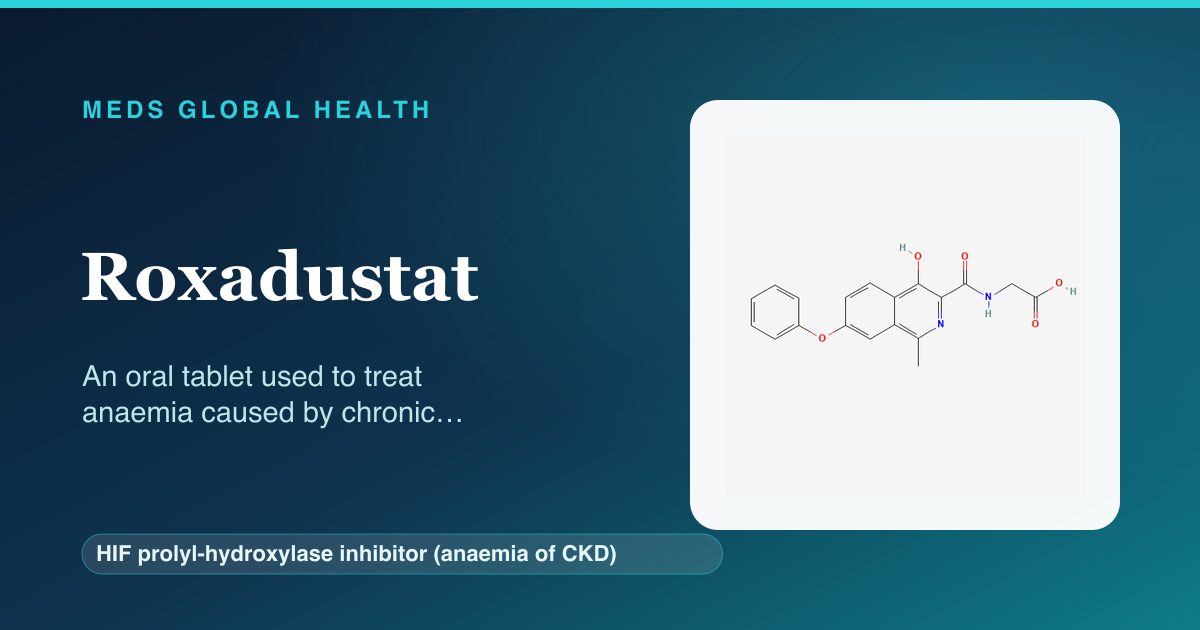
What it is
Roxadustat is a medicine used to treat anaemia in people with chronic kidney disease. In kidney disease the kidneys make less of a hormone (erythropoietin) that tells the bone marrow to make red blood cells, so anaemia develops and people feel tired and breathless. Roxadustat is taken by mouth as a tablet, which makes it different from the older injectable treatments. It works on the body's own oxygen-sensing system to boost red blood cell production, and is used under specialist or kidney-team supervision with regular blood tests to keep haemoglobin in a safe range.
How it works
The body has a natural oxygen-sensing system that, when oxygen is low, switches on a signal (called HIF) to make more red blood cells and handle iron better. Normally an enzyme keeps this signal switched off when oxygen is fine. Roxadustat blocks that enzyme (the prolyl-hydroxylase), so the body behaves as if it needs more red blood cells: it makes more of its own erythropoietin and uses iron more effectively, raising haemoglobin. Because raising haemoglobin too fast or too high can be harmful, it is taken on a schedule and the dose is adjusted to keep haemoglobin within a target range.
Company & origin
An oral medicine used in the UK to treat anaemia in people with chronic kidney disease, offering a tablet alternative to injections.
What it treats
Conditions Roxadustat is used for
Practical use
How to take Roxadustat
General, dose-free guidance — always follow your prescriber's and the leaflet's specific instructions.
- Take the tablet by mouth on the schedule your team sets, swallowing it whole.
- Separate it from phosphate binders and certain indigestion remedies by a few hours, as they can reduce how well it is absorbed.
- Go for your blood tests so haemoglobin and iron can be checked and the dose adjusted.
- Have your blood pressure checked, as it can rise during treatment.
- Give your team a full list of your medicines, as it interacts with some, including statins.
Weighing it up
Advantages & disadvantages of Roxadustat
Advantages
- Treats anaemia of chronic kidney disease with a tablet rather than an injection.
- Works with the body's own oxygen-sensing system and helps it use iron better.
- An oral option that some people find more convenient than injectable treatments.
Disadvantages
- Raising haemoglobin too quickly or too high is linked to blood clots and other risks.
- Can raise blood pressure, which needs monitoring.
- Interacts with some medicines and must be separated from phosphate binders and some indigestion remedies.
Practical use
Good to know
The main advantage of roxadustat is that it treats kidney-related anaemia with a tablet rather than an injection, which suits many people. The key safety idea is that haemoglobin should rise steadily and be kept within a target range rather than as high as possible: letting it climb too quickly or too high is linked to risks such as blood clots and raised blood pressure, so blood tests guide the dose. It can also raise blood pressure, which is monitored. Because it relies on the body using iron to make red blood cells, iron levels are checked and iron may be given alongside. It interacts with some medicines, including certain indigestion remedies and statins, so timing and a full medicines list matter. It is taken on an empty stomach or as advised, separated from phosphate binders and some indigestion remedies.
Who should not take it / use with caution
- People who have had a serious allergic reaction to roxadustat should not take it.
- It is used with caution in people at higher risk of blood clots or with poorly controlled blood pressure.
- It is generally avoided in pregnancy and breastfeeding unless the team advises otherwise.
Monitoring
- Regular blood tests to keep haemoglobin within a target range, not too high.
- Checking iron levels, as iron is needed to make red blood cells.
- Monitoring blood pressure during treatment.
Side effects
- Raised blood pressure, which is monitored during treatment.
- A higher risk of blood clots, particularly if haemoglobin rises too far.
- Nausea, diarrhoea or swelling in some people.
Key interactions
- Phosphate binders and some indigestion remedies can reduce its absorption, so separate them by a few hours.
- It can raise the levels of certain statins, so these may need reviewing.
- Tell your team about all your medicines, as several can interact with it.
Available as: Tablets taken by mouth.
Answers
Roxadustat: frequently asked questions
What is roxadustat used for?
It is used to treat anaemia (low haemoglobin) caused by chronic kidney disease, by prompting the body to make more red blood cells.
How is it different from older treatments?
It is taken by mouth as a tablet rather than given by injection, and it works through the body's own oxygen-sensing system.
Why is my haemoglobin kept within a range?
Letting haemoglobin rise too quickly or too high is linked to risks such as blood clots and raised blood pressure, so blood tests guide the dose.
Do I still need iron?
Often yes, because the body needs iron to make red blood cells, so iron levels are checked and iron may be given alongside.
Why must I separate it from indigestion remedies?
Phosphate binders and some indigestion remedies can reduce how well roxadustat is absorbed, so they should be taken a few hours apart.
Authoritative sources
- BNF
- NICE CKS
Building a medicines information resource?
We create evidence-led, dose-free drug and formulary references for teams.