A cofactor therapy for PKU
Sapropterin
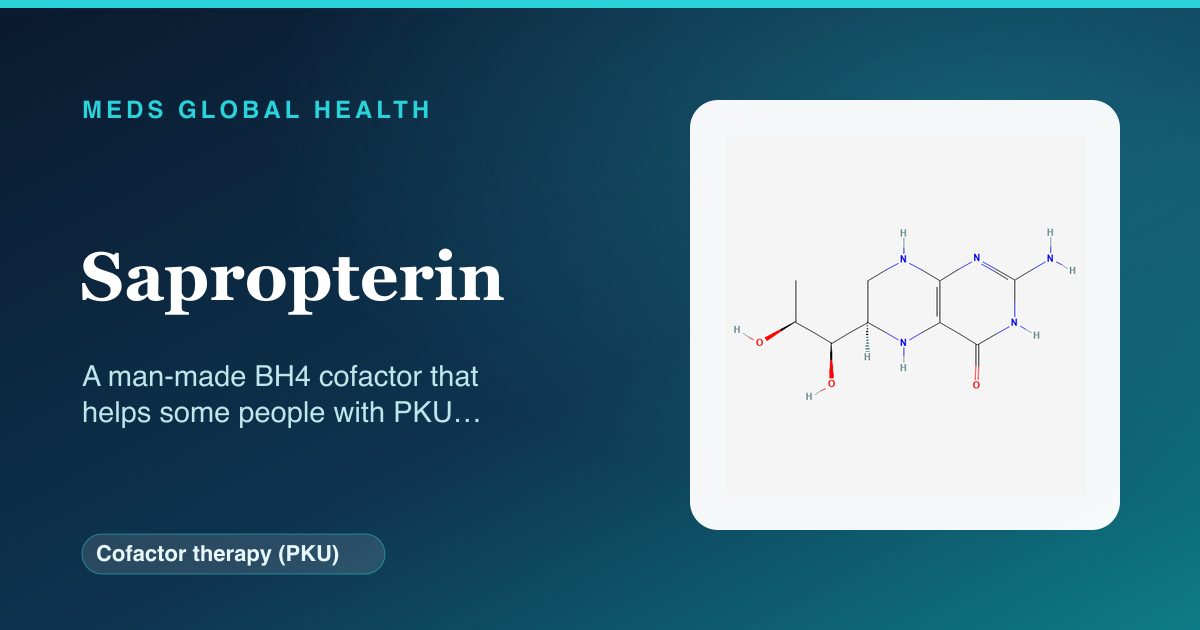
A man-made BH4 cofactor that helps some people with PKU tolerate more dietary phenylalanine.
What is Sapropterin?
Sapropterin is a specialist medicine for phenylketonuria (PKU), a rare inherited condition in which the body cannot properly break down a protein building block called phenylalanine, so it can build up and harm the brain if the diet is not controlled. It is a man-made form of a natural helper molecule (the BH4 cofactor) that, in some people, boosts the leftover activity of their enzyme so they can handle more phenylalanine from food. It only works in people who are responsive, which is checked with a trial, and it is used alongside, not instead of, dietary management. It is taken under the care of a metabolic team with regular blood monitoring.
Education and reference only. This is a plain-language guide to Sapropterin — it deliberately contains no doses. Doses depend on the person, the brand and the reason for treatment, and belong with your prescriber. Always check the BNF, the product labelling (SmPC) and follow medical advice.
What it is
Sapropterin is a treatment for phenylketonuria (PKU), a rare inherited (genetic) condition in which the enzyme that breaks down the amino acid phenylalanine works poorly, so phenylalanine can build up and, without dietary control, affect brain development and function. Sapropterin is a man-made version of BH4, a natural helper (cofactor) the enzyme needs. It is taken by mouth and used together with the PKU diet, under a specialist metabolic centre.
How it works
The enzyme that breaks down phenylalanine needs a helper molecule called BH4 to work. In some people with PKU, the enzyme still has a little activity that can be boosted by extra BH4. Sapropterin supplies this cofactor, helping the leftover enzyme break down more phenylalanine, so these people can tolerate more of it in their diet. It only helps those whose enzyme can respond in this way, which is why a response trial is done before deciding to continue it.
Company & origin
Originated / developed by: BioMarin.
A specialist medicine used in the UK by metabolic centres for some people with phenylketonuria (PKU), alongside dietary management.
Practical use
How to take Sapropterin
General, dose-free guidance — always follow your prescriber's and the leaflet's specific instructions.
- Take it once a day with a meal, as advised by your metabolic team, to help absorption.
- Take the tablets or powder exactly as instructed, dissolving in water or soft food if that is the form you are given.
- Do not change your PKU diet on your own; any relaxation is planned with your team based on your blood levels.
- Keep to your regular phenylalanine blood tests so your team can confirm it is helping and adjust your diet.
- Tell your team if your levels rise or your routine changes, as this may affect your treatment.
Weighing it up
Advantages & disadvantages of Sapropterin
Advantages
- Can let responsive people with PKU tolerate more phenylalanine and ease a very restrictive diet.
- Taken by mouth once a day alongside dietary management.
- Works with the body's own enzyme by supplying the cofactor it needs.
Disadvantages
- Only helps people who are responsive, so it is not suitable for everyone with PKU.
- Does not replace the diet, which must still be managed carefully.
- Needs lifelong specialist supervision and regular blood monitoring.
Practical use
Good to know
The key point is that sapropterin only helps people who are responsive, meaning their phenylalanine levels fall when they try it; a trial is used to find out, and it is continued only if it clearly helps. It does not replace dietary management; rather, it may let responsive people relax their diet somewhat while keeping phenylalanine in a safe range, always guided by the metabolic team and dietitian. It is taken with food and usually dissolved or swallowed as advised. As with all PKU care, regular blood tests to check phenylalanine levels are essential, and any diet changes are made carefully with the team rather than on your own.
Who should not take it / use with caution
- People with PKU who do not respond to it, shown by a trial that does not lower phenylalanine.
- It should only be used under a metabolic centre experienced in managing PKU.
- Use in pregnancy or breastfeeding is decided by the specialist team after weighing benefits and risks.
Monitoring
- A response trial to check whether it lowers phenylalanine before continuing it.
- Regular phenylalanine blood tests to keep levels in the safe range and guide diet.
- Reviewing growth, diet and symptoms with the metabolic team and dietitian.
Side effects
- Headache and a runny or blocked nose are among the more common effects.
- Sore throat, diarrhoea or feeling sick in some people.
- Low phenylalanine levels can occur if diet and medicine are not balanced, which the team monitors.
Key interactions
- It is used alongside the PKU diet, so any change in food intake affects phenylalanine levels.
- Tell your team about all other medicines, as treatment is overseen by a specialist centre.
- Some medicines that affect folate or related pathways may need review by your team.
Available as: Soluble tablets and oral powder taken by mouth.
Answers
Sapropterin: frequently asked questions
Will sapropterin work for me?
It only helps people who are responsive, meaning their phenylalanine levels fall when they try it; a trial under your metabolic team shows whether it is suitable for you.
Can I stop my PKU diet if I take it?
No. It does not replace the diet, though responsive people may be able to relax it somewhat; any change is planned carefully with your team based on your blood levels.
How is it taken?
It is usually taken once a day with a meal, as tablets or powder dissolved in water or soft food, following the form and instructions you are given.
Why do I still need blood tests?
Regular phenylalanine tests confirm the medicine is helping and let your team safely adjust your diet to keep levels in range.
What is the BH4 cofactor?
BH4 is a natural helper molecule the enzyme needs to break down phenylalanine; sapropterin is a man-made form that can boost any leftover enzyme activity.
Authoritative sources
- BNF
- NICE CKS
Building a medicines information resource?
We create evidence-led, dose-free drug and formulary references for teams.