A hormone used in specialised pancreas tests
Secretin
A hormone given by injection in specialised tests of pancreas function and certain imaging scans.
What is Secretin?
Secretin is a naturally occurring hormone that, as a medicine, is used in specialised hospital tests rather than as a treatment. It is given by injection to stimulate the pancreas during tests of how well the pancreas is working, and during certain imaging scans of the pancreatic ducts. It is used for diagnosis, not to treat a condition. It is generally well tolerated, with effects such as a brief feeling of flushing or warmth. It is given by specialist teams in hospital settings.
Education and reference only. This is a plain-language guide to Secretin — it deliberately contains no doses. Doses depend on the person, the brand and the reason for treatment, and belong with your prescriber. Always check the BNF, the product labelling (SmPC) and follow medical advice.
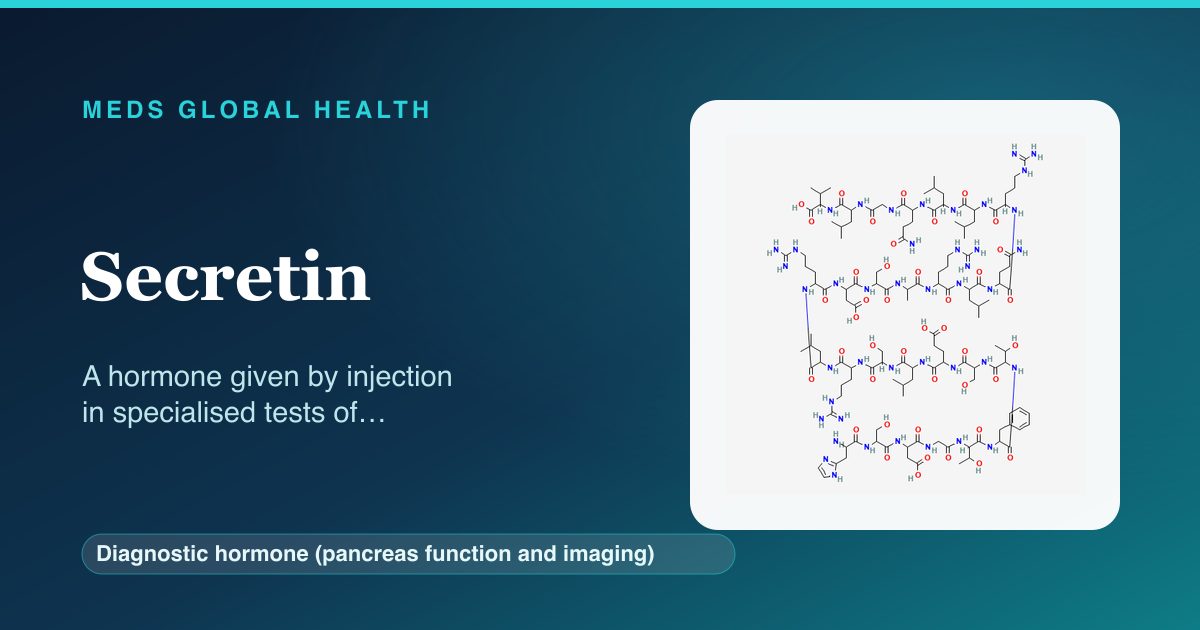
What it is
Secretin is a hormone the body makes naturally to help control digestion. As a medicine, it is used as a diagnostic tool rather than a treatment. Given by injection in hospital, it prompts the pancreas to release its digestive juices, which lets doctors test how well the pancreas is working or improve certain imaging scans, such as specialised scans of the pancreatic ducts. Because its role is to help with tests and imaging, it is given as a one-off or occasional procedure by specialist teams, not taken regularly at home.
How it works
Secretin naturally signals the pancreas and the lining of the gut to produce fluid and bicarbonate that help digestion. When given during a test, it stimulates the pancreas in a controlled way so that doctors can measure its output or see the pancreatic ducts more clearly on a scan. This makes it useful for diagnosing problems with how the pancreas is working. Its effect is short-lived, lasting only as long as needed for the test, which is why it is used as part of a procedure rather than as an ongoing medicine.
Company & origin
A specialist diagnostic medicine used in the UK in hospital tests of how the pancreas works and in certain types of imaging.
Practical use
How to take Secretin
General, dose-free guidance — always follow your prescriber's and the leaflet's specific instructions.
- It is given by injection by a specialist team as part of a hospital test or scan, not taken at home.
- Follow any preparation instructions you are given for the test, such as not eating beforehand if asked.
- Tell the team about any allergies or any previous reaction to secretin before the test.
- Let the team know if you feel unwell, flushed or sick during the procedure.
- Understand that it is used for diagnosis, so it is a one-off or occasional procedure rather than ongoing treatment.
Weighing it up
Advantages & disadvantages of Secretin
Advantages
- Helps doctors test how well the pancreas is working.
- Can improve certain imaging scans of the pancreatic ducts.
- Generally well tolerated, with only short-lived effects during the test.
Disadvantages
- It is a diagnostic tool, not a treatment, so it does not improve a condition itself.
- It is given by injection during a hospital procedure.
- It can cause brief flushing, nausea or mild discomfort during the test.
Practical use
Good to know
The key thing to understand is that secretin is a diagnostic medicine, not a treatment: it is used to help carry out tests of pancreas function and certain imaging scans, not to make a condition better. It is given by injection in hospital, and the most common effects are short-lived, such as a brief feeling of flushing or warmth, nausea or mild tummy discomfort during the procedure. Because it is used as a one-off part of a test, it is not something you take home or take regularly. Tell the team about any allergies and any previous reactions to it, and follow any preparation instructions, such as fasting beforehand, that you are given for the test.
Who should not take it / use with caution
- People who have had a serious allergic reaction to secretin should not be given it.
- It is used with care in certain conditions affecting the pancreas, guided by the specialist team.
- It should only be used as part of a supervised hospital test or scan.
Monitoring
- Watching how you feel during and shortly after the procedure.
- Collecting and measuring the samples or images that the test is designed to produce.
- Checking for any allergic-type reaction during the test.
Side effects
- A brief feeling of flushing or warmth during or just after the injection.
- Nausea or mild tummy discomfort during the procedure.
- Rarely, an allergic-type reaction, which the team is prepared to manage.
Key interactions
- It is used as a one-off part of a test, so routine medicine interactions are not usually a concern.
- Some medicines or recent procedures can affect the test results, so tell the team what you take.
- Always tell the team about all your medicines and allergies before the procedure.
Available as: A solution given by injection during a hospital test or scan.
Answers
Secretin: frequently asked questions
What is secretin used for?
It is a hormone used as a diagnostic tool in specialised hospital tests of how the pancreas is working and in certain imaging scans, not as a treatment.
Is it a treatment?
No. Secretin is used for diagnosis, to help carry out tests and scans, rather than to treat or cure a condition.
How is it given?
It is given by injection by a specialist team as part of a hospital test or scan, not taken at home.
Will it make me feel unwell?
It is generally well tolerated; some people notice a brief feeling of flushing or warmth, nausea or mild tummy discomfort during the procedure.
Do I need to prepare for the test?
You may be asked to follow instructions such as not eating beforehand; the team will tell you what is needed for your particular test.
Authoritative sources
- BNF
- NICE CKS
Building a medicines information resource?
We create evidence-led, dose-free drug and formulary references for teams.