An oral medicine for high blood pressure in the lung arteries
Selexipag
An oral medicine that acts on the prostacyclin pathway to widen the lung arteries for pulmonary arterial hypertension, with effects most noticeable as the dose is built up.
What is Selexipag?
Selexipag is a tablet used to treat pulmonary arterial hypertension, which is high blood pressure in the arteries of the lungs. It works on the same pathway as prostacyclin, acting on the prostacyclin (IP) receptor to relax and widen the lung arteries, easing breathlessness and helping you do more. Because it is taken by mouth, it avoids infusions and inhalations. Side effects such as headache, jaw pain, flushing and diarrhoea are common, especially while the dose is gradually built up to find the right level for you. It is started and supervised by a specialist pulmonary hypertension centre.
Education and reference only. This is a plain-language guide to Selexipag — it deliberately contains no doses. Doses depend on the person, the brand and the reason for treatment, and belong with your prescriber. Always check the BNF, the product labelling (SmPC) and follow medical advice.
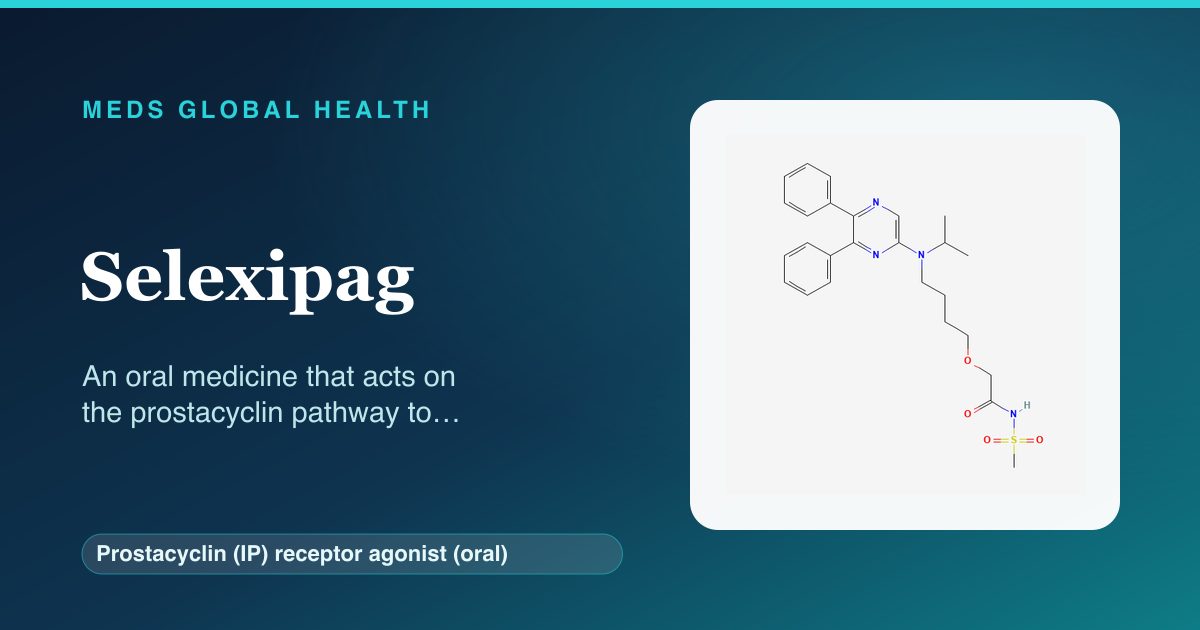
What it is
Selexipag is an oral medicine for pulmonary arterial hypertension, a serious condition where the pressure in the arteries between the heart and lungs is too high, straining the heart and causing breathlessness and tiredness. Rather than being a prostacyclin itself, it acts on the prostacyclin (IP) receptor — the same target prostacyclin uses — to relax the lung arteries. It is taken as a tablet twice a day and is prescribed only through specialist pulmonary hypertension services in the UK.
How it works
Prostacyclin normally relaxes and opens blood vessels by acting on a target called the IP receptor. In pulmonary arterial hypertension this relaxing signal is lacking. Selexipag switches on the same IP receptor, so the lung arteries relax and widen, lowering the pressure the heart pumps against and easing breathlessness. Taking it as a tablet means this prostacyclin-pathway effect can be achieved without an infusion or inhaler, though the dose has to be built up gradually.
Company & origin
Originated / developed by: Janssen (originator).
An oral prostacyclin-pathway medicine used in the UK by specialist centres to treat pulmonary arterial hypertension.
Practical use
How to take Selexipag
General, dose-free guidance — always follow your prescriber's and the leaflet's specific instructions.
- Take it by mouth as directed by your specialist, usually twice a day, swallowed whole with water; taking it with food can ease side effects.
- Follow the gradual dose build-up your team sets, increasing step by step to find the level you tolerate best.
- Expect headache, jaw pain, flushing or diarrhoea, especially during build-up; tell your team, as these often ease and can be managed.
- Do not stop the medicine suddenly without specialist advice, and keep taking it even when you feel well.
- Report severe or persistent side effects, fainting or sudden worsening of breathlessness to your team.
Weighing it up
Advantages & disadvantages of Selexipag
Advantages
- Taken by mouth, avoiding the need for infusions or inhalations.
- Acts on the prostacyclin pathway to widen the lung arteries and ease breathlessness.
- The dose can be tailored gradually to the level each person tolerates best.
Disadvantages
- Commonly causes headache, jaw pain, flushing, diarrhoea and nausea, especially during dose build-up.
- Needs a gradual, stepwise increase over weeks to reach the right dose.
- Can cause aching limbs and, less often, low blood pressure.
Practical use
Good to know
Selexipag is a specialist medicine, started and supervised by a pulmonary hypertension centre. A key practical point is that it is usually started low and built up step by step over weeks to find the highest dose you can comfortably tolerate; the typical prostacyclin-pathway effects — headache, jaw pain, flushing, diarrhoea, nausea and aching limbs — are most noticeable during this build-up and often ease once a steady level is reached. Taking it with food and managing symptoms simply can help. It avoids the burden of infusions and inhalations, which many people value. As with the other medicines, it controls rather than cures the condition and should not be stopped suddenly without specialist advice.
Who should not take it / use with caution
- People with very low blood pressure or certain unstable heart conditions are used with caution or not started on it.
- It is used cautiously in people with significant liver problems, who may need a different dosing approach.
- It is avoided with certain medicines that strongly affect how it is broken down, under specialist guidance.
Monitoring
- Review of how side effects are tolerated as the dose is built up.
- Monitoring of blood pressure and any dizziness or fainting.
- Regular specialist review of breathlessness, exercise capacity and overall response.
Side effects
- Headache, jaw pain, flushing and diarrhoea are common, especially during dose build-up.
- Nausea, aching in the limbs and muscle pain.
- Less often, low blood pressure, a fast heartbeat or fainting.
Key interactions
- Levels can be affected by some medicines that change how it is broken down, so the specialist team coordinates these.
- Adds to the blood-pressure-lowering effect of other medicines, increasing the risk of dizziness.
- Used alongside other pulmonary hypertension medicines under specialist supervision.
Available as: Tablets taken by mouth.
Answers
Selexipag: frequently asked questions
Why does my dose keep going up at first?
Selexipag is built up step by step over weeks to find the highest dose you tolerate well, which is the usual way to start this medicine.
Why do I get headaches and jaw pain?
These come from acting on the prostacyclin pathway and are common, especially during build-up; they often ease once you reach a steady dose.
Is it the same as a prostacyclin infusion?
It works on the same prostacyclin pathway but is taken as a tablet, so it avoids the infusions or inhalations that some other treatments need.
Should I take it with food?
Taking it with food can help reduce side effects such as nausea; follow the advice your specialist team gives you.
Does it cure pulmonary hypertension?
No, it controls the condition by relaxing and widening the lung arteries, which can ease breathlessness and help you do more.
Authoritative sources
- BNF
- NICE CKS
Building a medicines information resource?
We create evidence-led, dose-free drug and formulary references for teams.