A MEK inhibitor for neurofibromatosis type 1
Selumetinib
A specialist targeted medicine used in children with neurofibromatosis type 1 for inoperable plexiform neurofibromas.
What is Selumetinib?
Selumetinib is a specialist targeted medicine, a 'MEK inhibitor', used in children with neurofibromatosis type 1 (NF1) who have plexiform neurofibromas (nerve-related growths) that cannot be removed by surgery. It works by blocking a growth signal inside the cells, which can shrink the growths. It needs careful monitoring of the heart's pumping (LVEF) and the eyes (for retinopathy), and it can raise a muscle blood test (CK) and cause a rash. It is taken on an empty stomach and is given only by a specialist team.
Education and reference only. This is a plain-language guide to Selumetinib — it deliberately contains no doses. Doses depend on the person, the brand and the reason for treatment, and belong with your prescriber. Always check the BNF, the product labelling (SmPC) and follow medical advice.
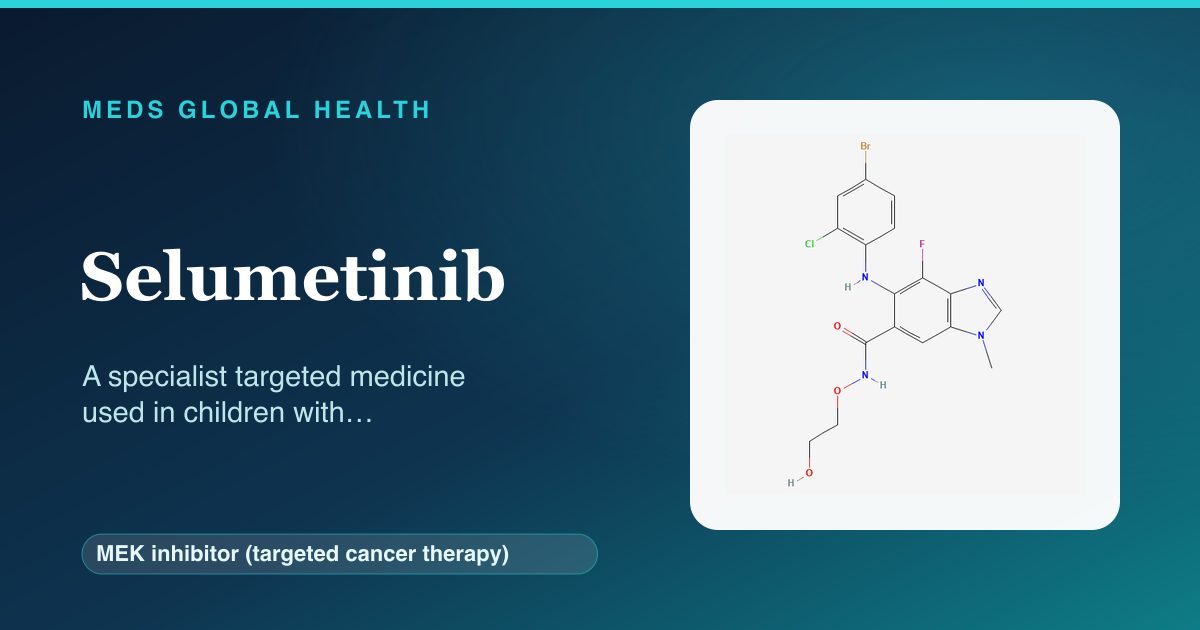
What it is
Selumetinib is a targeted medicine used in children who have neurofibromatosis type 1 (NF1), an inherited condition in which non-cancerous growths form along nerves. It is used specifically for plexiform neurofibromas, growths that cannot be treated with surgery and that can cause pain, disfigurement or pressure on nearby structures. It is a 'MEK inhibitor', meaning it blocks part of a signalling pathway that drives the growths. It is taken by mouth on an empty stomach and is prescribed and closely monitored by a specialist team, with particular attention to the heart and eyes.
How it works
In neurofibromatosis type 1, a faulty gene leaves a growth-promoting pathway (the MAPK pathway) overactive, which drives the formation of plexiform neurofibromas. Selumetinib blocks an enzyme in this pathway called MEK, which dampens the overactive growth signal and can cause the neurofibromas to shrink. Because the same pathway is used in other tissues, blocking it can also affect the heart muscle, the eyes, the skin and muscle, which is why these are monitored. It is taken regularly on an empty stomach so it is absorbed correctly, and its effect is judged over time with scans.
Company & origin
A specialist targeted medicine used in children with neurofibromatosis type 1 to treat inoperable plexiform neurofibromas.
Practical use
How to take Selumetinib
General, dose-free guidance — always follow your prescriber's and the leaflet's specific instructions.
- Take it on an empty stomach, away from food, as food greatly changes how it is absorbed.
- Swallow the capsules whole with water; they should not be opened, chewed or crushed.
- Attend all appointments for heart scans and eye checks, as these are an essential part of treatment.
- Report any new shortness of breath, swelling, tiredness or changes in eyesight straight away.
- Avoid grapefruit and grapefruit juice, and give your team a full list of your other medicines.
Weighing it up
Advantages & disadvantages of Selumetinib
Advantages
- Can shrink plexiform neurofibromas in children with NF1 that cannot be removed by surgery.
- A targeted, by-mouth option for growths that are otherwise hard to treat.
- Offers a treatment where previously there were few options.
Disadvantages
- Can reduce how well the heart pumps and can cause eye (retinal) changes, needing regular monitoring.
- Commonly causes rash, dry skin and a raised muscle blood test (CK).
- Must be taken on an empty stomach and interacts with several medicines and grapefruit.
Practical use
Good to know
Two areas dominate the safety monitoring for selumetinib: the heart and the eyes. It can reduce how well the heart pumps (a fall in the LVEF), so the heart's pumping is checked with scans before and during treatment; and it can cause changes at the back of the eye (retinopathy), so eyesight is monitored and any blurred vision or visual changes should be reported promptly. It can also raise a muscle blood test called creatine kinase (CK) and commonly causes a rash and dry skin. A practical point is that it must be taken on an empty stomach, away from food, for it to be absorbed properly. It interacts with several medicines and with grapefruit, so a full medicines list matters. It is a specialist treatment for children, with regular reviews.
Who should not take it / use with caution
- People who have had a serious allergic reaction to selumetinib should not take it.
- It is used with particular caution in people with existing heart or eye problems.
- It should only be used under a specialist team, with regular heart and eye monitoring.
Monitoring
- Heart scans to check how well the heart pumps (the LVEF) before and during treatment.
- Regular eye checks for changes at the back of the eye (retinopathy).
- Blood tests including the muscle marker creatine kinase (CK), with scans to judge response.
Side effects
- Rash, dry skin, nausea, vomiting or diarrhoea.
- A fall in how well the heart pumps (reduced LVEF) or eye (retinal) changes.
- A raised muscle blood test (creatine kinase, CK) and tiredness.
Key interactions
- Several medicines change how selumetinib is broken down, so they are reviewed and the dose may need adjusting.
- Grapefruit and grapefruit juice can raise its levels and should be avoided.
- Give a full list of your medicines, including herbal products, as many can interact.
Available as: Capsules taken by mouth on an empty stomach.
Answers
Selumetinib: frequently asked questions
What is selumetinib used for?
It is used in children with neurofibromatosis type 1 (NF1) to treat plexiform neurofibromas (nerve-related growths) that cannot be removed by surgery, by blocking a growth signal in the cells.
Why are the heart and eyes monitored?
Selumetinib can reduce how well the heart pumps and can cause changes at the back of the eye, so heart scans and eye checks are done regularly and any breathlessness or vision changes should be reported.
Why must it be taken on an empty stomach?
Food greatly changes how much of the medicine is absorbed, so it is taken away from food to make sure it works as intended.
Can it be taken with grapefruit?
No. Grapefruit and grapefruit juice can raise the levels of selumetinib, so they should be avoided during treatment.
Does it cure NF1?
No. It does not cure NF1, but it can shrink the plexiform neurofibromas and ease symptoms; its effect is judged over time with scans under specialist care.
Authoritative sources
- BNF
- NICE CKS
Building a medicines information resource?
We create evidence-led, dose-free drug and formulary references for teams.