An oral medicine for active secondary-progressive multiple sclerosis
Siponimod
An oral medicine used to treat active secondary-progressive multiple sclerosis, taken under specialist care.
What is Siponimod?
Siponimod is a specialist oral medicine used to treat active secondary-progressive multiple sclerosis (MS), a stage of MS where disability gradually worsens but there is still active inflammation. It is an S1P-receptor modulator that keeps certain immune cells out of the bloodstream, reducing the immune attack on the nervous system. The first dose can slow the heart rate, so it is started gradually with heart checks, and a genetic test (CYP2C9) is done first to set the dose. It needs eye checks for macular oedema, watching for infections, liver-enzyme blood tests, avoidance of live vaccines and reliable contraception. It is specialist-only.
Education and reference only. This is a plain-language guide to Siponimod — it deliberately contains no doses. Doses depend on the person, the brand and the reason for treatment, and belong with your prescriber. Always check the BNF, the product labelling (SmPC) and follow medical advice.
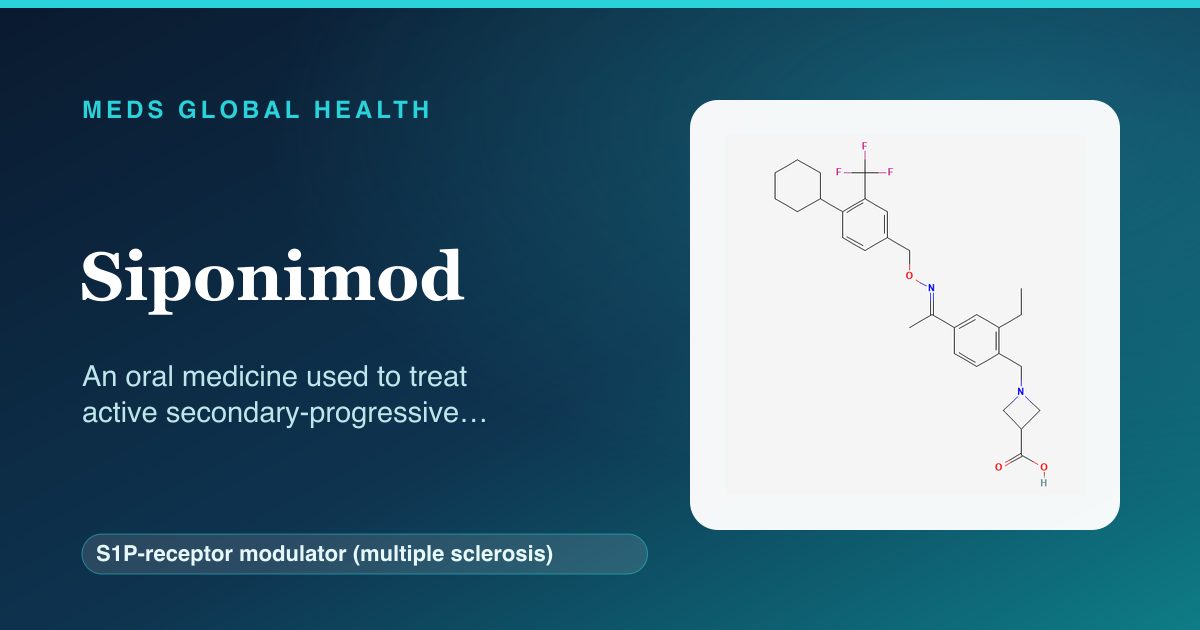
What it is
Siponimod is a medicine taken by mouth to treat active secondary-progressive multiple sclerosis, a phase of MS in which disability slowly increases but there is still active inflammation in the nervous system. It belongs to a group called S1P-receptor modulators. Before it is started, a genetic test (for an enzyme called CYP2C9) is done to choose the right dose, and the first doses are increased gradually with heart-rate checks because they can slow the heart. It is a specialist medicine prescribed and monitored by a neurology team, with several checks needed before and during treatment.
How it works
In MS, immune cells called lymphocytes leave the lymph nodes, travel in the blood and attack the protective covering of nerves. Siponimod is an S1P-receptor modulator: it holds these lymphocytes back inside the lymph nodes, so fewer of them reach the nervous system, which reduces the inflammation and damage. Because the same S1P receptors are found in the heart, the first doses can temporarily slow the heart rate, which is why treatment is started gradually with monitoring. The medicine is broken down by an enzyme called CYP2C9, and people's genes for this enzyme vary, so a genetic test is used to set a safe and effective dose.
Company & origin
A specialist oral medicine used in the UK for active secondary-progressive multiple sclerosis, given under neurology supervision.
Practical use
How to take Siponimod
General, dose-free guidance — always follow your prescriber's and the leaflet's specific instructions.
- Take it by mouth once a day as prescribed, following the step-by-step starting schedule your team gives you.
- Have the genetic (CYP2C9) test and heart checks before starting, as these set your dose and confirm it is safe to begin.
- Attend your eye checks for macular oedema and your liver and blood-count blood tests during treatment.
- Tell your team about fevers or signs of infection, and do not have live vaccines while taking it.
- Use reliable contraception, tell your team if you plan a pregnancy, and do not stop the medicine suddenly without advice.
Weighing it up
Advantages & disadvantages of Siponimod
Advantages
- Offers an oral treatment for active secondary-progressive MS, a stage with limited treatment options.
- Can slow the worsening of disability by reducing the immune attack on the nervous system.
- Taken as a once-daily tablet rather than by injection or infusion.
Disadvantages
- The first doses can slow the heart rate, so treatment must be started gradually with heart checks.
- Needs a genetic test before starting and ongoing eye, liver and blood-count monitoring.
- Raises the risk of infections, requires avoiding live vaccines, and can harm an unborn baby.
Practical use
Good to know
Siponimod needs careful set-up and ongoing checks. Before starting, you have a genetic (CYP2C9) test to set your dose, and the first doses are increased step by step with heart-rate and sometimes heart-tracing (ECG) checks, because they can slow the heart, particularly if you have a heart condition. During treatment, you need eye checks for a swelling at the back of the eye called macular oedema, which can affect vision, and blood tests to watch your liver and your immune cell counts. Because it dampens the immune system, it raises the risk of infections, so report fevers or signs of infection, and you should not have live vaccines while on it. It can harm an unborn baby, so reliable contraception is essential, and it must be stopped well before a planned pregnancy. Do not stop it suddenly without specialist advice.
Who should not take it / use with caution
- People who have had a serious allergic reaction to siponimod should not take it.
- It is not used in pregnancy or while trying to conceive, as it can harm an unborn baby; reliable contraception is essential.
- It is avoided or used only with special precautions in people with certain heart conditions, such as some heart-rhythm or recent heart problems.
- It is not suitable for people with a particular CYP2C9 gene type, and it should only be used under a specialist neurology team with full monitoring.
Monitoring
- A genetic (CYP2C9) test before starting, and heart-rate and ECG checks during the first doses.
- Eye checks for macular oedema, and regular liver and blood-count blood tests.
- Watching for infections and checking blood pressure during treatment.
Side effects
- A slowing of the heart rate, mainly with the first doses, which is why treatment is started gradually.
- Headache, raised blood pressure and a rise in liver blood tests.
- Swelling at the back of the eye (macular oedema) that can affect vision, and a higher risk of infections.
- Rarely but seriously, severe infections, serious heart-rhythm problems or significant vision changes, which need urgent medical attention.
Key interactions
- Some heart medicines, such as beta-blockers and certain heart-rhythm medicines, can add to its effect on the heart rate.
- Medicines that affect the CYP2C9 enzyme can change siponimod levels, so the dose may need adjusting.
- Other medicines that suppress the immune system, and live vaccines, are used with caution or avoided; tell your team everything you take.
Available as: Tablets taken by mouth, including a starter pack for the gradual first doses.
Answers
Siponimod: frequently asked questions
What is siponimod used for?
It is an oral medicine used to treat active secondary-progressive multiple sclerosis, reducing the immune attack on the nervous system to help slow worsening disability.
Why do I need a genetic test before starting?
A genetic test for the CYP2C9 enzyme is done because people break the medicine down differently; it is used to set a safe and effective dose for you.
Why are the first doses built up slowly?
The first doses can slow the heart rate, so treatment is started step by step with heart-rate and sometimes ECG checks to make sure it is safe.
Why do I need eye checks?
Siponimod can cause a swelling at the back of the eye called macular oedema, which can affect vision, so eye checks are done to catch this early.
Can I have vaccines while taking it?
You should not have live vaccines while on siponimod because it dampens the immune system; discuss any vaccinations with your specialist team first.
Authoritative sources
- BNF
- NICE CKS
Building a medicines information resource?
We create evidence-led, dose-free drug and formulary references for teams.