An emergency antidote for serious cyanide poisoning
Sodium nitrite
An emergency hospital antidote, often used with sodium thiosulfate, to treat life-threatening cyanide poisoning.
What is Sodium nitrite?
Sodium nitrite is an emergency antidote used in hospital to treat serious, life-threatening cyanide poisoning, often alongside another antidote called sodium thiosulfate. It works in a deliberate way: it changes some of the blood's haemoglobin into a form called methaemoglobin, which draws cyanide away from the cells where it does harm. Because it deliberately alters the blood and also lowers blood pressure, it is given carefully into a vein in hospital with close monitoring of blood pressure and oxygen. It is strictly an emergency, hospital-only treatment given by experienced staff.
Education and reference only. This is a plain-language guide to Sodium nitrite — it deliberately contains no doses. Doses depend on the person, the brand and the reason for treatment, and belong with your prescriber. Always check the BNF, the product labelling (SmPC) and follow medical advice.
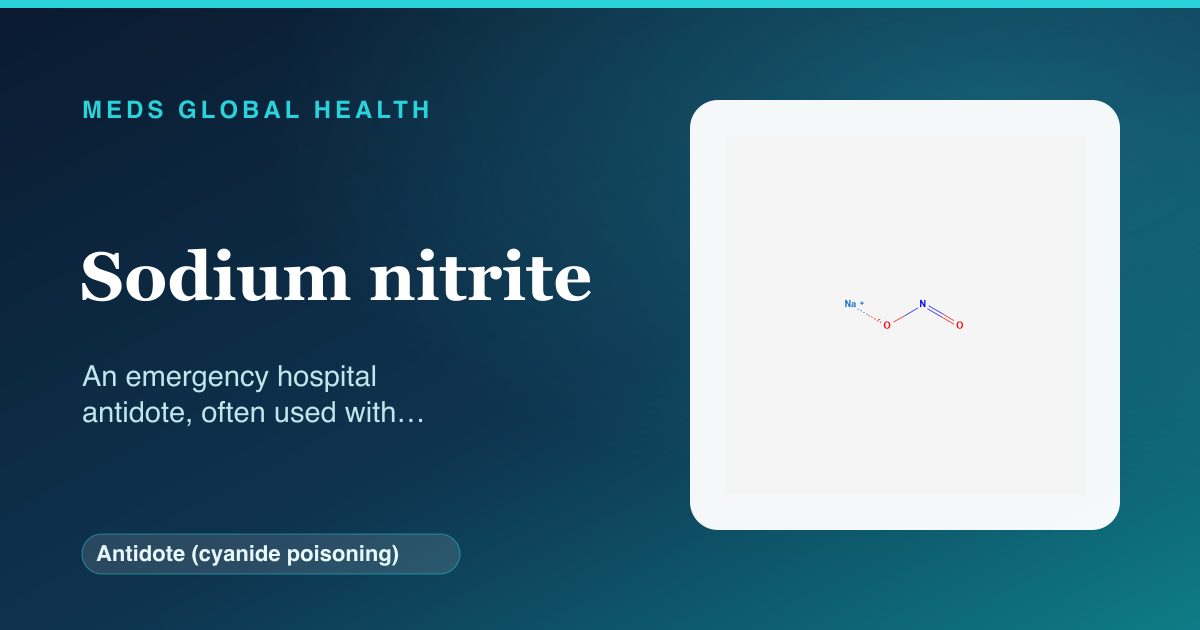
What it is
Sodium nitrite is a specialist antidote used to treat serious cyanide poisoning, a medical emergency. Cyanide stops the body's cells using oxygen, which can be rapidly fatal, so antidotes must be given quickly. Sodium nitrite is one of these antidotes and is often used together with sodium thiosulfate, which helps the body get rid of the cyanide. It is given into a vein in hospital by experienced staff and is never something used outside an emergency medical setting. Its use is carefully controlled because of how powerfully it acts on the blood and circulation.
How it works
Cyanide is poisonous because it binds inside cells and stops them using oxygen. Sodium nitrite deliberately converts some of the blood's haemoglobin into a different form called methaemoglobin. This methaemoglobin acts like a magnet for cyanide, pulling it out of the cells and into the blood, where it is less harmful and can then be dealt with, especially when sodium thiosulfate is also given to help the body remove it. The trade-off is that creating methaemoglobin reduces how much oxygen the blood can carry, and sodium nitrite also widens blood vessels and lowers blood pressure, which is why it must be given slowly and with close monitoring.
Company & origin
A specialist antidote used in the UK in hospital, often with sodium thiosulfate, to treat serious cyanide poisoning.
Practical use
How to take Sodium nitrite
General, dose-free guidance — always follow your prescriber's and the leaflet's specific instructions.
- It is given only in hospital by experienced staff, as an emergency treatment for serious cyanide poisoning.
- It is injected slowly into a vein, with close monitoring of blood pressure and oxygen.
- It is usually given together with sodium thiosulfate, which helps the body clear the cyanide.
- The team monitors the level of methaemoglobin, as too much itself reduces oxygen carrying.
- It is never used at home or outside an emergency medical setting.
Weighing it up
Advantages & disadvantages of Sodium nitrite
Advantages
- Acts as a fast antidote in life-threatening cyanide poisoning.
- Draws cyanide away from the cells where it stops oxygen being used.
- Works well together with sodium thiosulfate to treat the poisoning.
Disadvantages
- Deliberately forms methaemoglobin, which itself reduces the blood's oxygen-carrying ability.
- Lowers blood pressure, so it must be given slowly with monitoring.
- Strictly a hospital emergency treatment, not for any other use.
Practical use
Good to know
The defining feature of sodium nitrite is that it works by deliberately doing something that would normally be harmful, forming methaemoglobin, in order to draw cyanide away from the cells. Because of this it has to be given carefully: too much methaemoglobin itself reduces the blood's ability to carry oxygen, and sodium nitrite also lowers blood pressure, so it is given slowly into a vein with continuous monitoring of blood pressure, oxygen and the level of methaemoglobin. It is usually combined with sodium thiosulfate to clear the cyanide. It is strictly a hospital emergency treatment, used by experienced staff, and the decision to use it weighs the danger of the poisoning against these effects. It is never a treatment used at home or outside emergency care.
Who should not take it / use with caution
- It is used with great caution where forming methaemoglobin would be especially dangerous, such as serious smoke inhalation with low oxygen, where other antidotes may be preferred.
- It is used with care in people with very low blood pressure or significant anaemia, weighing the emergency against the risks.
- It is only ever used in hospital under experienced supervision for genuine cyanide poisoning.
Monitoring
- Continuous monitoring of blood pressure and oxygen during and after treatment.
- Checking the level of methaemoglobin so it does not become too high.
- Watching the overall response to the antidotes and the person's recovery.
Side effects
- A drop in blood pressure, dizziness, flushing and headache from widening of blood vessels.
- Too much methaemoglobin, which reduces oxygen carrying and can cause a bluish colour and breathlessness.
- A fast heartbeat or faintness, which is why monitoring is continuous.
Key interactions
- It adds to the effect of other medicines that lower blood pressure or widen blood vessels.
- It is used as part of a combined antidote plan, usually with sodium thiosulfate.
- The team takes account of other substances involved in the poisoning, such as smoke inhalation.
Available as: A solution given by injection into a vein in hospital.
Answers
Sodium nitrite: frequently asked questions
What is sodium nitrite used for?
It is an emergency antidote used in hospital to treat serious cyanide poisoning, often together with another antidote called sodium thiosulfate.
How does it work against cyanide?
It deliberately changes some haemoglobin into methaemoglobin, which draws cyanide away from the cells where it stops oxygen being used, making it less harmful.
Why does it have to be given so carefully?
Forming methaemoglobin reduces the blood's oxygen-carrying ability and sodium nitrite also lowers blood pressure, so it is given slowly with close monitoring.
Is it used on its own?
It is usually combined with sodium thiosulfate, which helps the body clear the cyanide, as part of the overall treatment of the poisoning.
Could it ever be used at home?
No. It is strictly a hospital emergency treatment given by experienced staff with monitoring, never something used outside emergency care.
Authoritative sources
- BNF
- NICE CKS
Building a medicines information resource?
We create evidence-led, dose-free drug and formulary references for teams.