A powerful intravenous vasodilator
Sodium nitroprusside
A powerful intravenous vasodilator used in intensive care to bring dangerously high blood pressure down quickly.
What is Sodium nitroprusside?
Sodium nitroprusside is a powerful medicine given into a vein to bring dangerously high blood pressure down quickly. It is a vasodilator, meaning it relaxes and widens blood vessels so blood flows more easily and pressure falls almost at once. Because it acts so fast and strongly, it is used only in intensive care or theatre, with continuous blood-pressure monitoring. It is sensitive to light, so the drip is protected from light, and prolonged or high use can lead to a build-up of cyanide in the body, so it is given carefully and for as short a time as possible.
Education and reference only. This is a plain-language guide to Sodium nitroprusside — it deliberately contains no doses. Doses depend on the person, the brand and the reason for treatment, and belong with your prescriber. Always check the BNF, the product labelling (SmPC) and follow medical advice.
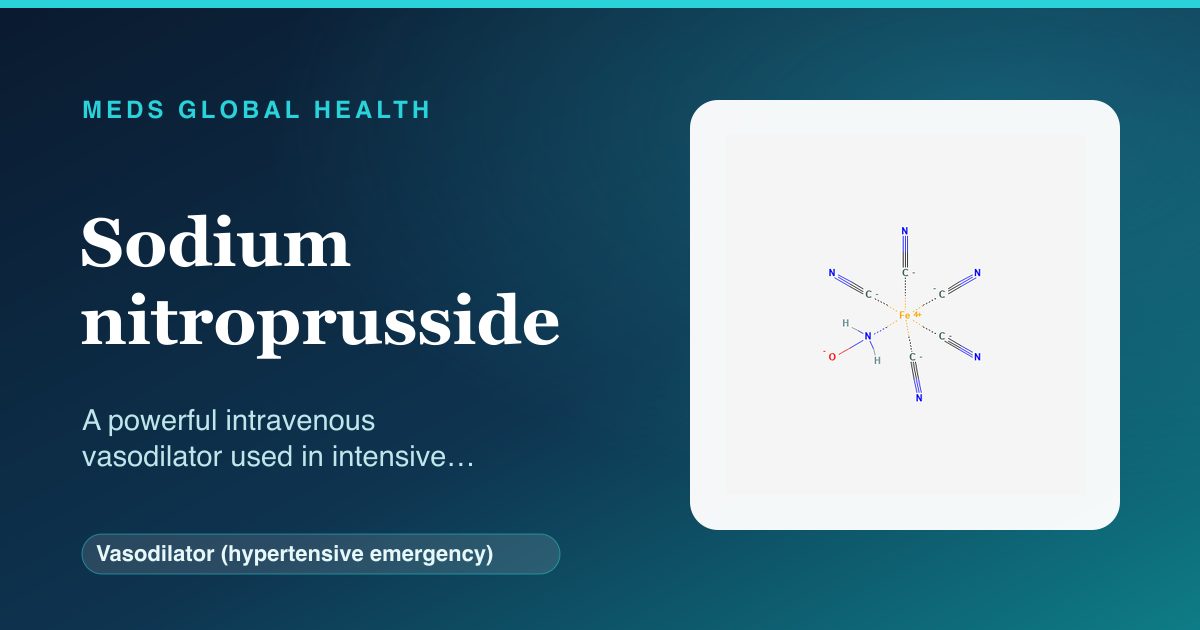
What it is
Sodium nitroprusside is a very strong vasodilator, a medicine that relaxes and widens blood vessels. It is given directly into a vein as a controlled drip and is used in emergencies and intensive care to lower dangerously high blood pressure quickly, or to reduce blood pressure deliberately during certain operations. Because it works so fast and powerfully, it is only ever used in closely monitored hospital settings such as intensive care or the operating theatre, never at home. It is sensitive to light and so the infusion is shielded from light.
How it works
Sodium nitroprusside releases a natural signalling substance (nitric oxide) that makes the muscle in the walls of both arteries and veins relax. As the vessels widen, resistance to blood flow falls and blood pressure drops within moments. Because the effect comes on and wears off very quickly, doctors can fine-tune the blood pressure by adjusting the drip rate. As the medicine is broken down, it releases small amounts of cyanide, which the body normally clears; but with high doses or prolonged use this can build up, which is the main reason its use is carefully limited and monitored.
Company & origin
A powerful intravenous vasodilator used in UK intensive care to bring very high blood pressure down quickly.
Practical use
How to take Sodium nitroprusside
General, dose-free guidance — always follow your prescriber's and the leaflet's specific instructions.
- It is given only in hospital, as a carefully controlled drip (infusion) into a vein in intensive care or theatre.
- Your blood pressure is monitored continuously, often through a fine line in an artery, so the drip can be fine-tuned.
- The infusion is shielded from light, because the medicine is broken down by light.
- It is used at the lowest effective rate and for as short a time as possible to limit cyanide build-up.
- It is a short-term emergency or surgical medicine and is never used at home.
Weighing it up
Advantages & disadvantages of Sodium nitroprusside
Advantages
- Brings dangerously high blood pressure down very quickly and powerfully.
- Its effect can be finely adjusted second by second and wears off rapidly when stopped.
- Useful both in hypertensive emergencies and for controlled lowering of blood pressure during surgery.
Disadvantages
- Can lower blood pressure too far, so it needs continuous, often invasive, monitoring.
- Prolonged or high-dose use can cause a harmful build-up of cyanide in the body.
- Must be protected from light and can only be used in intensive care or theatre by experienced staff.
Practical use
Good to know
Sodium nitroprusside is reserved for serious situations because it is so powerful: it can bring very high blood pressure down within moments, but it can also drop blood pressure too far, so it is always given with continuous, often invasive, blood-pressure monitoring in intensive care or theatre. Two practical points stand out. First, it is broken down by light, so the syringe or bag and sometimes the line are wrapped to protect it. Second, as it is broken down in the body it releases tiny amounts of cyanide; with high doses or use over more than a short period this can build up and become harmful, so the dose and duration are kept as low and short as possible and the team watches for warning signs. Because of these features it is a specialist medicine used only by experienced staff, and the effect stops quickly once the drip is turned off.
Who should not take it / use with caution
- It is avoided in people with certain conditions affecting cyanide handling, such as some rare inherited disorders or untreated severe vitamin B12 deficiency.
- It is used with great caution, or avoided, in severe liver or kidney problems, which affect how cyanide is cleared.
- It is not suitable where blood pressure is already low or where lowering it quickly would be dangerous.
Monitoring
- Continuous, often invasive, blood-pressure monitoring throughout the infusion.
- Watching for signs of cyanide build-up, including blood acid levels, with high or prolonged use.
- Keeping the dose and duration as low and short as possible and checking the line is shielded from light.
Side effects
- A blood pressure that falls too far, causing dizziness, nausea, sweating or a fast heartbeat.
- Headache, restlessness or flushing as the blood vessels widen.
- With high or prolonged use, signs of cyanide build-up such as confusion, breathlessness or a worsening acid level in the blood, which the team monitors closely.
Key interactions
- Other blood-pressure-lowering medicines and some anaesthetics can add to its effect and drop blood pressure further.
- Medicines for erectile problems (such as sildenafil) can dangerously increase blood-pressure lowering.
- Anything affecting liver or kidney function may influence how cyanide is cleared from the body.
Available as: A solution given as a light-protected drip (infusion) into a vein in hospital.
Answers
Sodium nitroprusside: frequently asked questions
What is sodium nitroprusside used for?
It is a powerful intravenous vasodilator used in intensive care or theatre to bring dangerously high blood pressure down quickly, or to lower blood pressure in a controlled way during surgery.
Why does it have to be protected from light?
The medicine is broken down by light, so the syringe, bag and sometimes the line are wrapped to keep it working safely.
What is the concern about cyanide?
As the medicine is broken down it releases tiny amounts of cyanide, which the body normally clears; with high doses or prolonged use this can build up, so the dose and duration are kept as low and short as possible and you are monitored closely.
Why is it only used in intensive care?
It is so powerful and fast-acting that it needs continuous, often invasive, blood-pressure monitoring by experienced staff, so it is used only in intensive care or the operating theatre.
What happens if my blood pressure drops too low?
Its effect wears off very quickly, so the team can slow or stop the drip and your blood pressure usually recovers promptly.
Authoritative sources
- BNF
- NICE CKS
Building a medicines information resource?
We create evidence-led, dose-free drug and formulary references for teams.