A way of replacing phosphate, and an ingredient in some bowel-preparation products
Sodium phosphate
A source of phosphate used to correct low phosphate levels, and an ingredient in some bowel-preparation products, with careful attention to salts, fluids and the kidneys.
What is Sodium phosphate?
Sodium phosphate is used in two main ways: to replace phosphate when blood levels are too low, and as an ingredient in some bowel-cleansing products taken before a procedure such as a colonoscopy. The dominant safety issue is its effect on the body's salts and fluids: it can shift sodium, calcium and phosphate, cause dehydration and strain the kidneys, which is a particular concern when it is used for bowel preparation in older or at-risk people. When given into a vein to correct low phosphate, it is given slowly with monitoring. It is used under medical guidance with attention to hydration and kidney function.
Education and reference only. This is a plain-language guide to Sodium phosphate — it deliberately contains no doses. Doses depend on the person, the brand and the reason for treatment, and belong with your prescriber. Always check the BNF, the product labelling (SmPC) and follow medical advice.
What it is
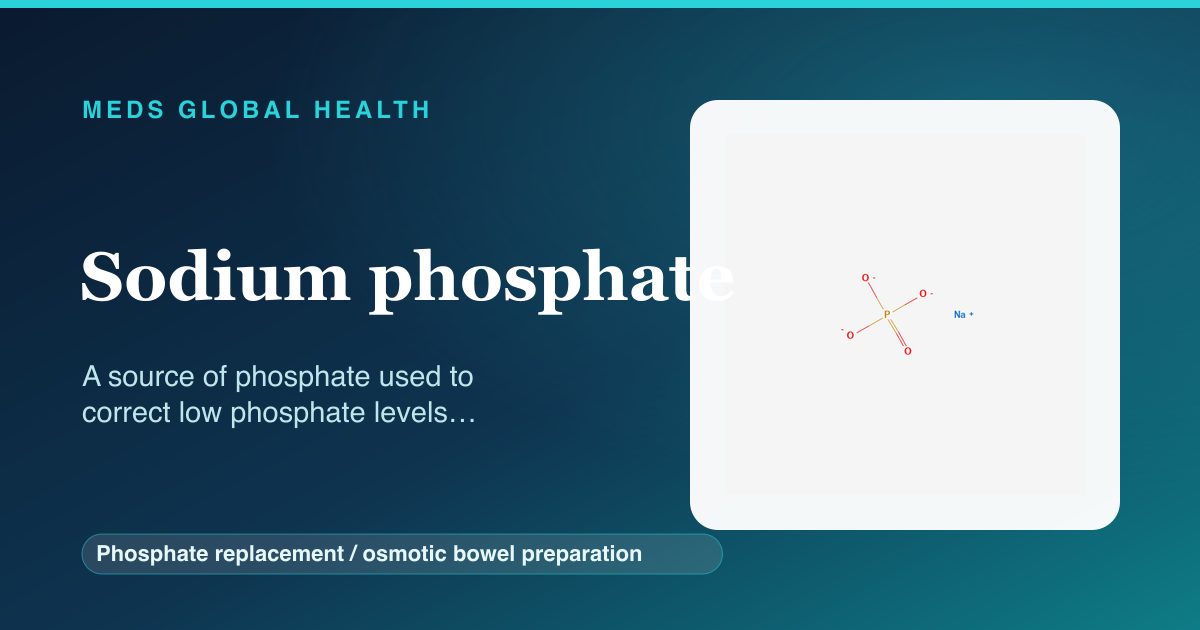
Sodium phosphate is a preparation that supplies phosphate, a salt the body needs for bones, energy and many cell processes. One use is to replace phosphate when blood levels are too low, either by mouth or, when more urgent, slowly into a vein. A separate use is as an ingredient in certain bowel-cleansing products taken before procedures such as a colonoscopy, where it draws water into the bowel to empty it. These two uses are quite different, but both share the need to watch the body's salts, fluids and kidney function, because phosphate-containing products can disturb this balance.
How it works
As a phosphate source, sodium phosphate simply restores phosphate to a healthy level when it has fallen too low, allowing bones, muscles and cells to work normally. As a bowel preparation, it works in a different way: it is poorly absorbed and draws water into the bowel, which softens the contents and triggers emptying to clean the bowel before a procedure. Both actions can shift the balance of the body's salts and fluids, because moving phosphate and water around also affects sodium and calcium and can lead to dehydration. This is why fluids, salts and the kidneys are watched closely whenever it is used.
Company & origin
A preparation used in the UK to replace phosphate when blood levels are low, and as an ingredient in some bowel-cleansing products used before procedures.
Practical use
How to take Sodium phosphate
General, dose-free guidance — always follow your prescriber's and the leaflet's specific instructions.
- Use it only as directed, whether to replace phosphate or as a bowel preparation, and follow the instructions exactly.
- When used for bowel preparation, drink all the extra fluids advised to avoid dehydration.
- Tell your prescriber about kidney, heart or salt-balance problems, as these can make it unsafe.
- When given into a vein, it is given slowly by the team, with monitoring of salts and kidney function.
- Report symptoms such as confusion, muscle cramps, an irregular heartbeat or passing little urine, which can signal a salt or fluid problem.
Weighing it up
Advantages & disadvantages of Sodium phosphate
Advantages
- Corrects a low phosphate level, restoring normal function of bones, muscles and cells.
- Provides an effective way to clean the bowel before some procedures.
- Available both by mouth and, when needed, into a vein.
Disadvantages
- Can shift the body's salts and fluids and cause dehydration, straining the kidneys.
- Bowel-prep use is risky in older or at-risk people, who often need safer alternatives.
- Given into a vein it must be infused slowly, with monitoring, to avoid dangerous salt changes.
Practical use
Good to know
The most important thing with sodium phosphate is its effect on the body's salts, fluids and kidneys. Used as a bowel preparation it can cause significant shifts in sodium, calcium and phosphate and lead to dehydration, which is especially risky in older people, those with kidney problems, heart problems or who are dehydrated, so safer bowel-prep options are often preferred for these groups. Drinking the fluids advised alongside it is essential to avoid dehydration. When given into a vein to correct a low phosphate level, it must be given slowly, because giving phosphate too quickly can cause dangerous changes in calcium and other salts, so it is done with monitoring. In all cases it is used under medical guidance, with attention to kidney function and hydration.
Who should not take it / use with caution
- People with significant kidney problems should generally avoid phosphate bowel preparations, which can be dangerous for them.
- It is used with great caution, or avoided, in people with heart failure, dehydration or certain salt imbalances.
- It is used with care in older people and others at higher risk, where safer options are usually preferred.
Monitoring
- Checking kidney function and salts, especially when used for bowel preparation or given into a vein.
- Watching hydration and making sure recommended fluids are taken.
- Reviewing phosphate, calcium and sodium levels when correcting a low phosphate.
Side effects
- Nausea, bloating, stomach cramps and, with bowel preparation, diarrhoea.
- Dehydration and shifts in salts such as sodium, calcium and phosphate.
- More seriously, kidney problems or, rarely, dangerous changes in salts causing confusion, an irregular heartbeat or seizures.
Key interactions
- Medicines that affect the kidneys or salts, such as some water tablets, ACE inhibitors and NSAIDs, add to the risk.
- It can affect the absorption or levels of some other medicines, so timing may need adjusting.
- Tell your prescriber about all your medicines, especially any that affect the kidneys or heart rhythm.
Available as: Tablets or a solution for replacing phosphate, and liquids used for bowel preparation; also a solution given into a vein.
Answers
Sodium phosphate: frequently asked questions
What is sodium phosphate used for?
It is used to replace phosphate when blood levels are too low, and as an ingredient in some bowel-cleansing products taken before procedures such as a colonoscopy.
Why is it risky for the kidneys?
It can shift the body's salts and cause dehydration, which strains the kidneys, especially when used as a bowel preparation in older or at-risk people.
Why must the drip version be given slowly?
Giving phosphate into a vein too quickly can cause dangerous changes in calcium and other salts, so it is infused slowly with monitoring.
Why do I need to drink extra fluids with bowel prep?
Bowel preparations draw water into the bowel and can cause dehydration, so drinking the recommended fluids is essential to stay safe.
Who should avoid phosphate bowel preparations?
People with significant kidney, heart or salt-balance problems, those who are dehydrated and many older people should usually avoid them and use safer alternatives.
Authoritative sources
- BNF
- NICE CKS
Building a medicines information resource?
We create evidence-led, dose-free drug and formulary references for teams.