A pentavalent antimony injection for leishmaniasis
Sodium stibogluconate
A specialist injection used to treat leishmaniasis, an infection spread by sandfly bites.
What is Sodium stibogluconate?
Sodium stibogluconate is a specialist medicine used to treat leishmaniasis, an infection caused by a parasite spread through sandfly bites, which can affect the skin or internal organs. It is a pentavalent antimony medicine given by injection under close supervision, usually by tropical or infectious-disease teams. Its most important risks are effects on the heart's rhythm, which need heart-tracing (ECG) checks, inflammation of the pancreas (pancreatitis), and changes in liver and blood tests. It is a demanding treatment used for a serious infection, so it needs careful monitoring throughout.
Education and reference only. This is a plain-language guide to Sodium stibogluconate — it deliberately contains no doses. Doses depend on the person, the brand and the reason for treatment, and belong with your prescriber. Always check the BNF, the product labelling (SmPC) and follow medical advice.
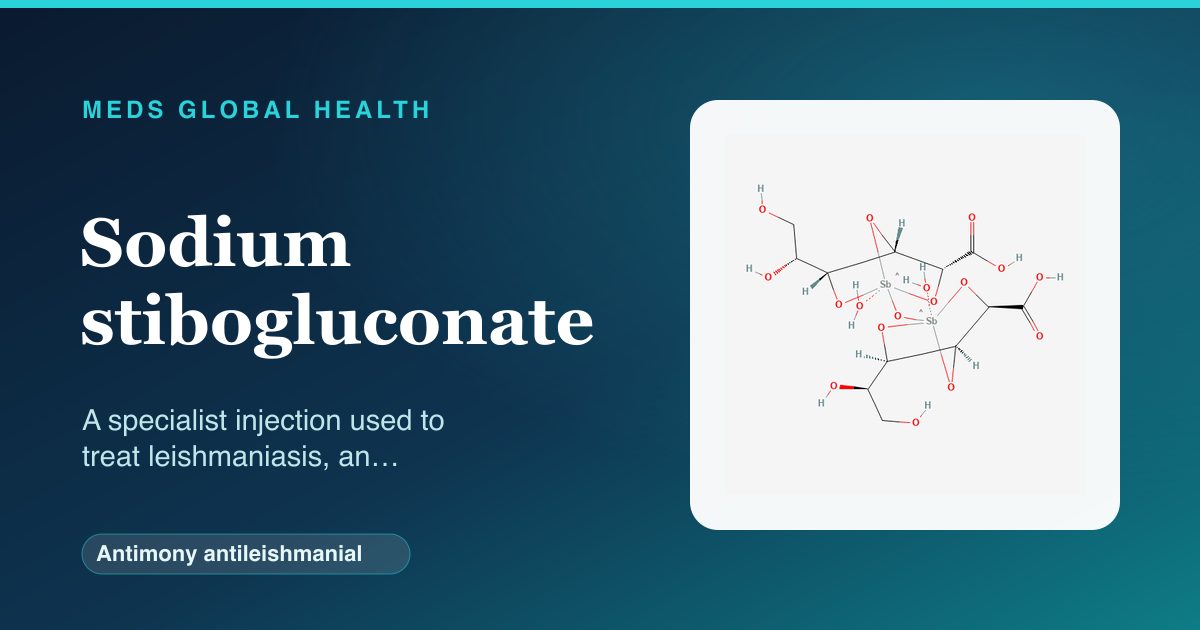
What it is
Sodium stibogluconate is a long-established medicine containing antimony, used to treat leishmaniasis. Leishmaniasis is an infection caused by a tiny parasite spread by the bite of sandflies, found in parts of the tropics, the Middle East and the Mediterranean; it can affect the skin, the lining of the nose and mouth, or internal organs such as the spleen and liver. The medicine is given by injection, usually in hospital or specialist clinics, over a course of treatment. Because it can affect the heart, pancreas, liver and blood, it is given under close specialist supervision with regular monitoring.
How it works
Sodium stibogluconate acts against the leishmania parasite inside the body, interfering with the parasite's energy and chemistry so that it can no longer survive, which clears the infection. Because the parasite can hide inside the body's own cells and, in some forms, affect internal organs, treatment is given as a course over a number of days rather than a single dose. The same antimony that acts on the parasite can also affect the body's own tissues, particularly the heart, pancreas and liver, which is why treatment is closely monitored throughout.
Company & origin
A specialist medicine used in the UK, mainly in tropical and infectious-disease care, to treat leishmaniasis, an infection spread by sandflies.
Practical use
How to take Sodium stibogluconate
General, dose-free guidance — always follow your prescriber's and the leaflet's specific instructions.
- It is given by injection by a specialist tropical or infectious-disease team, usually as a course over several days.
- Attend all heart-tracing (ECG) and blood-test appointments, as monitoring is an essential part of treatment.
- Report severe tummy pain, persistent vomiting, palpitations or feeling faint straight away, as these can signal serious effects.
- Tell the team about all your medicines, especially any that affect the heart rhythm.
- Complete the full course as directed, even though side effects such as aches and tiredness are common during it.
Weighing it up
Advantages & disadvantages of Sodium stibogluconate
Advantages
- An established treatment for leishmaniasis, including forms affecting internal organs.
- Acts directly against the parasite that causes the infection.
- Given as a defined course of treatment under specialist care.
Disadvantages
- Can affect the heart's rhythm and lengthen the QT interval, needing regular heart tracings.
- Can cause inflammation of the pancreas (pancreatitis) and changes in liver and blood tests.
- Commonly causes aches, tiredness, nausea and injection-related discomfort during the course.
Practical use
Good to know
The main thing to understand is that this is a powerful, demanding treatment for a serious infection, and it needs close monitoring throughout the course. Its most important risk is on the heart: it can affect the heart's electrical rhythm and lengthen the QT interval, so heart tracings (ECGs) are done regularly. It can also inflame the pancreas (pancreatitis), causing tummy pain and sickness, and it can disturb the liver and blood tests, so these are checked too. Side effects such as aches, tiredness, nausea and discomfort at the injection site are common during the course. It is given by experienced tropical or infectious-disease teams, and it is important to attend all monitoring appointments and report new symptoms, especially tummy pain, palpitations or feeling faint, straight away.
Who should not take it / use with caution
- People who have had a serious allergic reaction to sodium stibogluconate should not be given it.
- It is used with great caution, or avoided, in people with significant heart, pancreas, liver or kidney problems, guided by the specialist team.
- It is used with care alongside other medicines that affect the heart rhythm, and only under specialist supervision with monitoring.
Monitoring
- Regular heart-tracing (ECG) checks to watch the rhythm and QT interval during the course.
- Blood tests to check the pancreas, liver, kidneys and blood counts.
- Watching for tummy pain, palpitations, feeling faint or other new symptoms throughout treatment.
Side effects
- Aches in the muscles and joints, tiredness, headache and nausea.
- Discomfort, pain or inflammation where the injection is given.
- Changes in the heart's rhythm, including a lengthened QT interval.
- Inflammation of the pancreas (pancreatitis) and changes in liver and blood tests, which monitoring is designed to catch.
Key interactions
- It should be used with care alongside other medicines that affect the heart's QT interval, as the risk adds up.
- It is used with caution with other medicines that can affect the pancreas, liver or blood.
- Tell the team about all your medicines before and during treatment.
Available as: A solution given by injection, usually under specialist supervision.
Answers
Sodium stibogluconate: frequently asked questions
What is sodium stibogluconate used for?
It is a specialist medicine used to treat leishmaniasis, an infection caused by a parasite spread by sandfly bites that can affect the skin or internal organs.
Why does it need heart monitoring?
It can affect the heart's electrical rhythm and lengthen the QT interval, so regular heart tracings (ECGs) are done during the course of treatment.
What is pancreatitis and why does it matter?
Pancreatitis is inflammation of the pancreas, which this medicine can cause; it can lead to severe tummy pain and sickness, so report these symptoms straight away.
How is it given?
It is given by injection by a specialist tropical or infectious-disease team, usually as a course over several days with close monitoring.
Why are so many blood tests needed?
The medicine can affect the pancreas, liver and blood, so regular blood tests, alongside heart tracings, are used to catch any problems early.
Authoritative sources
- BNF
- NICE CKS
Building a medicines information resource?
We create evidence-led, dose-free drug and formulary references for teams.