An antidote and calcium-deposit treatment
Sodium thiosulfate
A specialist infused medicine used in cyanide-poisoning treatment, for calciphylaxis in kidney failure, and to protect hearing during some children's chemotherapy.
What is Sodium thiosulfate?
Sodium thiosulfate is a specialist medicine given by infusion that is used in several different situations. It forms part of the treatment for cyanide poisoning, helps reduce a painful condition called calciphylaxis (where calcium deposits damage the skin and tissues, mainly in people with kidney failure), and is used to help protect hearing during certain chemotherapy treatments in children. It is always given in hospital by a specialist team. Side effects can include nausea and changes in blood salts, so it is monitored. It is given as an infusion.
Education and reference only. This is a plain-language guide to Sodium thiosulfate — it deliberately contains no doses. Doses depend on the person, the brand and the reason for treatment, and belong with your prescriber. Always check the BNF, the product labelling (SmPC) and follow medical advice.
What it is
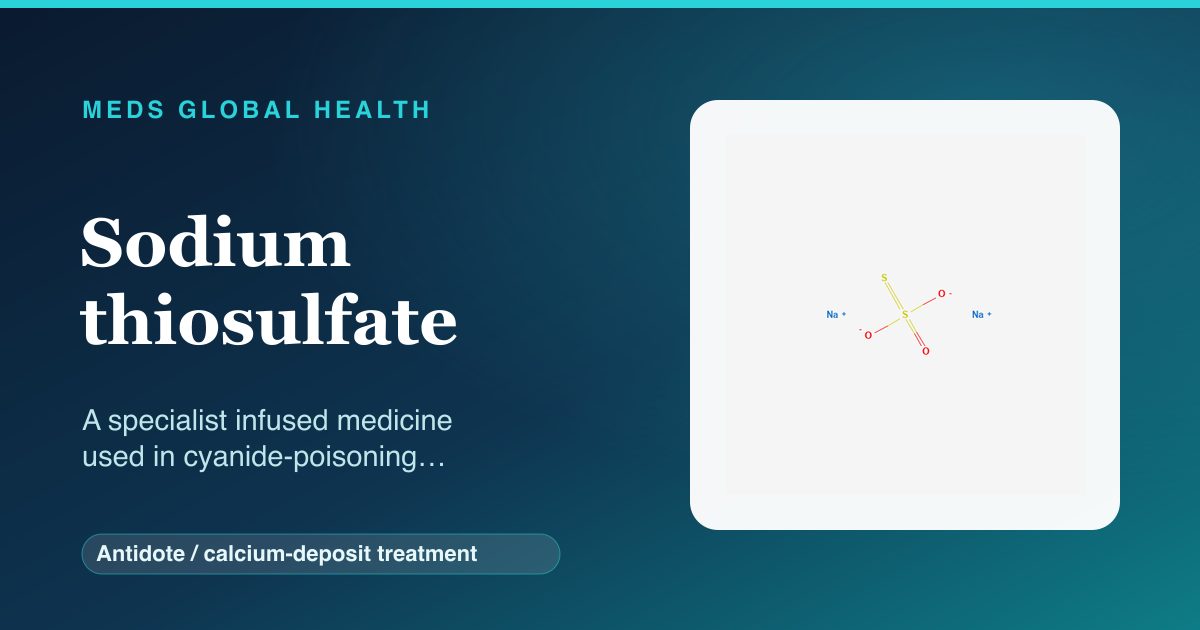
Sodium thiosulfate is a prescription-only medicine used in hospital for a few quite different purposes. It is part of the treatment for cyanide poisoning, where it helps the body deal with the poison. It is used to treat calciphylaxis, a serious and painful condition, mostly seen in people with kidney failure, in which calcium deposits build up in small blood vessels and damage the skin and tissues. It is also used to help protect hearing in some children receiving particular chemotherapy. It is given by infusion into a vein under specialist supervision.
How it works
Sodium thiosulfate works in different ways depending on what it is used for. In cyanide poisoning, it helps the body convert cyanide into a less harmful substance that can be removed. In calciphylaxis, it is thought to help dissolve and reduce the harmful calcium deposits in the small blood vessels, easing pain and helping the skin heal, although exactly how it does this is not fully understood. When used during certain children's chemotherapy, it helps protect the delicate cells of the inner ear, reducing the risk of hearing loss. In every case it is given by infusion and tailored to the situation.
Company & origin
A specialist hospital medicine used in the UK as part of cyanide-poisoning treatment, for calciphylaxis in kidney failure, and to protect hearing in some children's chemotherapy.
Practical use
How to take Sodium thiosulfate
General, dose-free guidance — always follow your prescriber's and the leaflet's specific instructions.
- It is given by infusion into a vein in hospital by a specialist team; you do not take it yourself.
- For calciphylaxis it is often given during dialysis sessions over a period of weeks or months, as planned by your team.
- Tell the team if you feel sick, dizzy or unwell during the infusion, as the rate can be adjusted.
- When used to protect hearing in children, the timing around chemotherapy is carefully arranged by the specialists.
- Attend the blood tests arranged, as the medicine can affect your blood salts and acid balance.
Weighing it up
Advantages & disadvantages of Sodium thiosulfate
Advantages
- A useful part of treatment for cyanide poisoning, a medical emergency.
- Can ease the pain of calciphylaxis and help wounds heal in people with kidney failure.
- Can help protect hearing in some children receiving particular chemotherapy.
Disadvantages
- Has to be given by infusion in hospital and cannot be taken at home as a tablet.
- Commonly causes nausea and vomiting during or after the infusion.
- Can affect the body's blood salts and acid balance, so blood tests and monitoring are needed.
Practical use
Good to know
Sodium thiosulfate is a hospital treatment given by infusion, and the way it is used depends entirely on the reason for it. In calciphylaxis it is usually given over several weeks or months, often during dialysis sessions, and the aim is to ease pain and help wounds heal. It can cause nausea and vomiting during or after the infusion, and it can affect the body's blood salts and acid balance, so blood tests are done and the infusion may be slowed. When used to protect hearing in children, the timing around chemotherapy is carefully planned by the specialist team. As with any infused medicine, tell the team about all your other medicines and any reactions during treatment.
Who should not take it / use with caution
- It is used with caution in people with significant heart or kidney problems, who need closer monitoring.
- People with known allergy to it should not receive it.
- It is used in pregnancy only when a specialist judges the benefit outweighs the risk.
Monitoring
- Blood tests to check blood salts and the body's acid balance during treatment.
- Watching for nausea, low blood pressure and other effects during the infusion.
- Reviewing progress, such as pain and wound healing in calciphylaxis, to guide how long it is used.
Side effects
- Nausea and vomiting during or after the infusion are common.
- Changes in blood salts and the body's acid balance, which are monitored with blood tests.
- Headache, dizziness or low blood pressure, particularly if the infusion is given quickly.
Key interactions
- It is used carefully alongside other treatments that affect blood salts or fluid balance.
- When used with chemotherapy to protect hearing, the timing is planned to avoid affecting the cancer treatment.
- Tell your team about all your medicines so the combination can be reviewed.
Available as: A solution given by infusion into a vein.
Answers
Sodium thiosulfate: frequently asked questions
What is sodium thiosulfate used for?
It is used as part of treatment for cyanide poisoning, to reduce the painful calcium-deposit condition calciphylaxis in kidney failure, and to help protect hearing during some children's chemotherapy.
How is it given?
It is given by infusion into a vein in hospital by a specialist team; for calciphylaxis it is often given during dialysis sessions.
Will it make me feel sick?
Nausea and vomiting during or after the infusion are common; tell the team, as slowing the infusion can help.
Why do I need blood tests during treatment?
It can affect your blood salts and the body's acid balance, so blood tests help the team keep these in a safe range.
How does it help in calciphylaxis?
It is thought to help reduce the harmful calcium deposits in small blood vessels, easing pain and helping the skin heal, though it is usually given over weeks or months.
Authoritative sources
- BNF
- NICE CKS
Building a medicines information resource?
We create evidence-led, dose-free drug and formulary references for teams.