A topical treatment for head lice
Spinosad
A medicine applied to the scalp and hair to treat head lice and their eggs.
What is Spinosad?
Spinosad is a topical medicine used to treat head lice, the tiny insects that live in hair and cause an itchy scalp. It is applied to dry hair and scalp, left on for a short time and then washed out, treating both the lice and often their eggs. The most common effects are local irritation of the scalp or skin and irritation of the eyes if it gets into them. It is for use on the scalp only and should be kept away from the eyes. It is one of several options for head lice and is used as directed, with a repeat treatment if needed.
Education and reference only. This is a plain-language guide to Spinosad — it deliberately contains no doses. Doses depend on the person, the brand and the reason for treatment, and belong with your prescriber. Always check the BNF, the product labelling (SmPC) and follow medical advice.
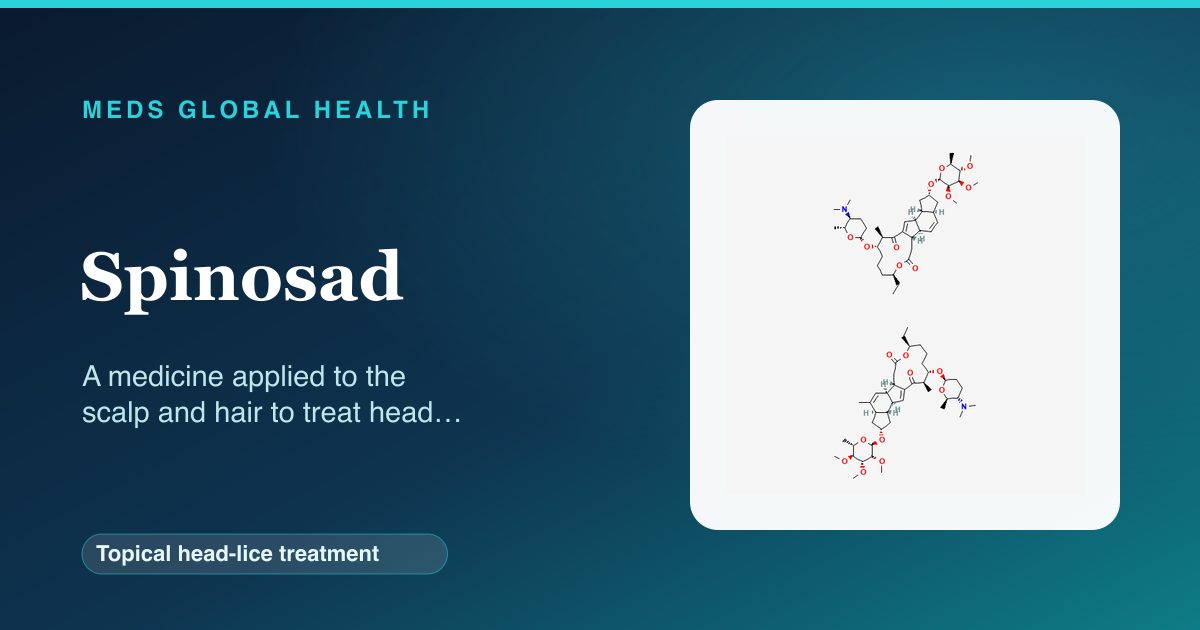
What it is
Spinosad is a topical treatment for head lice, the small wingless insects that live close to the scalp and feed on blood, causing itching. It comes as a lotion or suspension that is applied to dry hair and the scalp, left on for a set time and then rinsed out. It works against the live lice and can help with the eggs (nits) too, which can reduce the need for as much combing. It is applied directly to the head rather than taken by mouth, and is one of several treatments available for head lice.
How it works
Spinosad acts on the nervous system of the lice, overstimulating it so that the insects become paralysed and die. Because it is applied to dry hair, it can coat the lice well, and it is effective against the live insects and helps deal with their eggs, which is why it can sometimes clear an infestation with less fine-tooth combing than some other treatments. It works only where it is applied, on the scalp and hair, and a second application is sometimes advised to catch any lice that hatch after the first treatment.
Company & origin
A topical medicine used to treat head lice, applied to the scalp and hair.
Practical use
How to take Spinosad
General, dose-free guidance — always follow your prescriber's and the leaflet's specific instructions.
- Apply it to dry hair and scalp, covering all of the hair, and leave it on for the time stated before washing out.
- Keep it away from the eyes; if it gets in, rinse them with water, as it can cause eye irritation.
- Use it on the scalp only — it is for external use and should not be swallowed.
- Repeat the treatment after about a week if advised, to deal with any newly hatched lice.
- Check close household contacts and treat those affected, and wash your hands after applying it.
Weighing it up
Advantages & disadvantages of Spinosad
Advantages
- An effective topical treatment for head lice that works against lice and helps with their eggs.
- Applied to dry hair and washed out, and can need less fine-tooth combing than some treatments.
- Used directly on the scalp rather than taken by mouth.
Disadvantages
- Can cause local irritation, redness or dryness of the scalp or skin.
- Can irritate the eyes if it gets into them, so care is needed.
- May need a repeat treatment, and close contacts should be checked.
Practical use
Good to know
Spinosad is applied to dry hair and scalp, left on for the time stated and then washed out — following the timing and covering all of the hair and scalp matters for it to work well. The most common effects are local: redness, irritation or dryness of the scalp or surrounding skin, and irritation of the eyes if any gets into them, so keep it away from the eyes and rinse them with water if it does. It is for external use on the scalp only and should not be swallowed. A repeat treatment after a week or so is sometimes recommended to deal with newly hatched lice. As with all head-lice treatments, checking close household contacts and treating those affected helps stop it spreading back. Wash your hands after applying it and avoid getting it in the mouth.
Who should not take it / use with caution
- People who have had a serious allergic reaction to spinosad or its ingredients should not use it.
- It is used with care in very young children, following the age advice for the product.
- It is for external use on the scalp only and should not be swallowed or used near the eyes.
Monitoring
- Checking whether the head lice have cleared after treatment.
- Watching for local irritation of the scalp, skin or eyes.
- Deciding whether a repeat treatment or treating contacts is needed.
Side effects
- Local irritation, redness or dryness of the scalp or surrounding skin.
- Eye irritation or redness if it gets into the eyes.
- Rarely, more troublesome skin reactions, which should be reviewed.
Key interactions
- There are few well-established medicine interactions, as it works on the scalp.
- Other scalp or hair products on the same area should only be combined on advice.
- Tell your prescriber or pharmacist about anything else you put on the scalp.
Available as: A lotion or suspension applied to the hair and scalp.
Answers
Spinosad: frequently asked questions
What is spinosad used for?
It is a topical medicine used to treat head lice, the tiny insects that live in the hair and cause an itchy scalp.
How do I use it?
It is applied to dry hair and scalp, left on for the stated time and then washed out, covering all of the hair for it to work well.
What if it gets in my eyes?
It can irritate the eyes, so keep it away from them; if it does get in, rinse the eyes with water.
Do I need to use it again?
A repeat treatment after about a week is sometimes recommended to deal with any lice that hatch after the first application.
Does it treat the eggs too?
It works against the live lice and helps deal with their eggs, which can mean less fine-tooth combing than some other treatments.
Authoritative sources
- BNF
- NICE CKS
Building a medicines information resource?
We create evidence-led, dose-free drug and formulary references for teams.