Also called DMSA, an oral chelator for lead and some heavy-metal poisoning
Succimer
An oral chelating medicine, also called DMSA, used to treat lead and some heavy-metal poisoning by binding the metal so it can be passed out of the body.
What is Succimer?
Succimer, also called DMSA, is a specialist medicine taken by mouth to treat lead poisoning and some other heavy-metal poisoning, particularly in children. It works as a chelator, binding to the metal so it can be removed from the body in the urine. It is generally better tolerated than some older chelating treatments, with stomach upset and skin rash being the more common side effects. Because it can affect blood counts and the liver, these are monitored during treatment. It is used under specialist guidance, alongside finding and removing the source of the metal exposure.
Education and reference only. This is a plain-language guide to Succimer — it deliberately contains no doses. Doses depend on the person, the brand and the reason for treatment, and belong with your prescriber. Always check the BNF, the product labelling (SmPC) and follow medical advice.
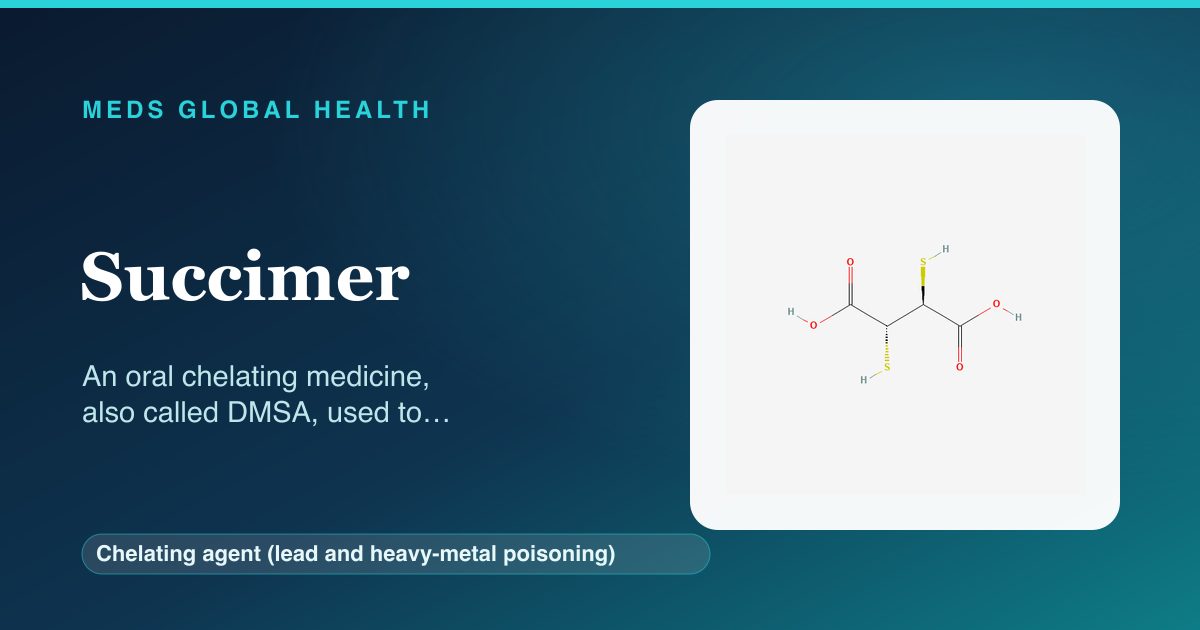
What it is
Succimer, known by the short name DMSA, is a chelating medicine used to treat poisoning with heavy metals, most commonly lead, and is often used in children with raised lead levels. A chelator is a medicine that grabs hold of a metal so the body can get rid of it. Unlike some older chelating treatments that must be injected, succimer is taken by mouth, which makes treatment easier. It is a specialist treatment used under medical supervision, and a key part of managing the poisoning is also finding and removing the source of the metal, such as old paint or contaminated items.
How it works
Succimer binds tightly to heavy metals such as lead in the body, forming a compound that the kidneys can filter out, so the metal is passed out in the urine. By lowering the amount of metal circulating in the body, it reduces the harm the metal can do, particularly to the nervous system in children with lead poisoning. Because it works by removing the metal already absorbed, it is given as a course of treatment, and levels are rechecked afterwards. Importantly, it cannot undo continued exposure, so stopping further contact with the metal is essential for the treatment to work properly.
Company & origin
A specialist medicine, also known as DMSA, used in the UK to treat lead poisoning and some other heavy-metal poisoning, taken by mouth.
Practical use
How to take Succimer
General, dose-free guidance — always follow your prescriber's and the leaflet's specific instructions.
- Take it by mouth exactly as prescribed for the full course; for young children the capsule contents can be given as advised.
- Make sure the source of the metal, such as old paint or a contaminated item, is found and removed, as the medicine cannot keep up with ongoing exposure.
- Drink fluids as advised to help the kidneys clear the metal.
- Attend for the blood tests arranged before and during treatment, including blood counts and liver checks.
- Tell your prescriber about any rash, persistent stomach upset or feeling unwell during treatment.
Weighing it up
Advantages & disadvantages of Succimer
Advantages
- An effective oral treatment for lead and some heavy-metal poisoning, including in children.
- Taken by mouth rather than by injection, which makes treatment easier.
- Generally better tolerated than some older chelating medicines.
Disadvantages
- Commonly causes stomach upset and can cause a skin rash.
- Can affect blood counts and the liver, so blood tests are needed.
- Cannot work properly unless the source of the metal exposure is removed.
Practical use
Good to know
An advantage of succimer is that it is taken by mouth and is generally better tolerated than some older chelating medicines that have to be injected. The more common side effects are stomach upset, such as nausea or diarrhoea, and a skin rash, and it can leave a sulphur-like smell on the breath or urine. More importantly, it can affect blood counts and the liver, so blood tests are done before and during treatment to keep an eye on these. Treatment is only part of the picture: finding and removing the source of the metal, for example old lead paint, is essential, because the medicine cannot keep up with ongoing exposure. Levels are usually rechecked after a course, as a rebound can occur and a further course is sometimes needed.
Who should not take it / use with caution
- People who have had a serious allergic reaction to succimer should not take it.
- It is used with care in people with kidney or liver problems, under specialist guidance.
- It is used only under specialist supervision, with monitoring and removal of the metal source.
Monitoring
- Blood counts and liver function before and during treatment.
- Rechecking metal levels after a course, as a rebound can occur.
- Making sure the source of the exposure has been found and removed.
Side effects
- Nausea, diarrhoea or other stomach upset.
- A skin rash, which should be reported, and sometimes a sulphur-like smell on breath or urine.
- Less commonly, changes in blood counts or liver blood tests, which monitoring is designed to catch.
Key interactions
- It is generally not combined with other chelating medicines unless a specialist advises it.
- Tell your prescriber about all your medicines, as some may need review during treatment.
- Continued exposure to the metal works against the treatment, so removing the source matters more than any medicine interaction.
Available as: Capsules taken by mouth; the contents can be given to young children as advised.
Answers
Succimer: frequently asked questions
What is succimer used for?
It is used to treat lead poisoning and some other heavy-metal poisoning, especially in children, by binding the metal so it can be passed out in the urine.
Is succimer the same as DMSA?
Yes, succimer is also called DMSA; they are two names for the same medicine, a chelator taken by mouth.
Why does the source of the metal need removing?
The medicine removes metal already in the body but cannot keep up with continued exposure, so finding and removing the source, such as old paint, is essential.
What side effects should I watch for?
Stomach upset and skin rash are the more common effects; it can also affect blood counts and the liver, which is why blood tests are done during treatment.
Will one course be enough?
Levels are usually rechecked after a course because they can rebound, and a further course is sometimes needed depending on the result.
Authoritative sources
- BNF
- NICE CKS
Building a medicines information resource?
We create evidence-led, dose-free drug and formulary references for teams.