A medicine for childhood focal epilepsies
Sultiame
An antiepileptic medicine used mainly for certain childhood focal epilepsies, such as benign rolandic epilepsy.
What is Sultiame?
Sultiame is an antiepileptic medicine used mainly in children for certain focal (partial) epilepsies, particularly a common childhood type known as benign rolandic epilepsy. It is taken by mouth and is related to a group of medicines that act on an enzyme called carbonic anhydrase. Common effects include tingling or pins-and-needles, loss of appetite and changes in breathing rate. It is started and supervised by a specialist, and should not be stopped suddenly. It is one of several options used for these childhood seizure types.
Education and reference only. This is a plain-language guide to Sultiame — it deliberately contains no doses. Doses depend on the person, the brand and the reason for treatment, and belong with your prescriber. Always check the BNF, the product labelling (SmPC) and follow medical advice.
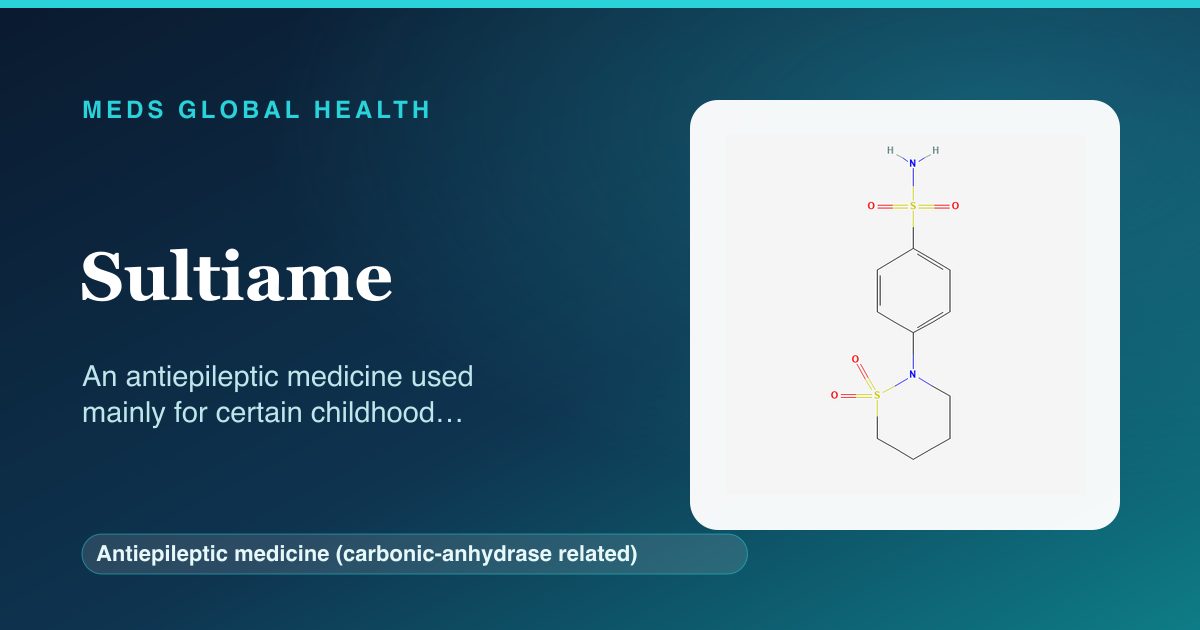
What it is
Sultiame is a medicine used to control seizures, mainly in children. Its main role is in certain focal (partial) epilepsies of childhood, especially a common, usually self-limiting type called benign rolandic epilepsy (benign epilepsy with centrotemporal spikes). It is taken by mouth and is related to medicines that act on an enzyme called carbonic anhydrase. It is a specialist medicine, started and supervised by a children's epilepsy team, and is one of several treatment options chosen depending on the child and the seizure type.
How it works
Sultiame helps to calm the excess electrical activity in the brain that causes seizures. It is related to medicines that block an enzyme called carbonic anhydrase, and this action is thought to contribute to its effect in epilepsy, although the full way it works is not completely understood. By steadying brain activity, it can reduce how often seizures happen in the childhood epilepsies it is used for. Because it works by keeping seizures controlled over time, it is taken regularly and is not stopped suddenly, as that can trigger seizures.
Company & origin
An antiepileptic medicine used in the UK mainly for certain childhood focal epilepsies, such as benign rolandic epilepsy.
What it treats
Conditions Sultiame is used for
Practical use
How to take Sultiame
General, dose-free guidance — always follow your prescriber's and the leaflet's specific instructions.
- Give it by mouth regularly as the specialist team advises, at evenly spaced times each day.
- Do not stop it suddenly, as this can trigger seizures; any changes are made gradually under specialist advice.
- Report troublesome tingling, loss of appetite or changes in breathing to the team.
- Tell the team about all other medicines, as some interactions can occur.
- Keep regular review appointments so seizure control and side effects can be checked.
Weighing it up
Advantages & disadvantages of Sultiame
Advantages
- Can control seizures in certain childhood focal epilepsies, such as benign rolandic epilepsy.
- Taken by mouth as part of a child's regular routine.
- A useful option among several for these specific childhood seizure types.
Disadvantages
- Can cause tingling or pins-and-needles, loss of appetite and changes in breathing rate.
- Must not be stopped suddenly, as this can trigger seizures.
- A specialist medicine that needs starting and supervising by an epilepsy team.
Practical use
Good to know
A useful thing to know is that sultiame is mostly used for specific childhood epilepsies, and the team will explain why it has been chosen and how long it may be needed, as some of these epilepsies improve as the child grows. Because it is related to carbonic-anhydrase medicines, it can cause tingling or pins-and-needles (often in the hands, feet or face), reduced appetite and faster or deeper breathing; these are worth knowing about so they are not alarming if mild, but should be reported if troublesome. As with all epilepsy medicines, it should not be stopped suddenly, as this can bring on seizures, and any changes are made gradually under specialist advice. Tell the team about other medicines, as some interactions can occur. Keeping to regular doses and review appointments helps keep seizures controlled.
Who should not take it / use with caution
- Children who have had a serious allergic reaction to sultiame should not take it.
- It is used with caution in children with kidney problems or certain other conditions, under specialist advice.
- It should only be started and supervised by a specialist children's epilepsy team.
Monitoring
- Reviewing how well seizures are controlled and any side effects over time.
- Watching for tingling, appetite changes and breathing changes.
- Adjusting treatment gradually and reviewing whether it is still needed as the child grows.
Side effects
- Tingling or pins-and-needles, often in the hands, feet or face.
- Loss of appetite, and sometimes weight loss.
- Changes in breathing, such as faster or deeper breathing, and headache or dizziness in some children.
Key interactions
- It can interact with other epilepsy medicines, changing their levels, so the team reviews these together.
- Tell the team about all other medicines, including pharmacy and herbal products.
- Some combinations may need dose adjustment or extra monitoring under specialist advice.
Available as: Tablets taken by mouth.
Answers
Sultiame: frequently asked questions
What is sultiame used for?
It is an antiepileptic medicine used mainly in children for certain focal epilepsies, particularly a common type called benign rolandic epilepsy.
Why does it cause tingling?
Sultiame is related to carbonic-anhydrase medicines, which can cause tingling or pins-and-needles, often in the hands, feet or face; report it if it is troublesome.
Can it be stopped suddenly?
No. Like other epilepsy medicines it should not be stopped suddenly, as this can trigger seizures; any changes are made gradually under specialist advice.
Will my child need it for life?
Not necessarily; some childhood epilepsies improve with age, so the specialist team will review how long treatment is needed.
Does it affect appetite?
Loss of appetite is a recognised effect and can sometimes lead to weight loss, so the team will keep an eye on this.
Authoritative sources
- BNF
- NICE CKS
Building a medicines information resource?
We create evidence-led, dose-free drug and formulary references for teams.