An old injectable medicine for early African sleeping sickness and river blindness
Suramin
An old injectable medicine used for the early (blood) stage of African sleeping sickness and, in some places, for river blindness.
What is Suramin?
Suramin is a long-established injectable medicine used in specialist tropical-medicine settings, mainly to treat the early (blood) stage of African sleeping sickness, a parasite infection spread by the tsetse fly, and in some settings for river blindness. It is given into a vein by specialists, often starting with a small test dose because allergic-type reactions can happen. The most important things to watch for are effects on the kidneys, including protein in the urine, as well as nausea and hypersensitivity reactions. It is a specialist medicine and is not used for everyday infections.
Education and reference only. This is a plain-language guide to Suramin — it deliberately contains no doses. Doses depend on the person, the brand and the reason for treatment, and belong with your prescriber. Always check the BNF, the product labelling (SmPC) and follow medical advice.
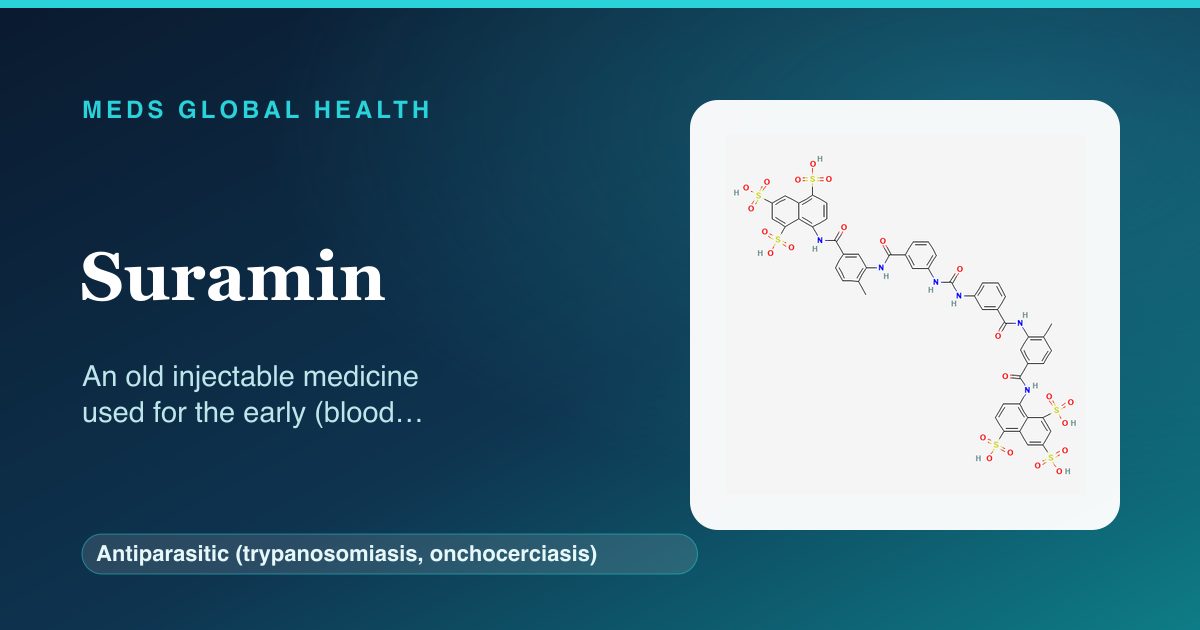
What it is
Suramin is an older injectable medicine used against certain parasite infections. Its main use is to treat the early stage of African sleeping sickness (trypanosomiasis), an infection spread by the bite of the tsetse fly, while the parasite is still in the blood and before it has reached the brain. In some settings it has also been used for river blindness (onchocerciasis). It is given into a vein and is only used under the care of a specialist tropical-medicine team. It is not a medicine that people take at home, and it is reserved for these specific infections.
How it works
Suramin acts against the parasites that cause African sleeping sickness, interfering with processes the parasite needs to survive so that the infection in the blood can be cleared. It does not pass well into the brain, which is why it is used for the early blood stage rather than the later stage that affects the nervous system. Because it stays in the body for a long time and can affect the kidneys, it is given carefully by specialists, usually spaced out over a course, with monitoring along the way to check how the body is coping.
Company & origin
A long-established medicine used in the UK only in specialist tropical-medicine settings, mainly for the early stage of African sleeping sickness.
Practical use
How to take Suramin
General, dose-free guidance — always follow your prescriber's and the leaflet's specific instructions.
- It is given as an injection into a vein by a specialist team, not taken at home.
- Expect a small test dose first, as allergic-type reactions can occur with the first exposure.
- Attend all appointments for the full course and for the kidney and urine checks that go with it.
- Tell the team straight away about any rash, itching, swelling, faintness or difficulty breathing.
- Report changes such as much less urine, swollen ankles or frothy urine, which can point to kidney effects.
Weighing it up
Advantages & disadvantages of Suramin
Advantages
- An established treatment for the early (blood) stage of African sleeping sickness.
- Has also been used against river blindness in some settings.
- Long experience with its use in specialist tropical medicine.
Disadvantages
- Can affect the kidneys, including causing protein to appear in the urine.
- Can cause allergic-type reactions, so a test dose and careful supervision are needed.
- Given only by injection into a vein under specialist care, with frequent monitoring.
Practical use
Good to know
Suramin is very much a specialist medicine for specific tropical infections, not something used for ordinary illnesses. A key safety point is that it can affect the kidneys, and one of the things doctors look for is protein appearing in the urine, which is why urine and kidney checks are part of treatment. Allergic-type (hypersensitivity) reactions can also happen, so a small test dose is often given first, and treatment is carried out where reactions can be managed. Nausea and feeling generally unwell are common during a course. Because the medicine lingers in the body and is used for serious infections, it is always given by an experienced specialist team who monitor closely and adjust care as needed.
Who should not take it / use with caution
- People who have had a serious allergic reaction to suramin should not be given it.
- It is used with great caution, or avoided, in people with significant kidney problems.
- It should only be used under specialist tropical-medicine supervision, with monitoring.
Monitoring
- Regular urine tests to check for protein, and blood tests to check kidney function.
- Watching for allergic-type reactions, especially after the test dose and early doses.
- Reviewing how the infection is responding and how the person is tolerating the course.
Side effects
- Nausea, vomiting or feeling generally unwell during the course.
- Kidney effects, including protein in the urine, which monitoring is designed to catch.
- Allergic-type (hypersensitivity) reactions, ranging from rash and itching to more serious responses.
- Tiredness, tingling, or skin and nail changes in some people with longer use.
Key interactions
- Tell the specialist team about all your medicines, especially other medicines that can affect the kidneys.
- Care is needed when combining it with other treatments given for the same or related infections.
- There are few well-established routine interactions, but a full medicines list helps keep treatment safe.
Available as: A powder made up into a solution for injection into a vein.
Answers
Suramin: frequently asked questions
What is suramin used for?
It is used mainly to treat the early (blood) stage of African sleeping sickness, and in some settings river blindness, under specialist tropical-medicine care.
Why is a test dose given first?
Allergic-type reactions can happen with suramin, so a small test dose is often given first to check how you react before the full course.
Why are my kidneys checked?
Suramin can affect the kidneys and cause protein to appear in the urine, so urine and blood tests are used to watch for this during treatment.
Can it treat the brain stage of sleeping sickness?
No. It does not pass well into the brain, so it is used for the early blood stage; the later stage that affects the nervous system needs different treatment.
Is it taken at home?
No. It is given as an injection into a vein by a specialist team, with monitoring, and is not a medicine taken at home.
Authoritative sources
- BNF
- NICE CKS
Building a medicines information resource?
We create evidence-led, dose-free drug and formulary references for teams.