An orexin-receptor blocker for insomnia
Suvorexant
A sleep medicine for insomnia that works by blocking orexin, a chemical that keeps the brain awake.
What is Suvorexant?
Suvorexant is a medicine for insomnia that works in a newer way, by blocking orexin, a chemical signal in the brain that keeps you awake. It is taken by mouth at bedtime. The most important things to know are that it can cause next-day drowsiness and may impair driving, and that it can cause sleep paralysis, vivid dreams or hallucinations around falling asleep or waking, and complex sleep behaviours such as doing things while not fully awake. It is a controlled medicine and should not be combined with certain strong interacting medicines. It is used for short to medium periods alongside good sleep habits.
Education and reference only. This is a plain-language guide to Suvorexant — it deliberately contains no doses. Doses depend on the person, the brand and the reason for treatment, and belong with your prescriber. Always check the BNF, the product labelling (SmPC) and follow medical advice.
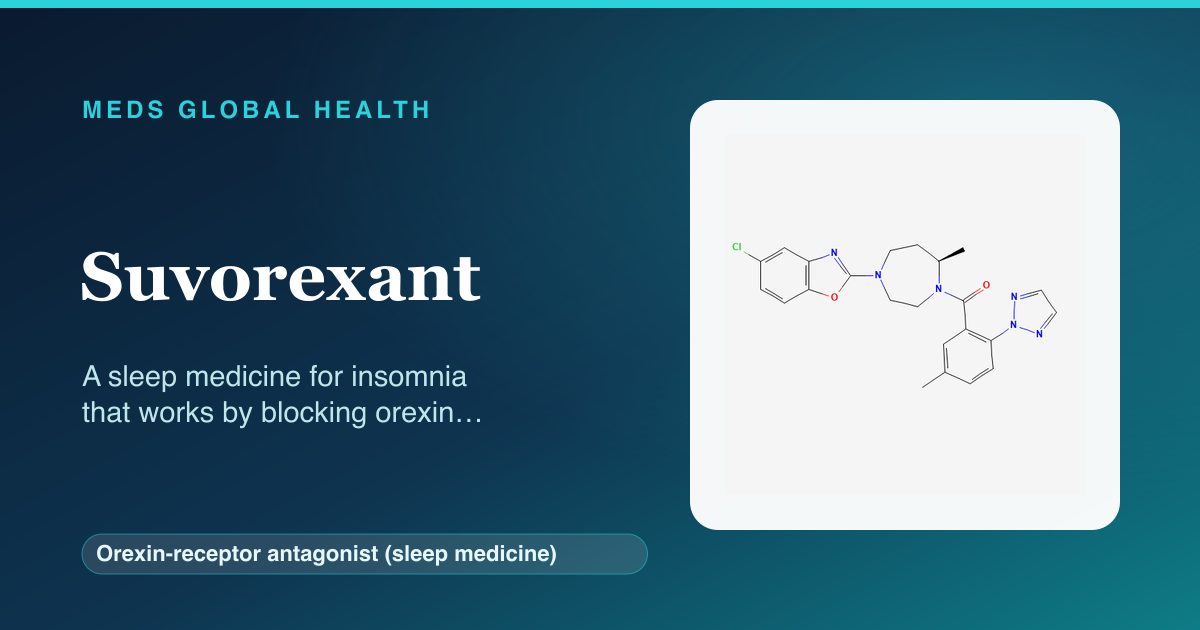
What it is
Suvorexant is a medicine used to treat insomnia, that is difficulty falling asleep or staying asleep. Unlike older sleeping tablets, it works by blocking orexin, a natural chemical in the brain that promotes wakefulness, so it dampens the 'stay awake' signal rather than broadly sedating the brain. It is taken by mouth shortly before bed. It is a controlled medicine, used for a limited time alongside advice on sleep habits, and is prescribed with care because of its effects on next-day alertness and sleep behaviour.
How it works
Staying awake is driven partly by a brain chemical called orexin. Suvorexant blocks the receptors that orexin acts on, reducing the wakefulness signal so it becomes easier to fall asleep and stay asleep. Because it works close to the time it is taken and can linger, it is taken at bedtime with enough time for a full night's sleep, and taking it too late or with too little sleep ahead makes next-day drowsiness more likely. It treats the symptom of poor sleep rather than the underlying cause, so it is used alongside good sleep habits and usually for a limited period.
Company & origin
A sleep medicine that works by blocking orexin, a wakefulness signal in the brain, used for insomnia.
What it treats
Conditions Suvorexant is used for
Practical use
How to take Suvorexant
General, dose-free guidance — always follow your prescriber's and the leaflet's specific instructions.
- Take it by mouth at bedtime, only when you can have a full night's sleep ahead.
- Avoid driving or skilled tasks the next day if you feel at all drowsy, and avoid alcohol.
- Take it as a single dose for the night and do not take extra if you wake; tell your prescriber if it is not helping.
- Tell your prescriber about all your medicines, as it should not be combined with certain strong interacting medicines.
- Report sleep paralysis, hallucinations or any complex sleep behaviours, such as doing things while not fully awake.
Weighing it up
Advantages & disadvantages of Suvorexant
Advantages
- Can help with falling asleep and staying asleep by reducing the brain's wakefulness signal.
- Works in a different way from older sleeping tablets.
- Taken as a single bedtime dose for short to medium-term use.
Disadvantages
- Can cause next-day drowsiness and impair driving and concentration.
- Can cause sleep paralysis, hallucinations and complex sleep behaviours such as acting while not fully awake.
- Is a controlled medicine and must not be combined with certain strong interacting medicines.
Practical use
Good to know
The most important safety points are about next-day effects and unusual sleep experiences. Suvorexant can leave you drowsy the next day and can impair driving and concentration, so you should not drive or do skilled tasks if you feel less than fully alert, and you should avoid alcohol. Some people get sleep paralysis (briefly being unable to move when falling asleep or waking), vivid dreams or hallucinations, and complex sleep behaviours, such as walking, eating or even driving while not fully awake and with no memory of it afterwards; these mean the medicine should be reviewed. It is a controlled medicine, so it is prescribed and handled with extra care. It should not be combined with certain strong interacting medicines (powerful CYP3A inhibitors), which can raise its levels too much. It works best alongside good sleep habits and for a limited time.
Who should not take it / use with caution
- People who have had a serious allergic reaction to suvorexant should not take it.
- It is not suitable for people with narcolepsy.
- It is avoided with strong CYP3A inhibitor medicines, and used with caution where next-day drowsiness would be dangerous.
Monitoring
- Reviewing how well sleep has improved and whether the medicine is still needed.
- Watching for next-day drowsiness and its effect on driving and daily tasks.
- Checking for sleep paralysis, hallucinations or complex sleep behaviours.
Side effects
- Next-day drowsiness, tiredness or feeling less alert.
- Headache, unusual or vivid dreams, and dry mouth.
- Sleep paralysis, hallucinations and complex sleep behaviours such as walking or eating while not fully awake.
Key interactions
- Strong CYP3A inhibitor medicines can raise suvorexant levels too much and should be avoided.
- Alcohol and other sedating medicines add to drowsiness and should be avoided or used with caution.
- Tell your prescriber about all your medicines, as some can change how it works.
Available as: Tablets taken by mouth at bedtime.
Answers
Suvorexant: frequently asked questions
What is suvorexant used for?
It is used to treat insomnia, helping with falling asleep and staying asleep by blocking orexin, a chemical that keeps the brain awake.
Can it make me drowsy the next day?
Yes. It can cause next-day drowsiness and impair driving and concentration, so avoid driving or skilled tasks if you feel less than fully alert, and avoid alcohol.
What are complex sleep behaviours?
These are things like walking, eating or even driving while not fully awake, often with no memory afterwards; if they happen, the medicine should be reviewed.
Why does it interact with some medicines?
Strong CYP3A inhibitor medicines can raise suvorexant levels too much, so it should not be combined with them; tell your prescriber about all your medicines.
Is it a controlled medicine?
Yes, it is a controlled medicine, so it is prescribed and handled with extra care and usually used for a limited time alongside good sleep habits.
Authoritative sources
- BNF
- NICE CKS
Building a medicines information resource?
We create evidence-led, dose-free drug and formulary references for teams.