A muscle relaxant for anaesthesia (also called succinylcholine)
Suxamethonium
A fast, short-acting muscle relaxant given by an anaesthetist to relax the muscles quickly so a breathing tube can be placed.
What is Suxamethonium?
Suxamethonium is a muscle relaxant given only by an anaesthetist during a general anaesthetic. It briefly paralyses the muscles — including the breathing muscles — so the anaesthetist can quickly place a breathing tube and a machine can breathe for you. You are always fully asleep first, and your breathing is supported throughout. It works very fast and wears off very quickly, which makes it useful when the airway needs to be secured rapidly. It is closely monitored, and the team watches carefully for two rare but serious reactions: a severe allergic reaction and a dangerous overheating condition called malignant hyperthermia.
Education and reference only. This is a plain-language guide to Suxamethonium — it deliberately contains no doses. Doses depend on the person, the brand and the reason for treatment, and belong with your prescriber. Always check the BNF, the product labelling (SmPC) and follow medical advice.
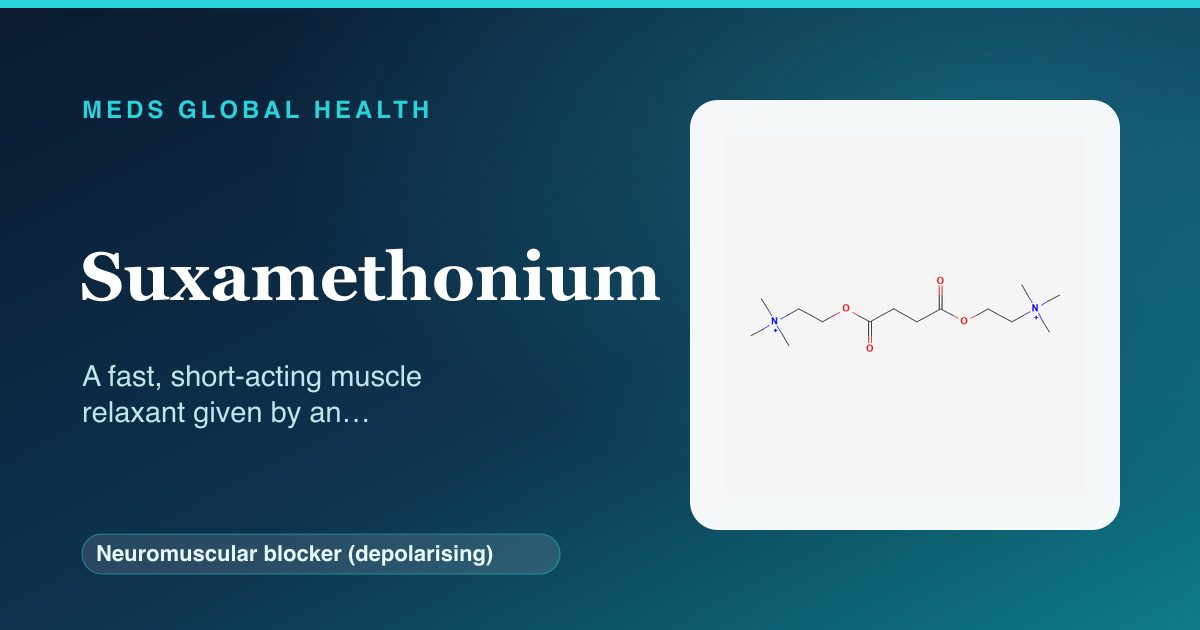
What it is
Suxamethonium is a depolarising muscle relaxant used during general anaesthesia. Muscle relaxants temporarily paralyse the muscles, including those used for breathing, so the anaesthetist can place a tube into the windpipe and keep the muscles still during surgery. Suxamethonium stands out because it works extremely quickly and wears off within a few minutes, which is why it is often chosen when the airway needs to be controlled fast. It is given as an injection into a vein by an anaesthetist, only when you are already asleep and your breathing is being supported by a machine.
How it works
Suxamethonium acts at the junction between nerves and muscles. Normally a nerve signal makes a muscle contract; suxamethonium first causes a brief twitching and then blocks further signals, so the muscle relaxes completely. Because the body breaks it down very quickly using a blood enzyme (called pseudocholinesterase), the effect is short-lived and usually passes within minutes. Throughout this time the anaesthetist breathes for you with a machine, and the depth of the block can be checked with a nerve monitor.
Company & origin
A very fast, very short-acting muscle relaxant used in the UK by anaesthetists to take rapid control of the airway during general anaesthesia.
Practical use
How to take Suxamethonium
General, dose-free guidance — always follow your prescriber's and the leaflet's specific instructions.
- This medicine is given only by an anaesthetist as an injection into a vein, never taken at home.
- You will always be fully asleep under general anaesthetic before it is given.
- A breathing tube is placed and a machine breathes for you while the muscles are relaxed.
- The anaesthetist monitors the block closely and supports you until it wears off, which is usually within minutes.
- Tell your anaesthetist beforehand about any family history of problems with anaesthetics or any reaction you or relatives have had to muscle relaxants.
Weighing it up
Advantages & disadvantages of Suxamethonium
Advantages
- Works extremely fast, which is helpful when the airway must be controlled quickly.
- Wears off very quickly, so the effect is short-lived.
- A long-established, well-understood option that anaesthetists know well.
Disadvantages
- Can cause a dangerous rise in blood potassium in certain conditions, such as burns, paralysis or some muscle and nerve diseases.
- Often causes muscle aches and pains afterwards, and briefly raises pressure in the eye and stomach.
- Is a trigger for malignant hyperthermia, and people with a rare enzyme deficiency stay paralysed much longer than expected.
Practical use
Good to know
The most important thing to understand is that you are always fully asleep before any muscle relaxant is given, and a machine breathes for you the whole time, so you are not aware of being paralysed. Suxamethonium is valued for being very fast and very short-acting. It does have specific risks the anaesthetist watches for: it can cause a dangerous rise in blood potassium in certain people (such as those with serious burns, long-standing paralysis or some muscle and nerve conditions), it commonly causes muscle aches afterwards, and it briefly raises the pressure inside the eye and stomach. It is one of the triggers for malignant hyperthermia, a rare inherited overheating reaction. A small number of people have a rare enzyme difference (pseudocholinesterase, or suxamethonium apnoea, deficiency) that means the drug is broken down slowly and they stay paralysed for much longer — if that happens, the team simply keeps you asleep and breathing on the machine until it wears off, and you would be advised to tell future anaesthetists.
Who should not take it / use with caution
- People with a personal or family history of malignant hyperthermia must not be given it.
- It is avoided in people known to have suxamethonium apnoea (pseudocholinesterase) deficiency.
- It is avoided where blood potassium may rise dangerously, such as major burns, long-standing paralysis or certain muscle and nerve conditions.
Monitoring
- Continuous monitoring of breathing, oxygen, heart rate and blood pressure throughout.
- A nerve monitor is used to check the depth of muscle relaxation and its recovery.
- The team watches closely for signs of a severe allergic reaction or malignant hyperthermia.
Side effects
- Muscle aches and pains are common in the day or two after surgery.
- A brief rise in pressure inside the eye and stomach, and a temporary rise in blood potassium.
- Rarely, a severe allergic reaction, malignant hyperthermia, or prolonged paralysis in people with an enzyme deficiency.
Key interactions
- Its effect can be prolonged by some other medicines and conditions, which the anaesthetist takes into account.
- Certain antibiotics and other anaesthetic drugs can change how muscle relaxants work.
- Because it is given in a controlled setting, the anaesthetist manages all interactions directly.
Available as: Injection into a vein, given only by an anaesthetist in hospital.
Answers
Suxamethonium: frequently asked questions
Will I be awake while my muscles are paralysed?
No. You are always fully asleep under general anaesthetic before a muscle relaxant is given, and a machine breathes for you, so you are not aware of being paralysed.
Why is suxamethonium used?
It works very fast and wears off very quickly, which makes it useful when the anaesthetist needs to place a breathing tube and take control of the airway rapidly.
What are the main risks the team watches for?
The key emergencies are a severe allergic reaction and malignant hyperthermia, a rare inherited overheating reaction; the anaesthetist also watches blood potassium in certain conditions.
Why might I have muscle aches afterwards?
Suxamethonium can cause muscle twitching as it starts to work, which often leads to muscle aches for a day or two; this is common and settles on its own.
What is suxamethonium apnoea?
A rare inherited difference in an enzyme means the drug is broken down slowly, so paralysis lasts much longer; if this happens you are kept safely asleep and breathing on the machine until it wears off, and you should tell future anaesthetists.
Authoritative sources
- BNF
- NICE CKS
Building a medicines information resource?
We create evidence-led, dose-free drug and formulary references for teams.