A calcineurin inhibitor immunosuppressant
Tacrolimus
A strong immunosuppressant used to prevent transplant rejection, taken by mouth and prescribed by brand.
What is Tacrolimus?
Tacrolimus is a powerful immunosuppressant from the calcineurin inhibitor group, used mainly to stop the body rejecting a transplanted organ and sometimes for severe autoimmune disease. It calms the immune system, which reduces rejection but increases the risk of infections. Like ciclosporin, it has a narrow safety margin, so regular blood tests are needed to keep the level just right and to watch the kidneys, blood pressure and blood sugar. The different brands and the once-daily and twice-daily forms are not interchangeable, so it must be prescribed by brand, and grapefruit juice should be avoided. (Tacrolimus also exists as a skin cream for eczema, but this page describes the systemic form taken by mouth or by drip.)
Education and reference only. This is a plain-language guide to Tacrolimus — it deliberately contains no doses. Doses depend on the person, the brand and the reason for treatment, and belong with your prescriber. Always check the BNF, the product labelling (SmPC) and follow medical advice.
What it is
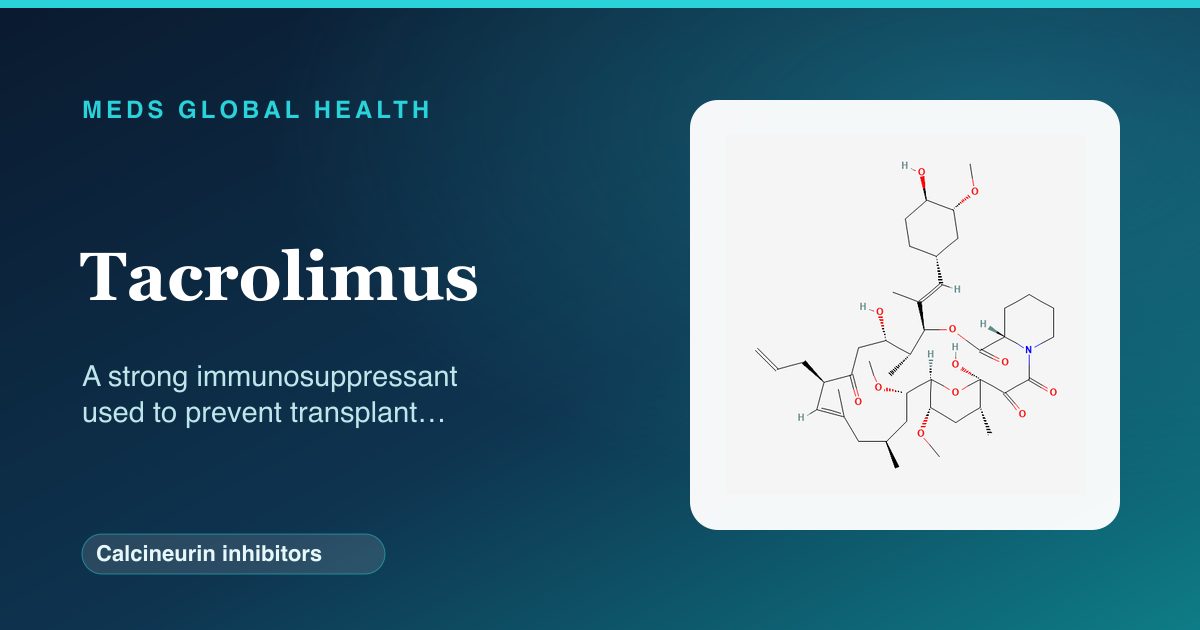
Tacrolimus is a calcineurin inhibitor that dampens down the immune system. It is used after organ transplants such as kidney, liver and heart to stop the body attacking the new organ, and occasionally in some severe autoimmune conditions. It is taken as capsules, granules or liquid by mouth, and is sometimes given by drip in hospital. There are immediate-release forms taken twice a day and modified-release forms taken once a day, which are not interchangeable. A separate skin cream form exists for eczema, but here we describe the medicine taken into the body as a whole.
How it works
Tacrolimus blocks the calcineurin pathway inside T-cells, the white blood cells that drive immune attacks, much like ciclosporin but it is generally more potent. By quietening these cells it stops the body rejecting a transplanted organ and reduces overactive immune responses. The downside is a weaker defence against infections. Because small changes in the blood level matter a great deal, treatment is guided by regular blood-level tests, and the once-daily and twice-daily preparations release the drug differently.
Company & origin
Originated / developed by: Generic (originally Astellas).
A widely used calcineurin inhibitor used in the UK after organ transplants and for some severe autoimmune conditions.
Practical use
How to take Tacrolimus
General, dose-free guidance — always follow your prescriber's and the leaflet's specific instructions.
- Take it exactly as prescribed, always keeping to the same brand and the same once-daily or twice-daily form.
- Take it consistently in relation to food, usually on an empty stomach, at the same times each day to keep levels steady.
- Avoid grapefruit and grapefruit juice, which raise the level of tacrolimus in your body.
- Attend all blood tests, as they guide your dose and check your kidneys, blood pressure and blood sugar.
- Never stop or change the dose yourself, and report any signs of infection or unusual thirst and passing more urine promptly.
- Tell every prescriber and pharmacist that you take tacrolimus, as many medicines and some herbal products interact with it.
Weighing it up
Advantages & disadvantages of Tacrolimus
Advantages
- A very effective way to prevent organ rejection, often as a mainstay after transplant.
- Available in once-daily and twice-daily forms, plus granules and liquid for those who cannot swallow capsules.
- Dosing can be fine-tuned precisely using blood-level tests.
Disadvantages
- Has a narrow safety margin and needs regular blood tests and close monitoring.
- Can harm the kidneys, raise blood pressure and raise blood sugar, sometimes causing diabetes.
- Increases the risk of infections and certain cancers, and interacts with many medicines and grapefruit.
Practical use
Good to know
As with ciclosporin, the key safety message is that tacrolimus brands and formulations are not interchangeable, so it must be prescribed and dispensed by brand, and the once-daily modified-release and twice-daily immediate-release forms must never be swapped without specialist supervision. It has a narrow therapeutic range, so blood-level tests are central to safe use. It can affect the kidneys, raise blood pressure, raise blood sugar (sometimes causing diabetes) and disturb the salts in the blood, so these are monitored. It increases the risk of infections and certain cancers with long-term use, so sun protection and prompt reporting of infections are important. Grapefruit and grapefruit juice raise the level and should be avoided, and many medicines interact with it.
Who should not take it / use with caution
- People with significant kidney problems or poorly controlled blood pressure may need extra caution or alternatives.
- It is generally avoided in active untreated infections and used carefully where blood sugar control is already difficult.
- Those unable to attend regular monitoring blood tests are not suitable without arrangements in place.
Monitoring
- Regular blood tests to measure the tacrolimus level and keep it within the target range.
- Routine checks of kidney function, blood pressure, blood sugar and salts in the blood.
- Ongoing watch for infections, skin changes and other side effects, with sun protection advised.
Side effects
- Kidney effects, high blood pressure, tremor, headache, raised blood sugar and disturbed salts are common.
- Increased risk of infections, sleep problems, tingling and stomach upset.
- Less commonly, new diabetes, kidney damage with long-term use and a higher risk of certain cancers.
Key interactions
- Grapefruit juice and medicines such as some antifungals and certain antibiotics can raise its level dangerously.
- Other medicines, including some epilepsy drugs and St John's wort, can lower its level and risk rejection.
- Combining it with other kidney-affecting drugs or other immunosuppressants needs careful supervision.
Available as: Capsules, granules and oral liquid taken by mouth, and a form given by drip in hospital. (A separate skin cream exists for eczema.)
Answers
Tacrolimus: frequently asked questions
Why must my tacrolimus brand stay the same?
The brands and the once-daily and twice-daily forms are not interchangeable, so switching can change the level in your body and risk rejection or side effects.
Is tacrolimus the same as the eczema cream?
The active ingredient is the same, but this page describes the systemic form taken by mouth or by drip; the cream acts mainly on the skin and is used differently.
Can tacrolimus cause diabetes?
It can raise blood sugar and sometimes cause diabetes, which is why your blood sugar is monitored; report unusual thirst or passing more urine.
Why must I avoid grapefruit juice?
Grapefruit raises the amount of tacrolimus in your blood, increasing side effects, so it should be avoided.
Can I stop taking it once I feel well?
No. Stopping suddenly risks rejection of your transplant, so never change or stop it without specialist advice.
The wider class
About Calcineurin inhibitors
Tacrolimus belongs to the calcineurin inhibitors class. For how the class as a whole works, its shared safety principles and monitoring, see the full guide.
Browse by body system
Authoritative sources
- BNF
- NICE CKS
Building a medicines information resource?
We create evidence-led, dose-free drug and formulary references for teams.