A capsule that stabilises transthyretin in ATTR amyloidosis
Tafamidis
An oral capsule used to treat transthyretin amyloidosis, a condition where a protein builds up in the heart or nerves.
What is Tafamidis?
Tafamidis is a specialist medicine used to treat transthyretin (ATTR) amyloidosis, a condition in which a protein called transthyretin becomes unstable, clumps together and builds up in the heart (causing cardiomyopathy) or nerves (causing polyneuropathy). It works by holding the transthyretin protein together so it is less likely to break apart and form harmful deposits. It is taken by mouth as a capsule and is generally very well tolerated. It is a long-term treatment that slows the condition rather than reversing damage already done.
Education and reference only. This is a plain-language guide to Tafamidis — it deliberately contains no doses. Doses depend on the person, the brand and the reason for treatment, and belong with your prescriber. Always check the BNF, the product labelling (SmPC) and follow medical advice.
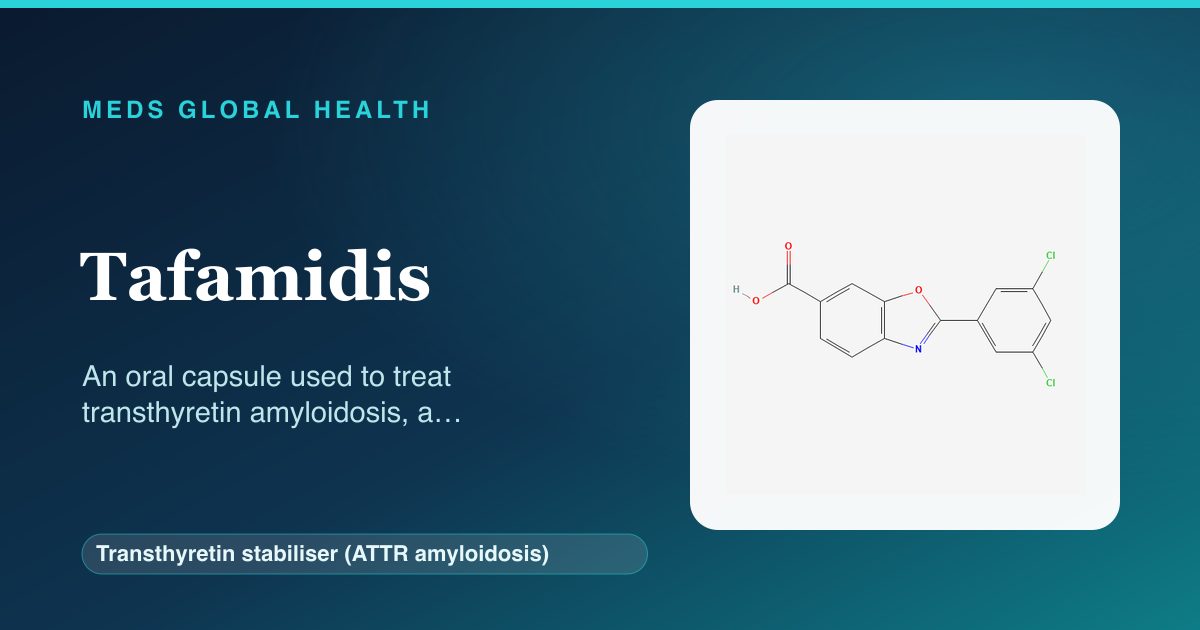
What it is
Tafamidis is a medicine used to treat transthyretin amyloidosis, a condition in which a blood protein called transthyretin becomes unstable, breaks apart and forms deposits (amyloid) in body tissues. These deposits most often affect the heart, leading to a stiff, failing heart muscle (cardiomyopathy), or the nerves, leading to polyneuropathy. Tafamidis is taken by mouth as a capsule and works on the underlying protein problem. It is a long-term treatment used under the care of a specialist amyloidosis service, and is known for generally being very well tolerated.
How it works
Transthyretin normally travels in the blood as a stable four-part structure. In ATTR amyloidosis this structure comes apart, and the loose pieces clump together to form amyloid deposits in the heart or nerves. Tafamidis binds to the transthyretin protein and holds its structure together, making it less likely to break apart. By stabilising the protein, it slows the formation of new deposits and helps slow the progression of the disease. It does not remove deposits that have already formed, so it works best when started before too much damage has occurred, which is why it is a long-term daily treatment.
Company & origin
A specialist oral medicine used in the UK to treat transthyretin amyloidosis affecting the heart or nerves, taken as a capsule.
Practical use
How to take Tafamidis
General, dose-free guidance — always follow your prescriber's and the leaflet's specific instructions.
- Take the capsule by mouth, usually once a day, with or without food.
- Swallow it whole and take it at about the same time each day to keep it working steadily.
- Keep taking it long term, as it works by slowing the condition rather than reversing it.
- Attend your specialist reviews so the heart or nerves can be monitored over time.
- Tell your team about any other medicines, even though significant interactions are uncommon.
Weighing it up
Advantages & disadvantages of Tafamidis
Advantages
- Slows the progression of ATTR amyloidosis affecting the heart or nerves.
- Generally very well tolerated, with few troublesome side effects for most people.
- Taken conveniently by mouth as a capsule, with or without food.
Disadvantages
- Slows the condition but does not reverse damage that has already happened.
- Works best when started earlier in the disease.
- A long-term treatment needing ongoing specialist monitoring.
Practical use
Good to know
An encouraging point about tafamidis is that it is generally very well tolerated, with few troublesome side effects for most people, which is unusual for a specialist heart or nerve treatment. It is taken by mouth as a capsule, usually once a day, and can be taken with or without food. The key thing to understand is that it works by slowing the condition down rather than reversing damage that has already happened, so it is most useful when started earlier and is taken long term and consistently. Because it acts on the underlying protein, the specialist team monitors the heart or nerves over time to see how the condition is responding. It is important to tell your team about other medicines, though significant interactions are uncommon.
Who should not take it / use with caution
- People who have had a serious allergic reaction to tafamidis should not take it.
- It is used with care, and under specialist guidance, in pregnancy and breastfeeding.
- It should only be used under a specialist amyloidosis service.
Monitoring
- Reviewing heart function in people with the cardiomyopathy type, or nerve function in the polyneuropathy type.
- Checking how the condition is progressing over time.
- Reviewing tolerance and any side effects, which are usually few.
Side effects
- It is generally very well tolerated, and many people have no obvious side effects.
- Occasionally, mild stomach upset or wind.
- Rarely, other effects, which the specialist team watches for over time.
Key interactions
- Significant medicine interactions are uncommon, but tell your team about everything you take.
- It may affect a small number of medicines handled by certain transporters in the body, so a full list helps.
- Discuss any new medicines or supplements with your specialist team.
Available as: Capsules taken by mouth.
Answers
Tafamidis: frequently asked questions
What is tafamidis used for?
It is used to treat transthyretin amyloidosis, slowing the build-up of an unstable protein in the heart (cardiomyopathy) or nerves (polyneuropathy).
How does it work?
It binds to the transthyretin protein and holds its structure together so it is less likely to break apart and form harmful amyloid deposits.
Will it reverse my heart or nerve damage?
No. It slows the condition rather than reversing damage already done, which is why it works best when started earlier and taken long term.
Is it well tolerated?
Yes, tafamidis is generally very well tolerated, and many people have no obvious side effects, though your team will still monitor you.
How is it taken?
It is taken by mouth as a capsule, usually once a day, with or without food, as a long-term treatment.
Authoritative sources
- BNF
- NICE CKS
Building a medicines information resource?
We create evidence-led, dose-free drug and formulary references for teams.