A single-dose medicine to prevent relapse of vivax malaria
Tafenoquine
A single-dose antimalarial used to prevent relapse of Plasmodium vivax malaria, and also used to prevent malaria.
What is Tafenoquine?
Tafenoquine is an antimalarial medicine used in two main ways: as a single dose to stop Plasmodium vivax malaria coming back after the main infection has been treated, and to prevent malaria in travellers. The single most important safety point is that it must not be used in people with a condition called G6PD deficiency, because it can cause severe breakdown of red blood cells, so a blood test to check G6PD must be done first. It can also cause psychiatric effects, so it is avoided in people with a significant history of mental-health problems. It is taken by mouth with food.
Education and reference only. This is a plain-language guide to Tafenoquine — it deliberately contains no doses. Doses depend on the person, the brand and the reason for treatment, and belong with your prescriber. Always check the BNF, the product labelling (SmPC) and follow medical advice.
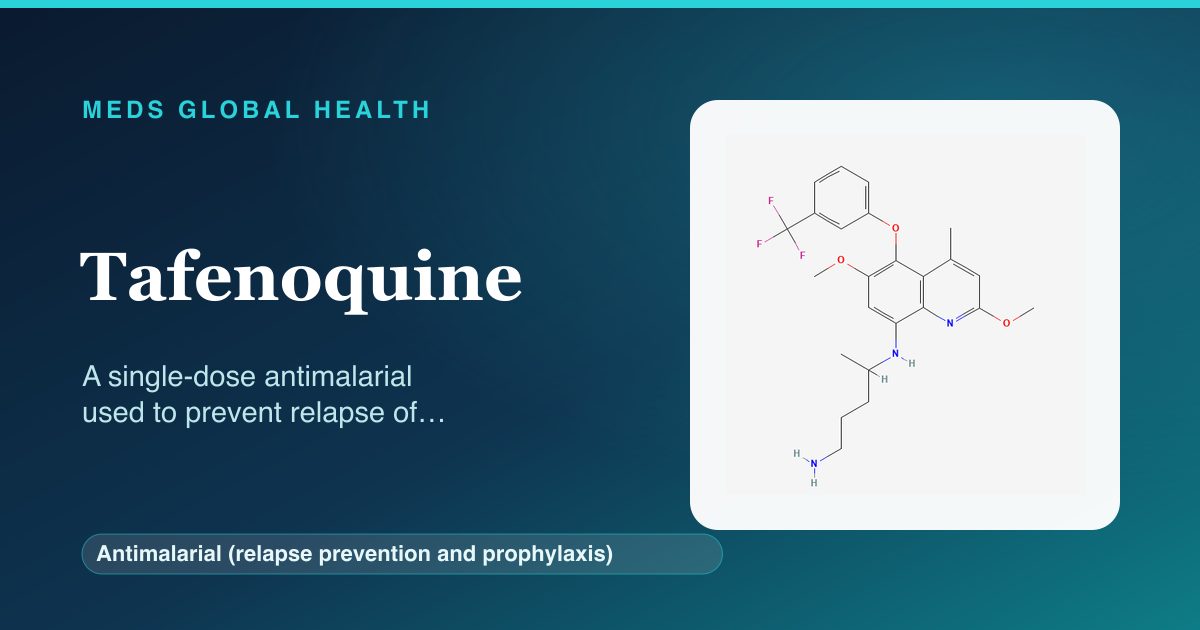
What it is
Tafenoquine is a medicine used against malaria. One use is to prevent relapse of Plasmodium vivax malaria: this type of malaria can hide in the liver and come back weeks or months later, so a single dose of tafenoquine is given alongside the main treatment to clear those hidden forms and stop it returning. It is also used to prevent malaria in people travelling to areas where it is a risk. It is taken by mouth. Because of important safety checks needed before it is used, it is prescribed with specialist or travel-health advice.
How it works
When Plasmodium vivax malaria is treated, the parasite can leave dormant forms hiding in the liver that later wake up and cause the illness to return. Tafenoquine clears these dormant liver forms, which is why it is used to prevent relapse. The same action against the parasite makes it useful for preventing malaria in travellers. However, the way it acts can put stress on red blood cells, which is why it is dangerous in people with G6PD deficiency, an inherited condition where red cells are more fragile, and why this must be checked before use.
Company & origin
A medicine used in the UK to stop Plasmodium vivax malaria coming back, and for malaria prevention, given as a single dose for the relapse-prevention use.
Practical use
How to take Tafenoquine
General, dose-free guidance — always follow your prescriber's and the leaflet's specific instructions.
- Only take it after a blood test has confirmed your G6PD levels are normal, as it is dangerous in G6PD deficiency.
- Take it by mouth with food, which helps it be absorbed properly.
- For relapse prevention, it is usually a single dose taken alongside the main malaria treatment, as directed.
- For malaria prevention when travelling, follow the schedule your prescriber gives, including before and after travel.
- Tell your prescriber about any history of mental-health problems before starting, and report new mood changes.
Weighing it up
Advantages & disadvantages of Tafenoquine
Advantages
- Clears the hidden liver forms of Plasmodium vivax malaria to stop it coming back.
- For relapse prevention, the treatment can be given as a single dose, which is convenient.
- Also provides an option for preventing malaria in travellers.
Disadvantages
- Must not be used in G6PD deficiency, so a blood test is required before it can be given.
- Can cause psychiatric effects and is avoided in people with significant mental-health history.
- Not suitable in pregnancy, partly because the baby's G6PD status cannot be checked.
Practical use
Good to know
The most important thing to understand about tafenoquine is the mandatory G6PD test before use: people with G6PD deficiency can suffer severe, dangerous breakdown of their red blood cells (haemolysis) if they take it, so a blood test to confirm normal G6PD levels must be done first, and it must not be used if levels are low. It is also avoided in pregnancy, partly because the unborn baby's G6PD status cannot be checked. Another key point is that it can affect mental health, so it is generally avoided in people with a significant history of psychiatric problems, and any new low mood, anxiety or unusual thoughts should be reported. It is taken with food, which helps absorption, and for relapse prevention the convenience of a single dose is a real advantage.
Who should not take it / use with caution
- People with G6PD deficiency must not take it, because of the risk of severe red-blood-cell breakdown.
- It is not used in pregnancy, and is avoided while breastfeeding a baby whose G6PD status is not known.
- It is avoided in people with a significant history of psychiatric problems, such as depression or psychosis.
- People who have had a serious allergic reaction to it should not take it.
Monitoring
- A G6PD blood test before use, which is essential and decides whether it can be given at all.
- Watching for signs of red-cell breakdown, such as dark urine, tiredness or unusual paleness.
- Reviewing mood and mental health, and eye checks where long-term use is planned.
Side effects
- Breakdown of red blood cells (haemolysis), which is severe in people with G6PD deficiency.
- Dizziness, headache or stomach upset such as nausea.
- Psychiatric effects such as low mood, anxiety, vivid dreams or unusual thoughts, which should be reported.
- Eye changes have been reported with long-term use, so eye checks may be advised in some cases.
Key interactions
- Tell your prescriber about all your medicines, including any that can themselves stress red blood cells.
- Care is needed with other antimalarials, and your prescriber will plan how they are used together.
- A full medicines and health history helps confirm it is safe for you, alongside the G6PD test.
Available as: Tablets taken by mouth.
Answers
Tafenoquine: frequently asked questions
What is tafenoquine used for?
It is used as a single dose to stop Plasmodium vivax malaria coming back by clearing its hidden liver forms, and also to prevent malaria in travellers.
Why do I need a G6PD blood test first?
In people with G6PD deficiency, tafenoquine can cause severe, dangerous breakdown of red blood cells, so a blood test must confirm normal levels before it is used.
Can I take it if I am pregnant?
No. It is not used in pregnancy, partly because the unborn baby's G6PD status cannot be checked, so a different option is needed.
Does it affect mental health?
It can cause psychiatric effects, so it is avoided in people with a significant mental-health history, and any new mood changes should be reported.
Why is it taken with food?
Taking tafenoquine with food helps it be absorbed properly, so it works as intended.
Authoritative sources
- BNF
- NICE CKS
Building a medicines information resource?
We create evidence-led, dose-free drug and formulary references for teams.