A topical cream for psoriasis and eczema
Tapinarof
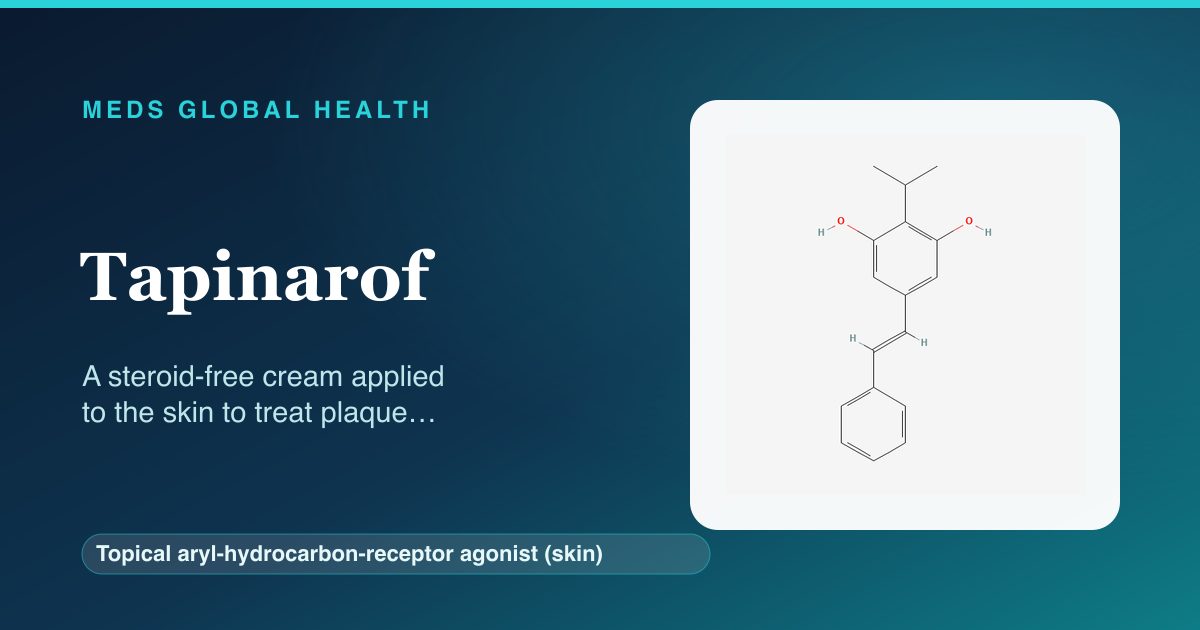
A steroid-free cream applied to the skin to treat plaque psoriasis and eczema.
What is Tapinarof?
Tapinarof is a topical cream used to treat plaque psoriasis and eczema (atopic dermatitis), applied directly to the affected skin. It is a steroid-free treatment that works through a target in the skin called the aryl-hydrocarbon receptor to calm inflammation. The most common effects are inflammation of the hair follicles (folliculitis), contact dermatitis where it is applied, and headache. It is for use on the skin only and is applied over a course of treatment as directed.
Education and reference only. This is a plain-language guide to Tapinarof — it deliberately contains no doses. Doses depend on the person, the brand and the reason for treatment, and belong with your prescriber. Always check the BNF, the product labelling (SmPC) and follow medical advice.
What it is
Tapinarof is a topical medicine that comes as a cream applied to the skin. It is used to treat plaque psoriasis, where the skin forms raised, scaly patches, and eczema (atopic dermatitis), where the skin becomes itchy and inflamed. It is a steroid-free option, which can make it useful for areas where corticosteroid creams are less suitable or for longer-term use. It works through a receptor in the skin rather than being taken by mouth, and is applied to the affected areas over a course of treatment.
How it works
Tapinarof activates a target in skin cells called the aryl-hydrocarbon receptor. Acting on this receptor helps to calm the overactive inflammation that drives psoriasis and eczema and supports the skin barrier, which improves the patches and itching over time. Because it is applied to the skin and is steroid-free, it does not carry the same long-term skin-thinning concerns as corticosteroid creams. It works gradually with regular use, which is why it is applied over a course rather than giving instant results, and the skin is reviewed to see how it is responding.
Company & origin
A topical medicine used to treat plaque psoriasis and eczema, applied as a cream to the affected skin.
What it treats
Conditions Tapinarof is used for
Practical use
How to take Tapinarof
General, dose-free guidance — always follow your prescriber's and the leaflet's specific instructions.
- Apply a thin layer of the cream to the affected skin as directed, and rub it in gently.
- Use it regularly and give it time, as it works gradually rather than instantly.
- Keep it away from the eyes, and use it on the skin only.
- Tell your prescriber if you develop spots around hair roots (folliculitis) or troublesome skin irritation.
- Wash your hands after applying it, unless your hands are the area being treated.
Weighing it up
Advantages & disadvantages of Tapinarof
Advantages
- A steroid-free cream for plaque psoriasis and eczema, useful for longer-term or sensitive-area use.
- Works through a skin receptor to calm inflammation without skin-thinning concerns of steroids.
- Applied directly to the affected skin as a cream.
Disadvantages
- Can cause inflammation of the hair follicles (folliculitis) where it is applied.
- Can cause contact dermatitis, with irritation or itching of the treated skin.
- May cause headache, and works gradually rather than instantly.
Practical use
Good to know
A useful point about tapinarof is that it is steroid-free, so it can be an option for sensitive areas or for use over longer periods where corticosteroid creams may be less suitable. The most common side effects are inflammation of the hair follicles (folliculitis), seen as small spots around hair roots; contact dermatitis, where the treated skin becomes irritated or itchy; and headache. It is applied to the affected skin as directed and is for external use only, kept away from the eyes. If folliculitis or skin irritation becomes troublesome, it is worth getting it reviewed, as the cream may need to be paused. It works gradually with regular use, so giving it time and applying it consistently matters. Wash your hands after applying it unless your hands are being treated.
Who should not take it / use with caution
- People who have had a serious allergic reaction to tapinarof or the cream's ingredients should not use it.
- It is used with care in pregnancy and breastfeeding, on the advice of a doctor.
- It is for external use on the skin only and should be kept away from the eyes.
Monitoring
- Reviewing how the psoriasis or eczema responds to treatment.
- Watching for folliculitis and contact dermatitis where it is applied.
- Deciding whether to pause or adjust treatment if skin reactions are troublesome.
Side effects
- Inflammation of the hair follicles (folliculitis), seen as small spots around hair roots.
- Contact dermatitis, with irritation, redness or itching of the treated skin.
- Headache in some people.
Key interactions
- There are few well-established medicine interactions, as it is applied to the skin.
- Other creams or ointments on the same area should only be combined on advice.
- Tell your prescriber about anything else you apply to the affected skin.
Available as: A cream applied to the skin.
Answers
Tapinarof: frequently asked questions
What is tapinarof used for?
It is a topical cream used to treat plaque psoriasis and eczema (atopic dermatitis), applied directly to the affected skin.
Is it a steroid?
No. Tapinarof is a steroid-free cream, which can make it useful for sensitive areas or for longer-term use where corticosteroid creams are less suitable.
What are the common side effects?
The most common are inflammation of the hair follicles (folliculitis), contact dermatitis where it is applied, and headache.
How quickly does it work?
It works gradually with regular use, so applying it consistently and giving it time matters rather than expecting instant results.
Where can I use it?
It is for external use on the affected skin only and should be kept away from the eyes.
Authoritative sources
- BNF
- NICE CKS
Building a medicines information resource?
We create evidence-led, dose-free drug and formulary references for teams.