A melatonin-receptor medicine for non-24-hour sleep-wake disorder
Tasimelteon
A specialist sleep medicine used for non-24-hour sleep-wake disorder, mainly in people who are totally blind.
What is Tasimelteon?
Tasimelteon is a specialist medicine used to treat non-24-hour sleep-wake disorder, a condition in which the body clock drifts out of step with the 24-hour day, mainly seen in people who are totally blind. It works like the natural hormone melatonin, helping to set the body clock to the right time. It is taken by mouth at the same time each night, before bed. It is generally well tolerated, with headache and tiredness among the more common effects. It should not be taken with fluvoxamine, and it is best taken on an empty stomach as advised. It is prescribed and supervised by a specialist.
Education and reference only. This is a plain-language guide to Tasimelteon — it deliberately contains no doses. Doses depend on the person, the brand and the reason for treatment, and belong with your prescriber. Always check the BNF, the product labelling (SmPC) and follow medical advice.
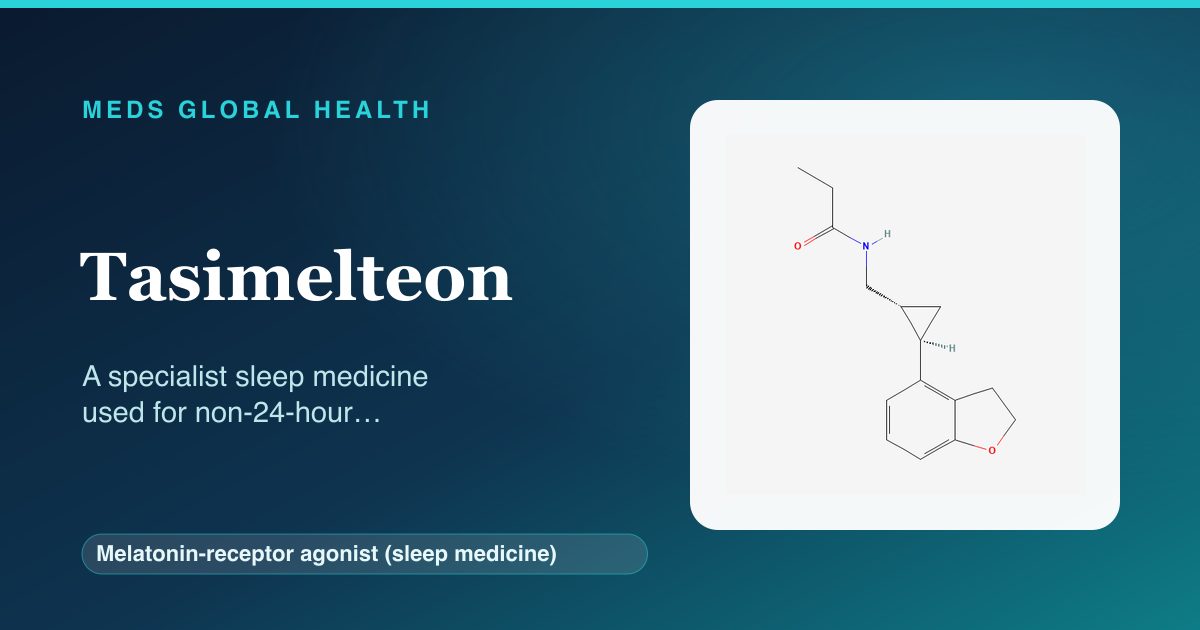
What it is
Tasimelteon is a medicine used to treat non-24-hour sleep-wake disorder, a problem where a person's internal body clock is not synchronised to the normal 24-hour day, so sleep gradually drifts later and later. It is seen mainly in people who are totally blind, because they cannot use light to keep the body clock on time. Tasimelteon acts like melatonin, the body's natural sleep-timing hormone. It is taken by mouth once a night before bed, at the same time each evening, and is prescribed and supervised by a specialist.
How it works
The body clock is normally kept on a 24-hour schedule partly by the hormone melatonin and by light. In non-24-hour sleep-wake disorder, this synchronisation is lost. Tasimelteon acts on the same receptors as melatonin, helping to nudge and set the body clock so that sleep and wakefulness line up with night and day. Because timing matters, it is taken at the same time each night, and it can take some weeks of regular use to show its full benefit as the body clock gradually adjusts. It is taken regularly rather than only on bad nights.
Company & origin
A specialist sleep medicine used in the UK for non-24-hour sleep-wake disorder, mainly in people who are totally blind.
What it treats
Conditions Tasimelteon is used for
Practical use
How to take Tasimelteon
General, dose-free guidance — always follow your prescriber's and the leaflet's specific instructions.
- Take it by mouth once a night, at the same time each evening before bed.
- Take it on an empty stomach as advised, since food can change how it is absorbed and slow its effect.
- Keep taking it regularly, as it may take several weeks of consistent use to show the full benefit.
- Do not take it with fluvoxamine, and tell your prescriber about all your medicines.
- Keep your review appointments so the specialist can check whether your sleep timing has improved.
Weighing it up
Advantages & disadvantages of Tasimelteon
Advantages
- Can help reset the body clock in non-24-hour sleep-wake disorder, particularly in people who are totally blind.
- Works like the body's natural melatonin and is generally well tolerated.
- Taken as a single nightly dose by mouth.
Disadvantages
- Needs to be taken at the same time every night and may take weeks to show full benefit.
- Must not be taken with fluvoxamine, which can raise its levels too much.
- A specialist medicine for a specific condition, prescribed and supervised by a specialist.
Practical use
Good to know
The key practical point is consistency: tasimelteon should be taken at the same time every night, before bed, because it works by setting the body clock, and it may take several weeks of regular use before the full benefit is seen. It is generally well tolerated, with headache, tiredness, unusual dreams and upper-airway or urinary infections among the effects reported. An important interaction to know is that it should not be taken with fluvoxamine, a medicine that can greatly raise its levels. It is usually advised to take it on an empty stomach, as food can change how it is absorbed and slow its effect. Because results build gradually, it is worth sticking with it and keeping review appointments, where the specialist checks whether sleep timing has improved.
Who should not take it / use with caution
- People who have had a serious allergic reaction to tasimelteon should not take it.
- It should not be taken together with fluvoxamine.
- It is used with care in people with significant liver problems, under specialist advice.
Monitoring
- Reviewing whether sleep timing has improved over several weeks of use.
- Watching for drowsiness and any troublesome side effects.
- Checking liver blood tests where appropriate.
Side effects
- Headache and tiredness or drowsiness.
- Unusual dreams and, in some people, upper-airway or urinary infections.
- Raised liver blood tests in some people, which may be checked.
Key interactions
- Fluvoxamine can greatly raise tasimelteon levels and should not be taken with it.
- Some medicines that affect liver enzymes can change tasimelteon levels, so tell your prescriber about all your medicines.
- Other sedating medicines and alcohol can add to drowsiness.
Available as: Capsules taken by mouth at bedtime.
Answers
Tasimelteon: frequently asked questions
What is tasimelteon used for?
It is used to treat non-24-hour sleep-wake disorder, where the body clock drifts out of step with the day, mainly in people who are totally blind.
Why must I take it at the same time each night?
It works by setting the body clock, so taking it at a consistent time each night before bed helps keep your sleep and wake times on track.
How long until it works?
It may take several weeks of regular use before the full benefit is seen, as the body clock adjusts gradually, so it is worth sticking with it.
Why can't I take it with fluvoxamine?
Fluvoxamine can greatly raise tasimelteon levels in the body, so the two should not be taken together; tell your prescriber about all your medicines.
Should I take it with food?
It is usually advised to take it on an empty stomach, as food can change how it is absorbed and slow down its effect.
Authoritative sources
- BNF
- NICE CKS
Building a medicines information resource?
We create evidence-led, dose-free drug and formulary references for teams.