An oxazolidinone antibiotic for skin infections
Tedizolid
An oxazolidinone antibiotic used to treat serious skin and soft-tissue infections, including some caused by resistant bacteria.
What is Tedizolid?
Tedizolid is a specialist antibiotic from the oxazolidinone group, used to treat certain serious skin and soft-tissue infections, including some caused by resistant bacteria such as MRSA. It can be taken by mouth or given into a vein. Like its relative linezolid, with longer or repeated use it can lower blood cell counts (myelosuppression), and it has serotonergic and MAOI-like cautions, meaning care is needed with antidepressants and some other medicines and foods. It is used under specialist supervision for short courses, and the team checks your other medicines and may monitor blood counts.
Education and reference only. This is a plain-language guide to Tedizolid — it deliberately contains no doses. Doses depend on the person, the brand and the reason for treatment, and belong with your prescriber. Always check the BNF, the product labelling (SmPC) and follow medical advice.
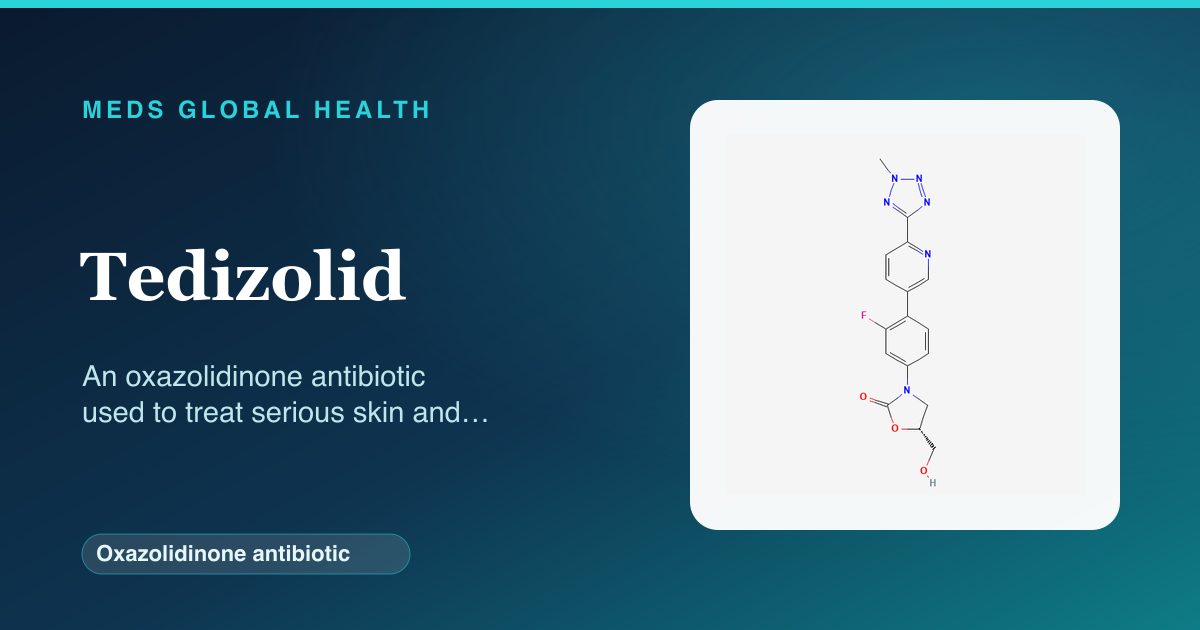
What it is
Tedizolid is an antibiotic belonging to a group called the oxazolidinones, the same family as linezolid. It is used to treat serious bacterial skin and soft-tissue infections, including some caused by bacteria that are resistant to other antibiotics, such as MRSA. It can be taken by mouth as a tablet or given as an infusion into a vein, which makes it useful when switching between hospital and home treatment. It is a specialist antibiotic, kept for situations where it is genuinely needed so that it stays effective, and is used under medical supervision.
How it works
Tedizolid works by stopping bacteria from making the proteins they need to grow and multiply, which brings the infection under control and allows the body to clear it. Because it acts in a different way from many older antibiotics, it can be effective against certain bacteria that have become resistant, such as MRSA. Like other antibiotics, it works best when the full course is completed, even if symptoms improve quickly, so that the infection is properly cleared and resistance is less likely to develop. It is used for short courses for skin and soft-tissue infections.
Company & origin
A specialist antibiotic used in the UK to treat certain serious skin and soft-tissue infections, including some caused by resistant bacteria.
Practical use
How to take Tedizolid
General, dose-free guidance — always follow your prescriber's and the leaflet's specific instructions.
- Take it by mouth as prescribed, or have it as an infusion into a vein when that is more suitable.
- Finish the full course even if you feel better, so the infection is properly cleared.
- Give the team a full list of your medicines, especially antidepressants, because of serotonergic and MAOI-like cautions.
- Tell the team about symptoms such as unusual bruising, bleeding or feeling very unwell, which may point to low blood counts or a reaction.
- Use it under specialist supervision and follow the team's advice on the length of the course.
Weighing it up
Advantages & disadvantages of Tedizolid
Advantages
- Treats serious skin and soft-tissue infections, including some caused by resistant bacteria such as MRSA.
- Available both as a tablet and as an infusion, allowing a switch between hospital and home.
- Usually given as a short course, which helps limit some of its risks.
Disadvantages
- Can lower blood cell counts (myelosuppression) with longer or repeated use, as with linezolid.
- Has serotonergic and MAOI-like cautions, so care is needed with antidepressants and some other medicines and foods.
- A specialist antibiotic kept for situations where it is genuinely needed.
Practical use
Good to know
Two safety areas are worth understanding. First, like its relative linezolid, tedizolid can lower the body's blood cell counts (myelosuppression) with longer or repeated use, which can affect how well you fight infection or how easily you bruise or bleed, so blood counts may be checked, especially with longer courses. Second, it has serotonergic and MAOI-like cautions: it can interact with antidepressants (such as SSRIs and others) and certain other medicines to raise the risk of a reaction called serotonin syndrome, and care may also be needed with some medicines and tyramine-rich foods, so it is important to give the team a full list of everything you take. Tedizolid is usually used for short courses, which helps limit these risks, and it can be switched between the vein and tablet forms. Finish the course as advised and report any unusual symptoms.
Who should not take it / use with caution
- People who have had a serious allergic reaction to tedizolid should not take it.
- It is used with caution alongside antidepressants and other serotonergic or MAOI-related medicines.
- It is used with care in people with low blood counts or other blood problems, with monitoring.
Monitoring
- Checking blood counts, especially with longer or repeated courses, for signs of myelosuppression.
- Reviewing other medicines for serotonergic or MAOI-like interactions.
- Reviewing how well the infection responds to treatment.
Side effects
- Nausea, diarrhoea or other stomach upset.
- Headache or feeling tired.
- Less commonly, lowered blood cell counts with longer use, or, rarely, a serotonin-type reaction when combined with certain medicines.
Key interactions
- It can interact with antidepressants such as SSRIs and others, raising the risk of serotonin syndrome.
- Care may be needed with other serotonergic or MAOI-related medicines and some tyramine-rich foods.
- Give the team a full list of all your medicines so interactions can be checked.
Available as: Tablets taken by mouth and a form given as an infusion into a vein.
Answers
Tedizolid: frequently asked questions
What is tedizolid used for?
It is an oxazolidinone antibiotic used to treat serious skin and soft-tissue infections, including some caused by resistant bacteria such as MRSA.
How is it given?
It can be taken by mouth as a tablet or given as an infusion into a vein, which makes it useful when moving between hospital and home.
Is it like linezolid?
Yes, it is in the same oxazolidinone family; like linezolid it can lower blood cell counts with longer use and has serotonergic and MAOI-like cautions.
Why does it matter what antidepressants I take?
Tedizolid can interact with antidepressants such as SSRIs and others to raise the risk of a reaction called serotonin syndrome, so give your team a full medicines list.
Should I finish the course?
Yes. Finish the full course even if you feel better, so the infection is properly cleared and resistance is less likely to develop.
Authoritative sources
- BNF
- NICE CKS
Building a medicines information resource?
We create evidence-led, dose-free drug and formulary references for teams.