A light-activated medicine for photodynamic therapy of head-and-neck cancer
Temoporfin
A light-activated medicine used in photodynamic therapy to treat certain head-and-neck cancers.
What is Temoporfin?
Temoporfin is a specialist medicine used in photodynamic therapy, a treatment for certain head-and-neck cancers. It is given into a vein and then, after a set time, a special light is shone onto the tumour to activate the medicine and destroy the cancer cells. The single most important thing to know is that it makes the skin and eyes extremely sensitive to light for a long time, so very strict light avoidance is needed for weeks to prevent serious burns. It can also damage tissue if it leaks at the injection site, so it is given very carefully in a cancer centre.
Education and reference only. This is a plain-language guide to Temoporfin — it deliberately contains no doses. Doses depend on the person, the brand and the reason for treatment, and belong with your prescriber. Always check the BNF, the product labelling (SmPC) and follow medical advice.
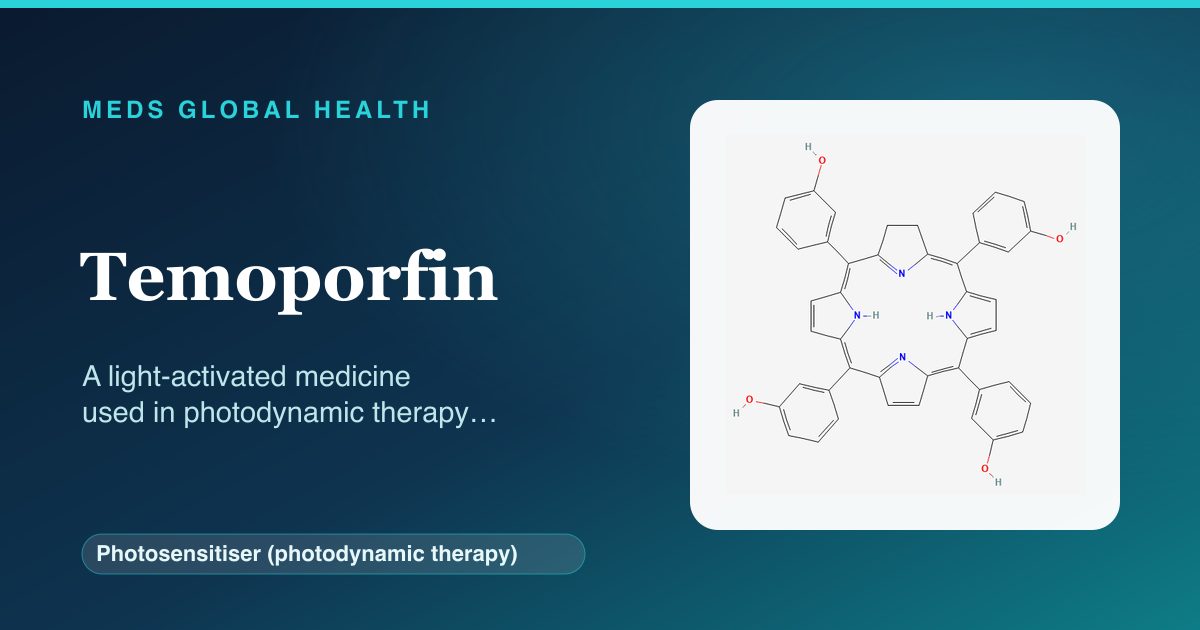
What it is
Temoporfin is a photosensitiser, a medicine that makes cells sensitive to light, used as part of photodynamic therapy for certain head-and-neck cancers. It is given as an injection into a vein, and then after the medicine has had time to gather in the tumour, a specially aimed light is used on the area to switch the medicine on and destroy the cancer cells. It is used in specialist cancer centres only, usually when other treatments are not suitable. Because it makes the whole body very sensitive to light, careful planning around light avoidance is a central part of treatment.
How it works
Once injected, temoporfin spreads through the body and builds up in tissues, including the tumour. On its own it does nothing, but when light of the right kind is shone onto the treatment area, the medicine is activated and produces reactive substances that destroy the nearby cancer cells. This lets doctors target the tumour with light while the medicine is present. The catch is that the medicine is also present in the skin and eyes, so ordinary light can activate it there too, which is why strict light avoidance is needed until the medicine has cleared from the body.
Company & origin
A specialist medicine used in UK cancer centres for photodynamic therapy of certain head-and-neck cancers.
Practical use
How to take Temoporfin
General, dose-free guidance — always follow your prescriber's and the leaflet's specific instructions.
- It is given as an injection into a vein in a specialist cancer centre, followed later by the light treatment.
- Follow the strict light-avoidance instructions for the full period advised, as your skin and eyes will be very sensitive to light.
- Avoid sunlight and bright light, keep skin covered, and use dim lighting at home as your team directs.
- Reintroduce normal light gradually and only as advised, testing exposure carefully rather than going straight outdoors.
- Tell the team at once if the injection area becomes painful or marked, as leakage can damage tissue.
Weighing it up
Advantages & disadvantages of Temoporfin
Advantages
- Offers a targeted treatment option for certain head-and-neck cancers using light-activated therapy.
- Can treat the tumour area while sparing some surrounding tissue when light is carefully aimed.
- May be an option when other treatments are not suitable.
Disadvantages
- Causes prolonged, severe sensitivity to light, needing strict light avoidance for weeks.
- Can cause serious tissue damage if it leaks at the injection site.
- Only available in specialist cancer centres and requires careful planning around light.
Practical use
Good to know
The dominant issue with temoporfin is light sensitivity: after the injection, the skin and eyes become extremely sensitive to light, and exposure to bright light, sunlight or even strong indoor and household lighting can cause severe burns or eye damage. Because of this, strict light avoidance is needed for several weeks, with a careful, gradual return to normal light as advised by the team, rather than going straight back into bright surroundings. Another important point is that the injection must be given very carefully into a vein, because if it leaks into the surrounding tissue (extravasation) it can cause damage, and that area then also needs protecting from light. The cancer team gives detailed instructions on covering up, lighting at home and when it is safe to go outside.
Who should not take it / use with caution
- People who have had a serious allergic reaction to temoporfin should not be given it.
- It is not suitable for people who cannot avoid bright light, or who have conditions made worse by light sensitivity (such as porphyria).
- It is avoided where the tumour or its position makes the light treatment unsuitable, as the cancer team decides.
Monitoring
- Careful planning and checking of light exposure throughout the sensitive period.
- Watching the injection site for signs of leakage and tissue damage.
- Reviewing how the treated area heals and how the cancer responds.
Side effects
- Severe, prolonged sensitivity of the skin and eyes to light, risking burns if light is not avoided.
- Pain, swelling, scarring or tissue damage at and around the treated area or injection site.
- Pain, difficulty swallowing or local effects in the treated head-and-neck area while it heals.
- Allergic-type reactions to the injection in some people.
Key interactions
- Other medicines or creams that increase sensitivity to light can add to the risk, so tell your team about them.
- Tell your cancer team about all your medicines, including those bought without a prescription.
- Care is needed around any treatment or procedure involving strong light during the sensitive period.
Available as: A solution for injection into a vein, used together with light treatment.
Answers
Temoporfin: frequently asked questions
What is temoporfin used for?
It is used in photodynamic therapy for certain head-and-neck cancers; after it is injected, a special light is used on the tumour to activate it and destroy cancer cells.
Why do I have to avoid light afterwards?
Temoporfin makes the skin and eyes extremely sensitive to light, so sunlight or bright indoor light can cause severe burns until the medicine has cleared, which takes weeks.
Can I sit in normal room lighting?
Only as your team advises; strong household lighting can still cause burns at first, so you follow strict instructions and reintroduce light gradually.
What happens if the injection leaks?
If it leaks into the tissue around the vein it can cause damage, so tell the team straight away if the area becomes painful or marked.
Is this a treatment I have at home?
No. It is given in a specialist cancer centre, both the injection and the light treatment, with detailed aftercare instructions.
Authoritative sources
- BNF
- NICE CKS
Building a medicines information resource?
We create evidence-led, dose-free drug and formulary references for teams.