A hospital injection for bleeding from oesophageal varices
Terlipressin
A hospital-only injection used mainly to control bleeding from swollen veins in the gullet caused by liver disease.
What is Terlipressin?
Terlipressin is a hospital-only injection used mainly to control bleeding from oesophageal varices, which are swollen veins in the gullet that can develop in people with advanced liver disease. It is a long-acting form of vasopressin and works by tightening blood vessels, which lowers the pressure in these veins and helps stop the bleeding. It is sometimes also used for hepatorenal syndrome, a serious kidney problem linked to liver failure. Because it narrows blood vessels throughout the body, it can reduce blood flow to the heart, gut, skin and limbs, so it is given only under close hospital monitoring.
Education and reference only. This is a plain-language guide to Terlipressin — it deliberately contains no doses. Doses depend on the person, the brand and the reason for treatment, and belong with your prescriber. Always check the BNF, the product labelling (SmPC) and follow medical advice.
What it is
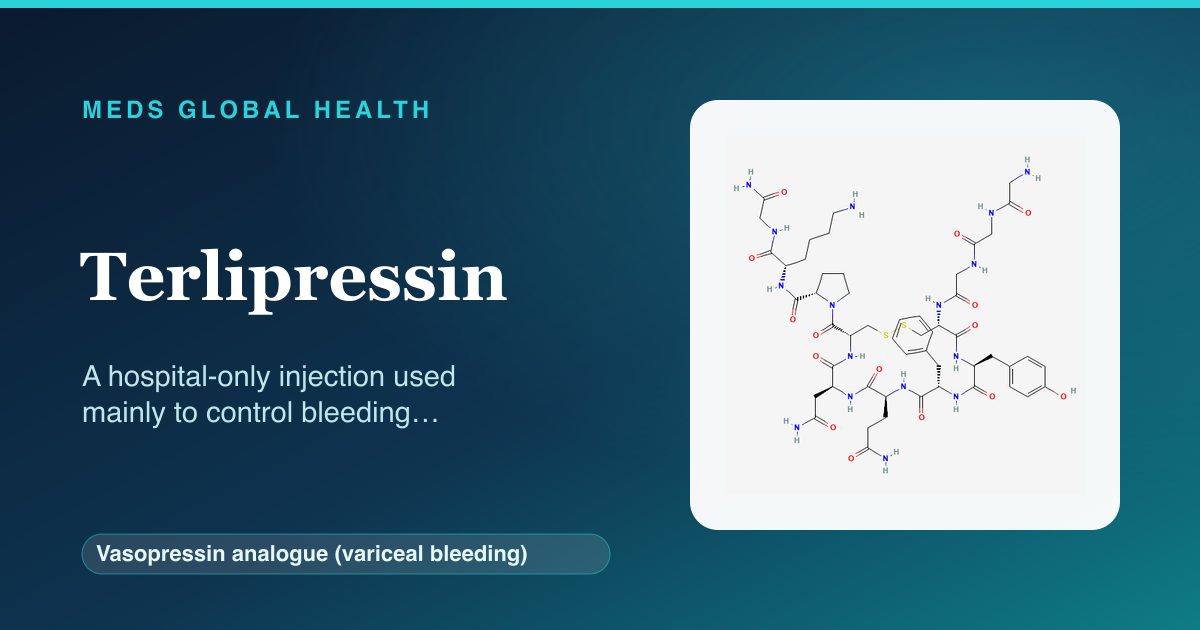
Terlipressin is a medicine related to vasopressin, a natural hormone that tightens blood vessels. It is used in hospital, given into a vein, mainly to control bleeding from oesophageal varices, the swollen veins in the gullet that can form in people with advanced liver disease (cirrhosis). It is also used in some people with hepatorenal syndrome, a dangerous kidney complication of liver failure. It is a powerful, short-term treatment used in an emergency or critical-care setting, always under specialist supervision, and is not something taken at home.
How it works
Terlipressin is a long-acting form of vasopressin. It works by tightening the blood vessels that supply the gut, which lowers the pressure in the portal vein system and so reduces blood flow into the swollen varices. With less pressure and flow, bleeding from these veins is more likely to stop. In hepatorenal syndrome, by tightening blood vessels in the circulation it helps redirect blood flow and support the kidneys. Because this vessel-tightening affects the whole body, it can also reduce blood flow to the heart, intestines, skin and limbs, which is why it is given carefully and monitored closely.
Company & origin
A hospital medicine used in the UK to control bleeding from oesophageal varices and, in some cases, a serious kidney complication of liver disease.
Practical use
How to take Terlipressin
General, dose-free guidance — always follow your prescriber's and the leaflet's specific instructions.
- It is given as an injection into a vein by a hospital team; it is never self-administered at home.
- Tell the team straight away if you get chest pain, breathlessness, tummy pain, or coldness, pain or colour changes in your fingers, toes or skin.
- Expect close monitoring of your heart, blood pressure and blood tests while it is being used.
- Let the team know about any heart, circulation or blood-pressure problems before it is started.
- It is a short-term treatment for an emergency and is stopped once bleeding is controlled or if circulation problems appear.
Weighing it up
Advantages & disadvantages of Terlipressin
Advantages
- An effective emergency treatment to help control bleeding from oesophageal varices.
- Can be used for hepatorenal syndrome, a serious kidney complication of liver failure.
- Longer-acting than older vasopressin treatments, so it can be given as spaced doses rather than a continuous drip.
Disadvantages
- Tightens blood vessels throughout the body, which can reduce blood flow to the heart, gut, skin and limbs.
- Can strain the heart and cause chest pain or rhythm changes, so it is unsuitable for some people with heart disease.
- A hospital-only treatment that needs close monitoring and is not used at home.
Practical use
Good to know
The most important thing to understand about terlipressin is that it is a strong, hospital-only medicine for a medical emergency, not a treatment used at home. Because it tightens blood vessels throughout the body, the key risks are reduced blood flow to vital areas: it can strain the heart, cause chest pain or rhythm changes, and reduce circulation to the gut, fingers, toes and skin, sometimes causing pain or, rarely, tissue damage. It can also lower the level of sodium in the blood, so this is watched. It is used with great care in people with heart disease, high blood pressure or poor circulation. The medical team monitors the heart, blood pressure, fluid balance and blood salts closely throughout treatment, and stops it if signs of reduced circulation appear.
Who should not take it / use with caution
- People who have had a serious allergic reaction to terlipressin should not be given it.
- It is used with great caution, or avoided, in people with serious heart disease, uncontrolled high blood pressure or poor circulation.
- It is used with care in pregnancy and only when the benefit is judged to outweigh the risk, under specialist supervision.
Monitoring
- Close monitoring of heart rhythm, blood pressure and fluid balance during treatment.
- Regular blood tests, including checking the blood sodium level.
- Watching for signs of reduced circulation to the gut, limbs, skin, heart or fingers and toes.
Side effects
- Paleness, high blood pressure, tummy cramps or headache from the tightening of blood vessels.
- Reduced blood flow to the heart, gut, fingers, toes or skin, which can cause chest pain, tummy pain or coldness and colour changes.
- A fall in the blood sodium level, which is monitored with blood tests.
- Rarely, serious heart-rhythm problems or tissue damage from poor circulation, which need urgent attention.
Key interactions
- Medicines that slow the heart rate may have a stronger effect when given with terlipressin.
- Other medicines that affect blood pressure or the heart rhythm are reviewed carefully by the hospital team.
- Because it is used in critical care, all other treatments are weighed up together by the specialist team.
Available as: A solution given as an injection into a vein in hospital.
Answers
Terlipressin: frequently asked questions
What is terlipressin used for?
It is a hospital injection used mainly to help control bleeding from oesophageal varices, the swollen veins in the gullet that can form in advanced liver disease, and sometimes for a serious kidney complication called hepatorenal syndrome.
How does it stop bleeding?
It is a long-acting form of vasopressin that tightens the blood vessels supplying the gut, which lowers the pressure in the swollen veins and helps the bleeding to stop.
Why is it only given in hospital?
It tightens blood vessels throughout the body, which can reduce blood flow to the heart, gut, skin and limbs, so it needs close monitoring of the heart, blood pressure and blood tests.
What should I report while having it?
Tell the team straight away about chest pain, breathlessness, tummy pain, or any coldness, pain or colour change in your fingers, toes or skin, as these can signal reduced circulation.
Is terlipressin a long-term medicine?
No. It is a short-term emergency treatment given over a limited time and stopped once bleeding is controlled or if circulation problems appear.
Authoritative sources
- BNF
- NICE CKS
Building a medicines information resource?
We create evidence-led, dose-free drug and formulary references for teams.