A synthetic ACTH (Synacthen) used mainly to test the adrenal glands
Tetracosactide
A synthetic form of the hormone ACTH used mainly to test whether the adrenal glands make enough cortisol.
What is Tetracosactide?
Tetracosactide, often known by the brand name Synacthen, is a synthetic version of the natural hormone ACTH, which tells the adrenal glands to release cortisol. Its main use is as a test: in the short Synacthen test, it is given and then a blood sample checks whether the adrenal glands respond by making enough cortisol. The single most important safety point is the risk of serious allergic (anaphylactic) reactions, which are more likely in people with allergies or asthma, so the test is done where such reactions can be treated. It is mostly a diagnostic medicine rather than a treatment.
Education and reference only. This is a plain-language guide to Tetracosactide — it deliberately contains no doses. Doses depend on the person, the brand and the reason for treatment, and belong with your prescriber. Always check the BNF, the product labelling (SmPC) and follow medical advice.
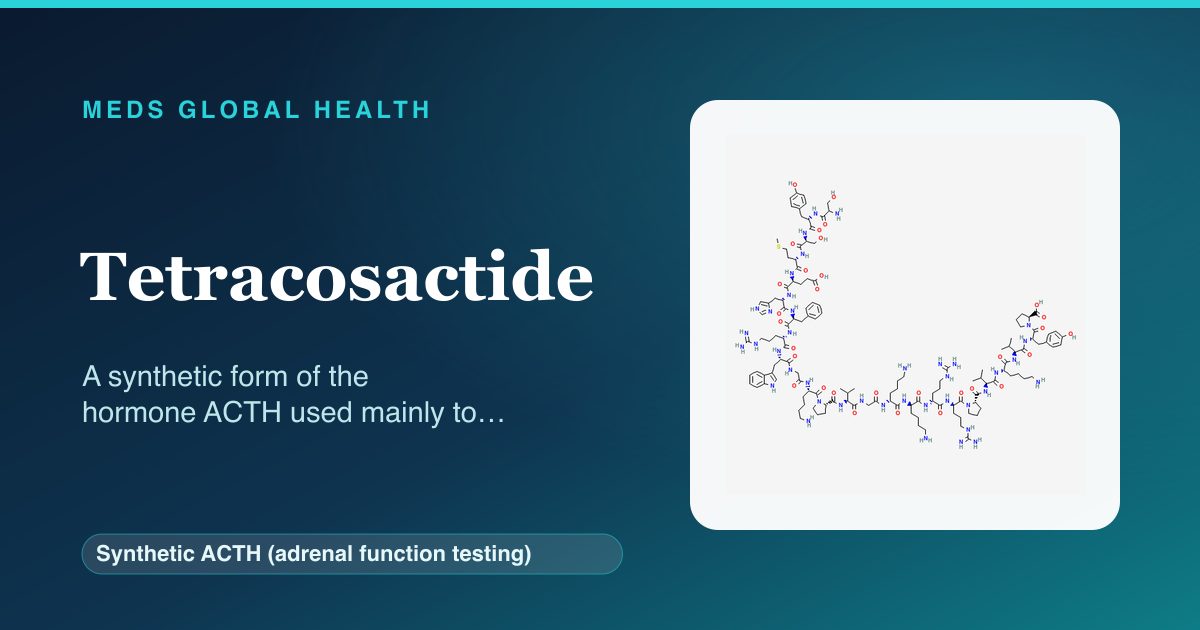
What it is
Tetracosactide is a man-made copy of part of ACTH, the natural hormone from the pituitary gland that signals the adrenal glands to produce cortisol. It is best known as the medicine used in the short Synacthen test, a test of adrenal function: it is given by injection and then cortisol is measured in the blood to see whether the adrenal glands are working properly. It has also been used in some other situations, but its main everyday role in the UK is diagnostic. It is given by healthcare staff, usually in a hospital or clinic setting.
How it works
Cortisol is normally released by the adrenal glands when they receive the ACTH signal from the pituitary gland. Tetracosactide mimics ACTH, so when it is given it prompts healthy adrenal glands to release cortisol. By measuring cortisol in the blood before and after the injection, doctors can see whether the adrenal glands respond as they should. A poor response suggests the adrenal glands are underactive. This is why the medicine is used as a test of adrenal function rather than as a long-term treatment in most cases.
Company & origin
A medicine used in the UK mainly as a test of how well the adrenal glands work (the short Synacthen test).
Practical use
How to take Tetracosactide
General, dose-free guidance — always follow your prescriber's and the leaflet's specific instructions.
- It is given by injection by healthcare staff, usually as part of a test in a clinic or hospital.
- For the short Synacthen test, expect a blood sample before and after the injection to measure cortisol.
- Tell the staff beforehand about any allergies, asthma or previous reactions to injections.
- Stay as advised for observation after the injection, in case of an allergic reaction.
- Tell the staff straight away if you feel flushed, itchy, dizzy, swollen or short of breath.
Weighing it up
Advantages & disadvantages of Tetracosactide
Advantages
- Provides a reliable way to test whether the adrenal glands make enough cortisol.
- The short Synacthen test is quick and widely used.
- Gives doctors clear information to diagnose adrenal problems.
Disadvantages
- Can cause serious allergic (anaphylactic) reactions, especially in people with allergies or asthma.
- Must be given where allergic reactions can be treated, usually in a clinic or hospital.
- Mostly a diagnostic test rather than a treatment people take regularly.
Practical use
Good to know
The most important safety point with tetracosactide is the risk of serious allergic reactions, including anaphylaxis, which is why it is given where staff and equipment are ready to treat such a reaction. This risk is higher in people who have allergies or asthma, so it is used with particular caution, or avoided, in those people, and you should always mention any allergies beforehand. For most people it is a one-off diagnostic test rather than an ongoing treatment, so the usual concerns about long-term steroid effects do not apply in the same way. The test itself is straightforward: an injection followed by a blood sample after a set wait. Tell the staff if you feel unwell, flushed, itchy or short of breath during or after the injection.
Who should not take it / use with caution
- People who have had a serious allergic reaction to tetracosactide or ACTH should not be given it.
- It is used with great caution, or avoided, in people with allergies, asthma or other allergic conditions.
- It should only be given where staff and equipment are ready to treat a severe allergic reaction.
Monitoring
- Observation for allergic reactions during and after the injection.
- Measuring cortisol in the blood to interpret the test result.
- With any repeated use, watching for effects linked to raised steroid hormones.
Side effects
- Serious allergic (anaphylactic) reactions, which are the main safety concern.
- Flushing, itching or a rash, sometimes a sign of an allergic reaction.
- Local reaction at the injection site.
- With repeated or longer use, effects linked to raised steroid hormones, such as fluid retention.
Key interactions
- Tell the staff about all your medicines, as some treatments can affect cortisol or the test result.
- Certain medicines, including some steroids, can influence how the test is interpreted.
- Always mention any allergy medicines and any history of allergic reactions before the test.
Available as: A solution for injection given by healthcare staff.
Answers
Tetracosactide: frequently asked questions
What is tetracosactide used for?
It is mainly used as a test of adrenal function: in the short Synacthen test it prompts the adrenal glands to release cortisol so doctors can check they are working properly.
Is it the same as Synacthen?
Yes, Synacthen is a common brand name for tetracosactide, a synthetic form of the hormone ACTH.
Why is it given in a clinic or hospital?
It can cause serious allergic reactions, so it is given where staff and equipment are ready to treat such a reaction quickly.
Should I mention my asthma or allergies?
Yes. Serious allergic reactions are more likely in people with allergies or asthma, so always tell the staff beforehand.
Is it a treatment or a test?
It is mostly used as a diagnostic test of how well the adrenal glands work, rather than as a regular treatment.
Authoritative sources
- BNF
- NICE CKS
Building a medicines information resource?
We create evidence-led, dose-free drug and formulary references for teams.