A medicine that lowers cystine in the urine
Tiopronin
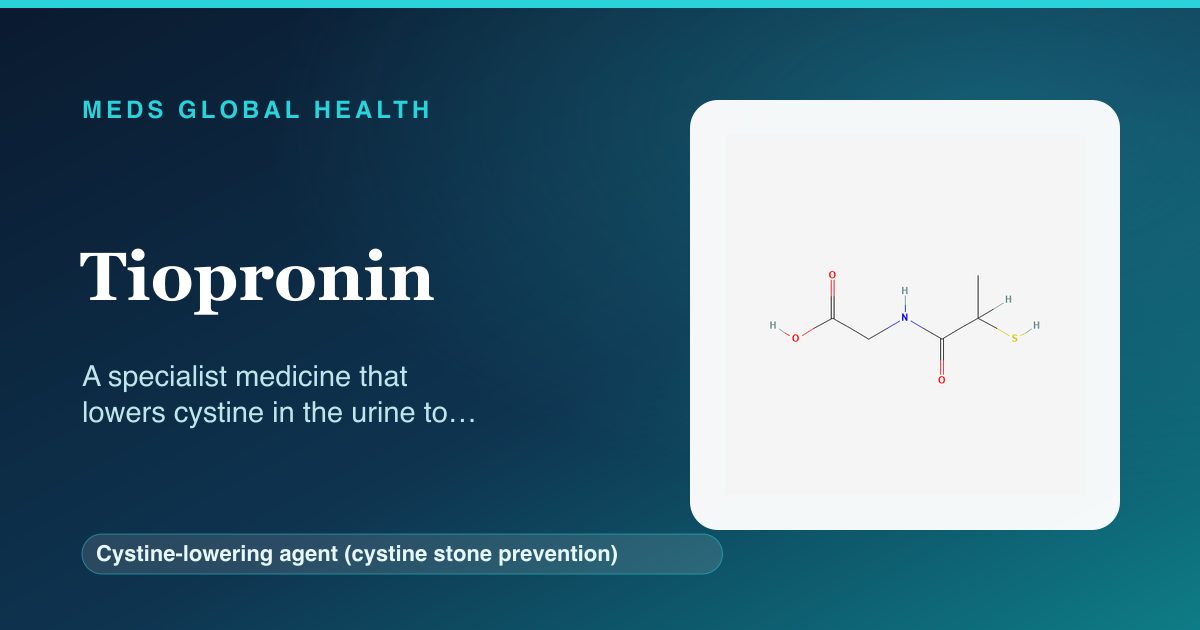
A specialist medicine that lowers cystine in the urine to help prevent cystine kidney stones.
What is Tiopronin?
Tiopronin is a specialist medicine used to help prevent cystine kidney stones in people with cystinuria, an inherited condition in which too much of a substance called cystine is passed in the urine and forms stones. It is taken by mouth. It works by combining with cystine to keep it dissolved so it is less likely to form stones. The most important everyday measure alongside it is drinking plenty of fluids. It can cause skin rashes and, less commonly, blood or kidney problems (such as protein in the urine), so regular monitoring is needed.
Education and reference only. This is a plain-language guide to Tiopronin — it deliberately contains no doses. Doses depend on the person, the brand and the reason for treatment, and belong with your prescriber. Always check the BNF, the product labelling (SmPC) and follow medical advice.
What it is
Tiopronin is a medicine used to help prevent the formation of cystine kidney stones in people with cystinuria, an inherited condition where the kidneys leak too much cystine into the urine, where it can clump together into hard, recurrent stones. It is taken by mouth. It is usually added when general measures, such as drinking lots of fluid, are not enough on their own to keep stones from forming. It is a specialist treatment, prescribed and monitored by kidney or urology teams, and is generally a long-term treatment for a long-term condition.
How it works
Cystine does not dissolve well in urine, so when there is a lot of it, it can crystallise and form stones. Tiopronin combines chemically with cystine to form a more soluble compound that stays dissolved in the urine, lowering the amount of free cystine available to form stones. By keeping cystine in a dissolved form, it reduces how often stones develop. It works alongside, rather than instead of, the key general measures of drinking plenty of fluids and other advice to keep the urine less likely to form stones.
Company & origin
A specialist medicine used in the UK to help prevent cystine kidney stones in people with the inherited condition cystinuria.
Practical use
How to take Tiopronin
General, dose-free guidance — always follow your prescriber's and the leaflet's specific instructions.
- Take it by mouth as prescribed by your kidney or urology team.
- Drink plenty of fluids throughout the day and night, as this is central to preventing cystine stones.
- Attend your regular blood and urine tests, which check for blood and kidney side effects.
- Report any rash, swelling, or frothy urine, as these can signal skin, blood or kidney effects.
- Keep taking it consistently, as it is a long-term treatment for a long-term condition.
Weighing it up
Advantages & disadvantages of Tiopronin
Advantages
- Helps prevent recurrent cystine kidney stones in people with cystinuria.
- Taken by mouth and used alongside fluids and general measures.
- Offers an option when fluids and diet alone are not enough.
Disadvantages
- Commonly causes skin rashes and other skin reactions.
- Less commonly can affect the blood and the kidneys, including protein in the urine, needing monitoring.
- Works only alongside drinking plenty of fluids, and is a long-term commitment.
Practical use
Good to know
The single most important thing alongside tiopronin is drinking plenty of fluids throughout the day and night, because keeping the urine dilute is central to preventing cystine stones; the medicine supports this rather than replacing it. The most common side effect is a skin rash, and skin reactions of various kinds can occur. Less commonly but importantly, it can affect the blood and the kidneys, including causing protein to appear in the urine (proteinuria), which is why regular blood and urine tests are used to catch any problems early. Because it is closely related to another stone-prevention medicine (penicillamine), people who have reacted to that may also react to this. It is a long-term treatment, so taking it consistently and keeping up with monitoring and fluids matters.
Who should not take it / use with caution
- People who have had a serious allergic reaction to tiopronin should not take it.
- It is used with caution in people who have reacted to the related medicine penicillamine.
- It is used with caution, and with monitoring, in people with existing kidney or blood problems.
- It is used in pregnancy only under specialist guidance, weighing the benefits and risks.
Monitoring
- Regular urine tests for protein and to check stone control.
- Regular blood tests to check blood counts and kidney function.
- Reviewing the skin for rashes and checking fluid intake is being kept up.
Side effects
- Skin rashes and other skin reactions.
- Protein in the urine (proteinuria) or other kidney effects.
- Changes in blood counts, picked up by monitoring.
- Nausea, stomach upset or altered taste in some people.
Key interactions
- It is used with caution alongside other medicines that can affect the blood or kidneys.
- Tell your team about all your medicines, including the related medicine penicillamine.
- Other stone-prevention measures, such as making the urine less acidic, may be used alongside it under guidance.
Available as: Tablets taken by mouth.
Answers
Tiopronin: frequently asked questions
What is tiopronin used for?
It is used to help prevent cystine kidney stones in people with cystinuria, an inherited condition in which too much cystine in the urine forms hard, recurrent stones.
Why do I need to drink so much fluid?
Keeping the urine dilute is central to preventing cystine stones, so drinking plenty of fluids day and night is essential; tiopronin supports this rather than replacing it.
Why do I need regular blood and urine tests?
Tiopronin can less commonly affect the blood and the kidneys, including causing protein in the urine, so regular tests are used to catch any problems early.
What should I do if I get a rash?
Skin rashes are the most common side effect, so report any rash or skin reaction to your team, as it may need the treatment to be reviewed.
Is it the same as penicillamine?
It is a related medicine used for the same purpose, so people who have reacted to penicillamine may also react to tiopronin; tell your team if this applies to you.
Authoritative sources
- BNF
- NICE CKS
Building a medicines information resource?
We create evidence-led, dose-free drug and formulary references for teams.