A blue dye used to highlight suspicious tissue
Toluidine blue
A blue dye used to highlight suspicious tissue, for example in the mouth, as an aid during examinations.
What is Toluidine blue?
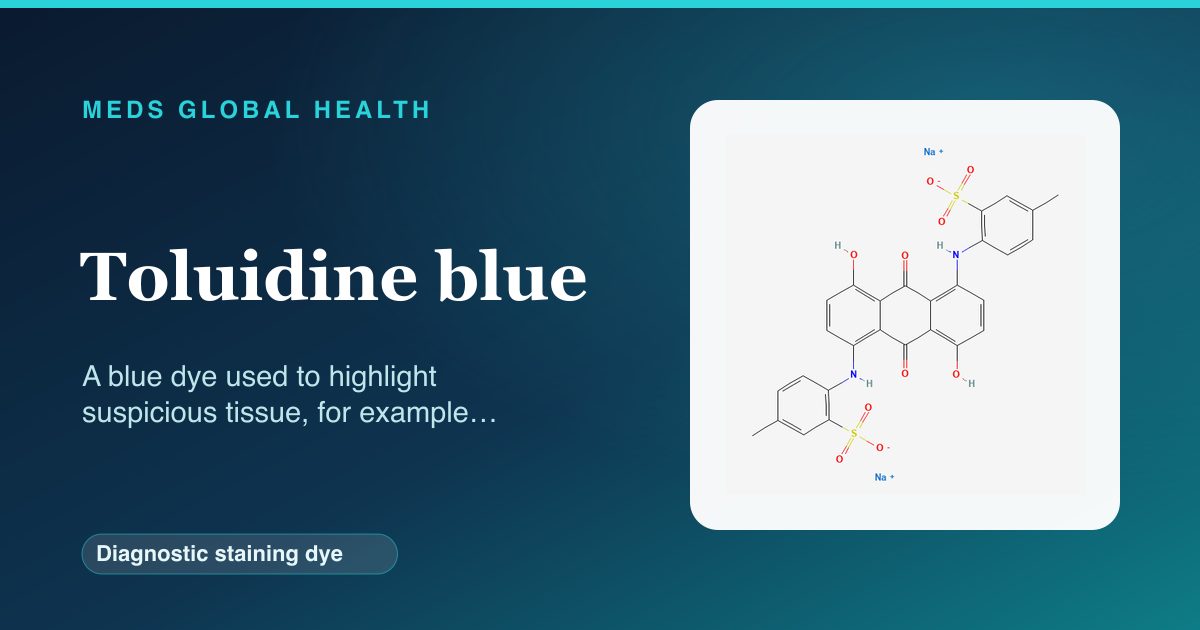
Toluidine blue is a blue dye used as an aid during certain examinations and procedures, where it is applied to tissue to highlight suspicious areas, for example in the mouth, so that they stand out and can be looked at or sampled more easily. It is a diagnostic aid rather than a treatment for any condition. It is usually applied to the surface of the tissue and can stain the area and surrounding skin temporarily. It is used by clinicians, who explain what to expect, and is not a medicine that people take to treat an illness.
Education and reference only. This is a plain-language guide to Toluidine blue — it deliberately contains no doses. Doses depend on the person, the brand and the reason for treatment, and belong with your prescriber. Always check the BNF, the product labelling (SmPC) and follow medical advice.
What it is
Toluidine blue is a coloured dye used to help clinicians see suspicious areas of tissue more clearly. When applied, it tends to be taken up more by certain abnormal cells, so areas that take on the colour can be examined more closely or chosen for a sample (biopsy). It is used, for example, to highlight suspicious patches in the mouth. It is an aid to examination, not a treatment: it does not cure or change a condition, it just helps reveal where attention may be needed. It is applied by a clinician as part of an examination or procedure.
How it works
Toluidine blue binds to certain components inside cells, and abnormal or rapidly dividing cells tend to take up more of the dye than normal tissue does. When the dye is applied and the excess rinsed away, areas that hold on to the colour stand out against the paler normal tissue. This helps the clinician decide where to look more carefully or where to take a sample for testing. Because it is highlighting tissue rather than treating it, its role is to guide examination and sampling, and the colour it leaves is temporary.
Company & origin
A blue dye used in UK clinics to help highlight suspicious areas of tissue, such as in the mouth, during examinations and procedures.
Practical use
How to take Toluidine blue
General, dose-free guidance — always follow your prescriber's and the leaflet's specific instructions.
- It is applied by a clinician to the tissue being examined, often to the surface such as inside the mouth.
- It is not a medicine you take to treat a condition; it is used to highlight areas during a check or procedure.
- Follow any simple instructions, such as rinsing, or not eating or drinking for a short time around the procedure.
- Expect a temporary blue stain on the area and possibly the lips or surrounding skin, which fades.
- Tell the clinician about any allergies before it is used.
Weighing it up
Advantages & disadvantages of Toluidine blue
Advantages
- Helps highlight suspicious areas of tissue so they can be examined or sampled more easily.
- A simple aid that can be applied to the surface during an examination.
- Supports earlier or more accurate sampling of areas that need checking.
Disadvantages
- Only a diagnostic aid; it does not treat any condition.
- Can leave a temporary blue stain on tissue, lips or surrounding skin.
- A highlighted area still needs proper examination or a sample to know what it means.
Practical use
Good to know
The key thing to understand about toluidine blue is that it is a diagnostic aid, not a treatment: it highlights suspicious tissue so it can be examined or sampled, but it does not treat anything itself. It is usually applied to the surface, for example by painting or rinsing it over an area such as the inside of the mouth, and it can leave a temporary blue stain on the tissue, lips or surrounding skin, which fades over time. A highlighted area does not by itself mean something serious; it simply guides where the clinician looks more closely or takes a sample. Tell the clinician about any allergies beforehand, and follow any simple instructions they give, such as not eating or drinking for a short time around the procedure.
Who should not take it / use with caution
- People who have had an allergic reaction to toluidine blue should not have it used on them.
- It is used with care in anyone with sensitive or broken tissue, as the clinician judges.
- It is used only by clinicians as part of an examination or procedure, not for self-treatment.
Monitoring
- The clinician looks at which areas take up the dye to guide examination or sampling.
- Watching for any allergic reaction when it is applied.
- Following up highlighted areas with proper examination or a sample as needed.
Side effects
- Temporary blue staining of the tissue, lips or surrounding skin.
- Mild, brief irritation or an unusual taste when used in the mouth.
- Rarely, an allergic reaction to the dye.
Key interactions
- There are few well-established interactions when it is used on the surface as an aid.
- Tell the clinician about all your medicines and any allergies before it is used.
- Recent food, drink or other rinses may affect how clearly it shows areas, so follow any instructions given.
Available as: A blue dye solution applied to tissue by a clinician.
Answers
Toluidine blue: frequently asked questions
What is toluidine blue used for?
It is a dye used to highlight suspicious areas of tissue, such as in the mouth, so they stand out and can be examined or sampled more easily.
Is it a treatment?
No. It is a diagnostic aid that highlights tissue; it does not treat or cure any condition itself.
Will it stain my mouth or skin?
It can leave a temporary blue stain on the tissue, lips or surrounding skin, which fades over time.
Does a blue area mean I have cancer?
No. A highlighted area simply guides where the clinician looks more closely or takes a sample; it needs proper examination to know what it means.
How is it used?
A clinician applies it to the surface of the area being examined, often by painting or rinsing it on, as part of a check or procedure.
Authoritative sources
- BNF
- NICE CKS
Building a medicines information resource?
We create evidence-led, dose-free drug and formulary references for teams.