A vasopressin receptor antagonist
Tolvaptan
A tablet used to slow kidney growth in polycystic kidney disease and to treat low sodium, needing liver monitoring.
What is Tolvaptan?
Tolvaptan blocks the action of vasopressin (also called ADH), the hormone that tells the kidneys to hold on to water. It is used to slow the growth of kidney cysts in autosomal dominant polycystic kidney disease (ADPKD) and to treat certain causes of low blood sodium. Because it makes the kidneys pass more water, it causes a lot of thirst and frequent urination. Its most important risk is liver injury, so regular blood tests are needed. UK brands are Jinarc (for ADPKD) and Samsca.
Education and reference only. This is a plain-language guide to Tolvaptan — it deliberately contains no doses. Doses depend on the person, the brand and the reason for treatment, and belong with your prescriber. Always check the BNF, the product labelling (SmPC) and follow medical advice.
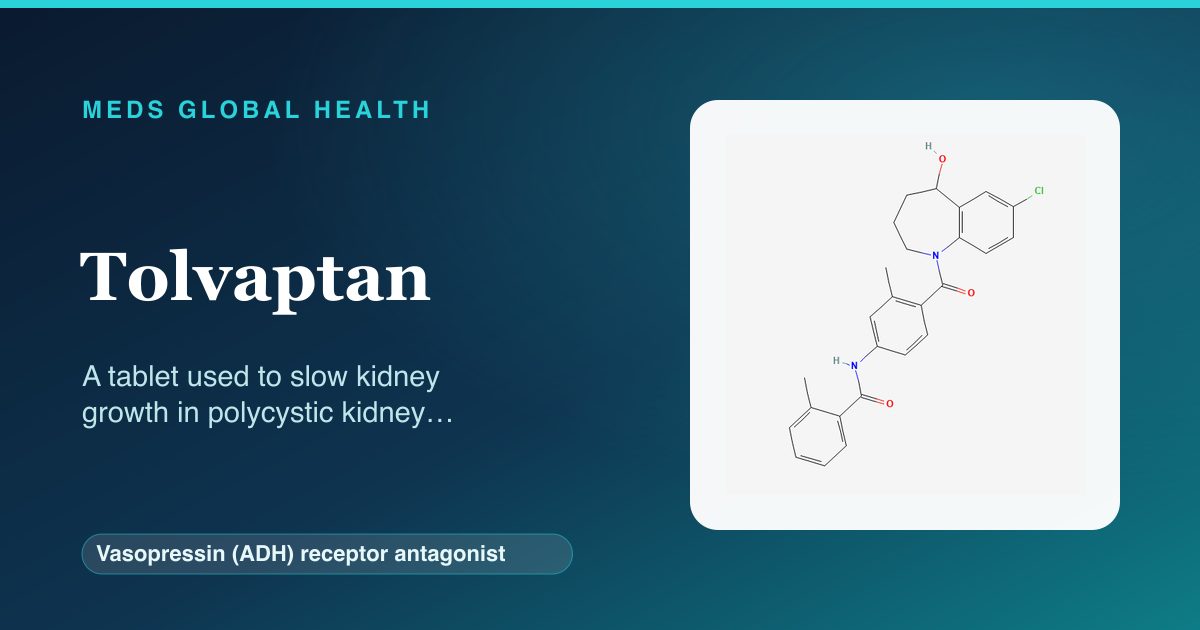
What it is
Tolvaptan is a tablet that blocks the receptors for vasopressin, the hormone (also called antidiuretic hormone, or ADH) that signals the kidneys to retain water. It is used in two main ways. As Jinarc, it slows the growth of fluid-filled cysts in autosomal dominant polycystic kidney disease (ADPKD), a common inherited condition where the kidneys enlarge and gradually lose function. As Samsca, it treats certain types of low blood sodium (hyponatraemia), where there is too much water relative to salt in the blood.
How it works
Vasopressin normally tells the kidneys to reabsorb water back into the body, concentrating the urine. By blocking vasopressin's receptors, tolvaptan stops the kidneys holding on to so much water, so more water is passed out as dilute urine. In ADPKD, vasopressin also drives the growth of the kidney cysts, so blocking it helps slow how quickly the cysts and kidneys enlarge. In low sodium, passing extra water without losing salt raises the concentration of sodium in the blood back towards normal.
Company & origin
Originated / developed by: Otsuka.
A vasopressin (ADH) receptor antagonist used in the UK to slow polycystic kidney disease and to treat low sodium.
Practical use
How to take Tolvaptan
General, dose-free guidance — always follow your prescriber's and the leaflet's specific instructions.
- Take it as prescribed; for ADPKD it is usually a larger amount in the morning and a smaller amount later in the day.
- Drink enough water to satisfy your thirst and avoid dehydration, and keep water and a toilet within easy reach.
- Have your liver blood tests before starting and regularly during treatment, and do not miss them.
- Avoid grapefruit juice, which can increase the level of the medicine in your body.
- Report yellowing of the skin or eyes, dark urine, severe tiredness, nausea or tummy pain straight away.
Weighing it up
Advantages & disadvantages of Tolvaptan
Advantages
- Can slow the growth of kidney cysts and the loss of kidney function in ADPKD.
- Effectively raises blood sodium in certain types of low-sodium conditions.
- Taken as a tablet rather than needing an injection or a drip.
Disadvantages
- Causes a lot of thirst and frequent urination, including at night.
- Carries a risk of liver injury, so regular blood tests are essential.
- Can cause dehydration if enough water is not taken, and needs specialist supervision.
Practical use
Good to know
Two things stand out with tolvaptan. First, because it makes the kidneys pass a lot of water, it causes marked thirst and very frequent urination, including waking at night, so people need free access to water and a toilet, and must drink enough to avoid becoming dehydrated. Second, and most importantly, it can cause liver injury, so liver blood tests are done before starting and regularly during treatment, and any yellowing of the skin or eyes, dark urine, severe tiredness, loss of appetite or tummy pain should be reported at once. In ADPKD it is started and overseen by a kidney specialist, with blood tests for liver and kidney function and sodium. When used for low sodium, treatment is usually started in hospital so sodium can be corrected slowly and safely, because raising it too fast can be harmful. Grapefruit juice should be avoided, as it can raise the level of the medicine.
Who should not take it / use with caution
- People with certain liver problems should not take it, and it is stopped if liver tests become abnormal.
- It is not suitable for people who cannot sense thirst or cannot drink enough water.
- It should not be used in those who are dehydrated or have certain other sodium problems until corrected.
Monitoring
- Liver blood tests before starting and regularly during treatment.
- Blood tests for sodium and kidney function, with very close sodium monitoring when treating low sodium.
- Checking hydration, thirst and how well frequent urination is tolerated.
Side effects
- Marked thirst, frequent urination, passing large amounts of urine and waking at night to urinate.
- Liver injury, which can show as yellowing skin or eyes, dark urine, tiredness, nausea and tummy pain.
- Dry mouth, dizziness, tiredness and, if too much water is lost, signs of dehydration.
Key interactions
- Grapefruit juice and some medicines for fungal infections or heart rhythm can raise its level in the body.
- Certain other medicines can lower its level and reduce its effect.
- Care is needed with other treatments that affect sodium or water balance, such as some water tablets.
Available as: Tablets taken by mouth.
Answers
Tolvaptan: frequently asked questions
What is tolvaptan used for?
It is used to slow the growth of kidney cysts in autosomal dominant polycystic kidney disease (ADPKD) and to treat certain causes of low blood sodium.
Why am I so thirsty and passing so much urine?
Tolvaptan stops the kidneys holding on to water, so you pass more dilute urine and feel very thirsty; you need to drink enough to avoid dehydration.
Why do I need regular liver blood tests?
Its most important risk is liver injury, so liver tests are done before and during treatment, and any yellowing, dark urine or severe tiredness should be reported at once.
Can I drink grapefruit juice with it?
No, grapefruit juice can raise the level of the medicine in your body, so it should be avoided.
Why is it sometimes started in hospital?
When used for low sodium, treatment is usually started in hospital so your sodium can be raised slowly and safely, because correcting it too fast can be harmful.
Authoritative sources
- BNF
- NICE CKS
Building a medicines information resource?
We create evidence-led, dose-free drug and formulary references for teams.