Benzhexol; an antimuscarinic for Parkinson's
Trihexyphenidyl
An antimuscarinic used for tremor in Parkinson’s disease and for drug-induced movement problems, mostly in younger people.
What is Trihexyphenidyl?
Trihexyphenidyl, also known as benzhexol, is an antimuscarinic (anticholinergic) medicine used mainly to help tremor in Parkinson's disease and to treat movement problems caused by certain other medicines. It does little for slowness of movement. It causes drying side effects such as dry mouth, blurred vision, constipation and difficulty passing urine, and can cause confusion, so it is generally avoided in older people. It should not be stopped abruptly.
Education and reference only. This is a plain-language guide to Trihexyphenidyl — it deliberately contains no doses. Doses depend on the person, the brand and the reason for treatment, and belong with your prescriber. Always check the BNF, the product labelling (SmPC) and follow medical advice.
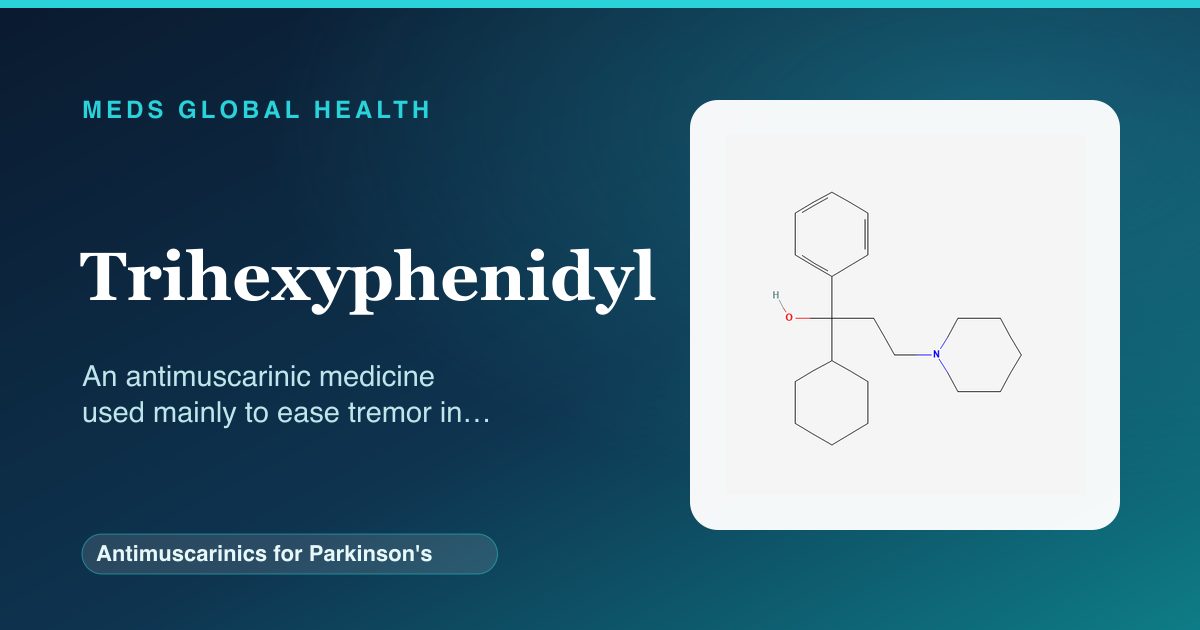
What it is
Trihexyphenidyl (benzhexol) is an antimuscarinic medicine used in Parkinson's disease, where it mainly helps tremor rather than slowness of movement. It is also used to treat the stiffness and abnormal movements that some other medicines, particularly antipsychotics, can cause. It works by blocking the chemical messenger acetylcholine in the brain. It is taken by mouth and used under medical guidance.
How it works
In Parkinson's the loss of dopamine upsets the balance with another messenger, acetylcholine. Trihexyphenidyl blocks the action of acetylcholine, helping to rebalance the two and easing tremor in particular. The same blocking action elsewhere in the body produces its drying side effects, such as dry mouth and blurred vision.
Company & origin
An antimuscarinic medicine used in the UK mainly for tremor in Parkinson's disease and for drug-induced movement problems.
What it treats
Conditions Trihexyphenidyl is used for
Practical use
How to take Trihexyphenidyl
General, dose-free guidance — always follow your prescriber's and the leaflet's specific instructions.
- Take it regularly as prescribed, usually starting low and building up slowly; it mainly helps tremor.
- Expect possible dry mouth, blurred vision and constipation; sips of water and extra fibre can help, and report difficulty passing urine.
- Be alert to confusion, agitation or memory problems, especially in older people, and report them.
- Do not stop it suddenly, as this can worsen symptoms; your team will reduce it gradually if needed.
- If you miss a dose, take it when you remember unless it is nearly time for the next, then skip it and do not double up.
Weighing it up
Advantages & disadvantages of Trihexyphenidyl
Advantages
- Can be helpful specifically for tremor in Parkinson's disease.
- Useful for movement problems caused by some antipsychotic medicines.
- Taken by mouth as a tablet or liquid, which is straightforward.
Disadvantages
- Does little for slowness of movement, a major Parkinson's symptom.
- Causes drying side effects such as dry mouth, blurred vision and urinary problems.
- Can cause confusion and agitation, so it is generally avoided in older people.
Practical use
Good to know
Like other antimuscarinics, trihexyphenidyl mainly helps tremor and does relatively little for the slowness of movement. Its drying effects commonly cause dry mouth, blurred vision, constipation and difficulty passing urine, and it can cause confusion, agitation and memory problems, so it is generally avoided in older people. It is used with extra care in people with glaucoma or an enlarged prostate. It is usually started low and built up slowly, and it should not be stopped abruptly because sudden withdrawal can worsen symptoms. Combining it with other drying medicines can make side effects add up.
Who should not take it / use with caution
- People with closed-angle glaucoma should not usually take it.
- People with significant urinary retention or an enlarged prostate should generally avoid it.
- It is usually avoided in older people and in those with bowel obstruction or certain stomach problems.
Monitoring
- Review of whether tremor or drug-induced movements are improving.
- Watching for antimuscarinic effects such as urinary retention, constipation and confusion.
- Extra care and review in older people and those on multiple drying medicines.
Side effects
- Dry mouth, blurred vision and constipation are common antimuscarinic effects.
- Difficulty passing urine, dizziness and sometimes a fast heartbeat.
- Confusion, agitation, memory problems or hallucinations, especially in older people.
Key interactions
- Other antimuscarinic medicines add to dry mouth, constipation and urinary problems.
- Sedating medicines and alcohol can increase drowsiness and confusion.
- Tell your prescriber about all medicines, as several drying medicines together need care.
Available as: Tablets and an oral liquid.
Answers
Trihexyphenidyl: frequently asked questions
Is benzhexol the same as trihexyphenidyl?
Yes. Benzhexol is an older name for the same medicine, trihexyphenidyl, used mainly for tremor in Parkinson's disease.
Why is it often avoided in older people?
Its antimuscarinic effects can cause confusion, agitation and memory problems, which are more likely in older people, so it is generally avoided in that group.
Why do I get a dry mouth and blurred vision?
These are antimuscarinic effects from blocking acetylcholine; they are common, but report difficulty passing urine to your team.
Can I stop it suddenly?
No. Stopping abruptly can worsen symptoms, so any change should be made gradually under your team's guidance.
Can I take it with glaucoma or prostate problems?
It needs caution and is often avoided in closed-angle glaucoma and significant prostate enlargement, so tell your prescriber about these.
The wider class
About Antimuscarinics for Parkinson's
Trihexyphenidyl belongs to the antimuscarinics for parkinson's class. For how the class as a whole works, its shared safety principles and monitoring, see the full guide.
Browse by body system
Authoritative sources
- BNF
- NICE CKS
Building a medicines information resource?
We create evidence-led, dose-free drug and formulary references for teams.