An old anti-seizure medicine for absence seizures
Trimethadione
An obsolete older anti-seizure medicine once used for absence seizures, largely abandoned because of serious safety problems.
What is Trimethadione?
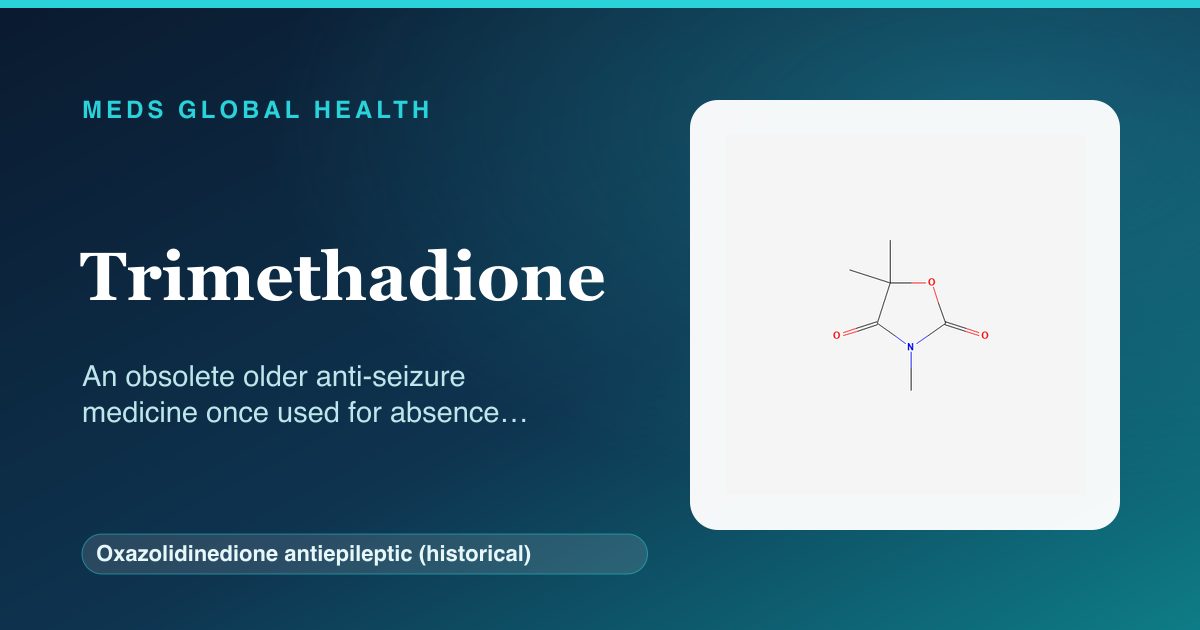
Trimethadione is an old anti-seizure medicine, one of a group called oxazolidinediones, that was once used to control absence (so-called 'petit mal') seizures. It is now obsolete and almost never used, because safer and more effective medicines are available and because trimethadione carries serious risks. These include dangerous drops in blood cell counts, harm to the kidneys and liver, and, very importantly, severe birth defects if taken in pregnancy, a pattern known as 'fetal trimethadione syndrome'. It is included here for completeness and historical understanding rather than as a current treatment.
Education and reference only. This is a plain-language guide to Trimethadione — it deliberately contains no doses. Doses depend on the person, the brand and the reason for treatment, and belong with your prescriber. Always check the BNF, the product labelling (SmPC) and follow medical advice.
What it is
Trimethadione is one of the oldest anti-seizure (antiepileptic) medicines, belonging to a group called the oxazolidinediones. It was historically used to treat absence seizures, brief episodes of staring and loss of awareness that were once called 'petit mal'. It is taken by mouth. Today it is regarded as obsolete: it has been replaced by medicines that work better and are far safer, and it is essentially of historical interest. Its serious side effects, particularly its danger in pregnancy, are the main reason it is no longer used.
How it works
Trimethadione acts on the brain to dampen the abnormal electrical activity that causes absence seizures, in particular reducing certain rhythmic patterns linked to these brief lapses of awareness. By calming this activity it could reduce how often absence seizures happened. However, it affects the body widely, which is why it can damage the bone marrow, kidneys and liver, and crucially it crosses the placenta and interferes with the developing baby. Modern medicines achieve the same seizure control with far fewer of these dangers, which is why trimethadione has been abandoned.
Company & origin
An old anti-seizure medicine once used for absence ('petit mal') seizures, now obsolete because of its serious risks and the availability of safer treatments.
What it treats
Conditions Trimethadione is used for
Practical use
How to take Trimethadione
General, dose-free guidance — always follow your prescriber's and the leaflet's specific instructions.
- It is an obsolete medicine and is essentially no longer prescribed; modern anti-seizure medicines are used instead.
- It must never be taken in pregnancy or by anyone who might become pregnant, because of severe harm to the baby.
- If it were ever used, it would require close monitoring of blood counts, kidney and liver function.
- Anti-seizure medicines should never be stopped suddenly, as this can trigger seizures.
- Discuss any historical use of this medicine with a specialist, who will recommend safer alternatives.
Weighing it up
Advantages & disadvantages of Trimethadione
Advantages
- Historically, it could reduce absence seizures at a time when few treatments existed.
- Of value mainly for understanding the history of epilepsy treatment.
- Largely replaced by modern medicines that are both safer and more effective.
Disadvantages
- Can cause dangerous, sometimes life-threatening, drops in blood cell counts.
- Can damage the kidneys and the liver.
- Causes severe birth defects ('fetal trimethadione syndrome'), making it unsafe in pregnancy; now obsolete.
Practical use
Good to know
The most important thing to understand about trimethadione is why it is no longer used. It can cause dangerous drops in the body's blood cells, including conditions where the bone marrow stops making enough cells, which can be life-threatening, so blood counts had to be watched closely. It can also damage the kidneys and the liver. Above all, it is severely harmful in pregnancy: babies exposed to it before birth can develop a recognised pattern of birth defects called fetal trimethadione syndrome, which is one of the strongest reasons it was withdrawn from routine use. Because of all of this, it has been replaced by safer, more effective anti-seizure treatments. Anyone with epilepsy today would be offered modern medicines rather than this one.
Who should not take it / use with caution
- It must not be used in pregnancy or by those who could become pregnant, because of severe harm to the developing baby.
- People with serious blood, kidney or liver problems should not take it.
- People who have had a serious allergic reaction to it should not take it.
- In practice it is not recommended for anyone, as safer alternatives exist.
Monitoring
- Frequent blood counts to watch for dangerous falls in blood cells.
- Checking kidney and liver function.
- Strict avoidance and counselling around pregnancy because of the severe risk to the baby.
Side effects
- Serious drops in blood cell counts, including conditions where the bone marrow fails, which can be life-threatening.
- Kidney damage and liver damage.
- Severe birth defects if taken in pregnancy ('fetal trimethadione syndrome').
- Drowsiness, visual disturbances such as glare, and skin reactions.
Key interactions
- It can interact with other anti-seizure medicines and with many other drugs, so a full medicines list matters.
- Combining it with other medicines that affect blood cells, the liver or kidneys increases the risk of harm.
- Because it is obsolete, the main message is to use safer modern alternatives instead.
Available as: Tablets and capsules taken by mouth (historical).
Answers
Trimethadione: frequently asked questions
What was trimethadione used for?
It was an old anti-seizure medicine used to control absence (once called 'petit mal') seizures, brief episodes of staring and loss of awareness.
Why is it no longer used?
It is obsolete because it can cause dangerous blood, kidney and liver problems and severe birth defects, and because much safer, more effective medicines now exist.
What is fetal trimethadione syndrome?
It is a recognised pattern of severe birth defects that can occur in babies exposed to trimethadione before birth, which is a major reason the medicine was withdrawn.
Is it dangerous to the blood?
Yes, it can cause serious, sometimes life-threatening, drops in the body's blood cells, which is why blood counts had to be watched very closely.
What would be used instead today?
People with absence seizures are now offered modern anti-seizure medicines, chosen by a specialist, which control seizures with far fewer risks.
Authoritative sources
- BNF
- NICE CKS
Building a medicines information resource?
We create evidence-led, dose-free drug and formulary references for teams.