Also called DMPS, a chelating agent for heavy-metal poisoning
Unithiol
A specialist chelating medicine used to treat heavy-metal poisoning by binding the metal so the body can remove it.
What is Unithiol?
Unithiol, also called DMPS, is a specialist chelating medicine used to treat poisoning with heavy metals such as mercury, arsenic and sometimes lead. It works by binding to the metal so it can be passed out of the body, mainly in the urine. It can be taken by mouth or given by injection, depending on the situation. It is generally well tolerated, with hypersensitivity or skin reactions and temporary dizziness or changes in blood pressure being the main concerns. It is used under specialist or poisons-service guidance.
Education and reference only. This is a plain-language guide to Unithiol — it deliberately contains no doses. Doses depend on the person, the brand and the reason for treatment, and belong with your prescriber. Always check the BNF, the product labelling (SmPC) and follow medical advice.
What it is
Unithiol, also known as DMPS, is a chelating agent, a medicine that grabs hold of metals so the body can get rid of them. It is used to treat poisoning with heavy metals, particularly mercury and arsenic, and sometimes lead. It can be given by mouth as a capsule or by injection, depending on how unwell the person is and which metal is involved. It is a specialist treatment, usually guided by a clinical toxicology or poisons service, because confirming the diagnosis and choosing the right chelating medicine and approach is important.
How it works
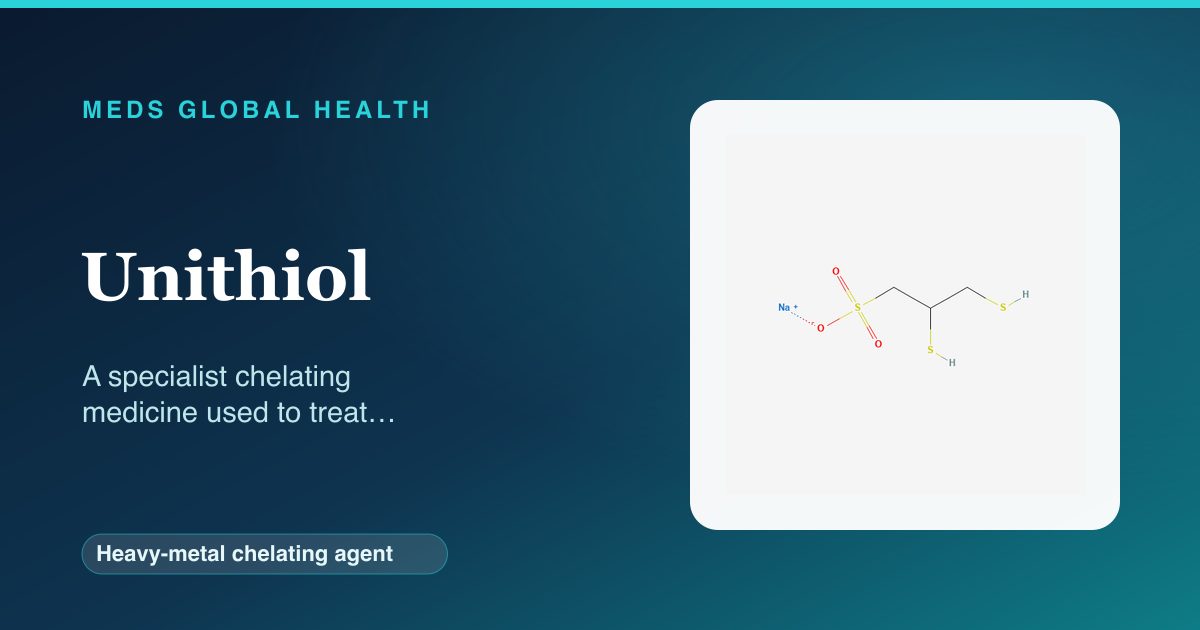
Heavy metals such as mercury and arsenic are toxic because they bind to important parts of the body's cells and stop them working properly. Unithiol contains chemical groups that latch onto these metals, forming a stable, water-soluble package. The metal, now bound to the medicine, can then be carried in the blood and removed from the body, mainly through the urine. By steadily pulling the metal out, it lowers the harmful levels and reduces the damage they cause. It is given over a course guided by how much metal is present and how the person responds.
Company & origin
A specialist medicine used in the UK and elsewhere to treat poisoning with heavy metals such as mercury, arsenic and lead, by binding the metal so it can be removed.
Practical use
How to take Unithiol
General, dose-free guidance — always follow your prescriber's and the leaflet's specific instructions.
- Take it by mouth, or have it given by injection, exactly as your specialist or poisons service directs.
- Drink plenty of fluid if advised, as the bound metal is removed mainly through the urine.
- Tell the team straight away about any rash, itching or other signs of an allergic reaction.
- If it is given by injection, expect it to be given slowly and with monitoring, as it can cause temporary dizziness or blood-pressure changes.
- Make sure the source of the exposure is identified and removed, as part of the overall treatment.
Weighing it up
Advantages & disadvantages of Unithiol
Advantages
- Effectively binds heavy metals such as mercury and arsenic so the body can remove them.
- Generally well tolerated compared with some other chelating medicines.
- Can be given by mouth or by injection, depending on the situation.
Disadvantages
- Can cause hypersensitivity or skin reactions in some people.
- When given by injection, can cause temporary dizziness or changes in blood pressure.
- Needs specialist or poisons-service guidance to use safely and correctly.
Practical use
Good to know
Unithiol is generally well tolerated, which is one of its advantages compared with some older chelating medicines. The main things to watch for are hypersensitivity or skin reactions, such as rash or itching, and, particularly when it is given by injection, temporary dizziness or changes in blood pressure, so it is often given slowly and with monitoring. Because it removes metals through the urine, drinking enough fluid is usually encouraged. It is important that treatment is guided by a specialist or poisons service, because the diagnosis needs confirming, the source of exposure needs removing, and the type and length of chelation should be tailored to the metal involved and the person's kidney function. Other useful minerals can also be removed alongside the harmful metal, so this may be monitored.
Who should not take it / use with caution
- People who have had a serious allergic reaction to unithiol should not use it.
- It is used with care in people with kidney problems, as the bound metal is removed through the urine.
- It should only be used under specialist or poisons-service guidance, with the diagnosis confirmed.
Monitoring
- Checking levels of the heavy metal and how they respond to treatment.
- Watching for allergic or skin reactions and, with injection, blood pressure.
- Reviewing kidney function and levels of useful minerals during treatment.
Side effects
- Hypersensitivity or skin reactions, such as rash or itching.
- Temporary dizziness or changes in blood pressure, particularly with injection.
- Occasionally, nausea or a loss of useful minerals, which may be monitored.
Key interactions
- Tell your team about all your medicines and any mineral supplements you take.
- Because it can remove useful minerals as well as harmful metals, these may need checking and replacing.
- It is used as part of poisons-service-led care, alongside removing the source of exposure.
Available as: Capsules taken by mouth, and a solution for injection.
Answers
Unithiol: frequently asked questions
What is unithiol used for?
It is used to treat poisoning with heavy metals such as mercury, arsenic and sometimes lead, by binding the metal so the body can remove it, mainly in the urine.
Is unithiol the same as DMPS?
Yes, unithiol is also called DMPS; they are two names for the same chelating medicine.
How is it given?
It can be taken by mouth as a capsule or given by injection, depending on the situation, as directed by a specialist or poisons service.
Is it well tolerated?
It is generally well tolerated; the main things to watch for are allergic or skin reactions and, with injection, temporary dizziness or blood-pressure changes.
Why does it need specialist guidance?
The diagnosis must be confirmed, the source of exposure removed, and the type and length of treatment tailored to the metal and the person, so a specialist or poisons service guides it.
Authoritative sources
- BNF
- NICE CKS
Building a medicines information resource?
We create evidence-led, dose-free drug and formulary references for teams.