An into-the-vein alpha-blocker for very high blood pressure
Urapidil
A medicine given into a vein in hospital to bring down dangerously high blood pressure under close monitoring.
What is Urapidil?
Urapidil is a specialist alpha-blocker given into a vein in hospital to lower dangerously high blood pressure quickly, such as in a hypertensive emergency or to control blood pressure around surgery. It works by relaxing and widening blood vessels so blood pressure falls, and it is used only under close monitoring. The main risk is that blood pressure can drop too far or too fast, causing dizziness, faintness or low blood pressure, which is why it is given carefully with constant monitoring of blood pressure. It is a hospital-only medicine, not something taken at home.
Education and reference only. This is a plain-language guide to Urapidil — it deliberately contains no doses. Doses depend on the person, the brand and the reason for treatment, and belong with your prescriber. Always check the BNF, the product labelling (SmPC) and follow medical advice.
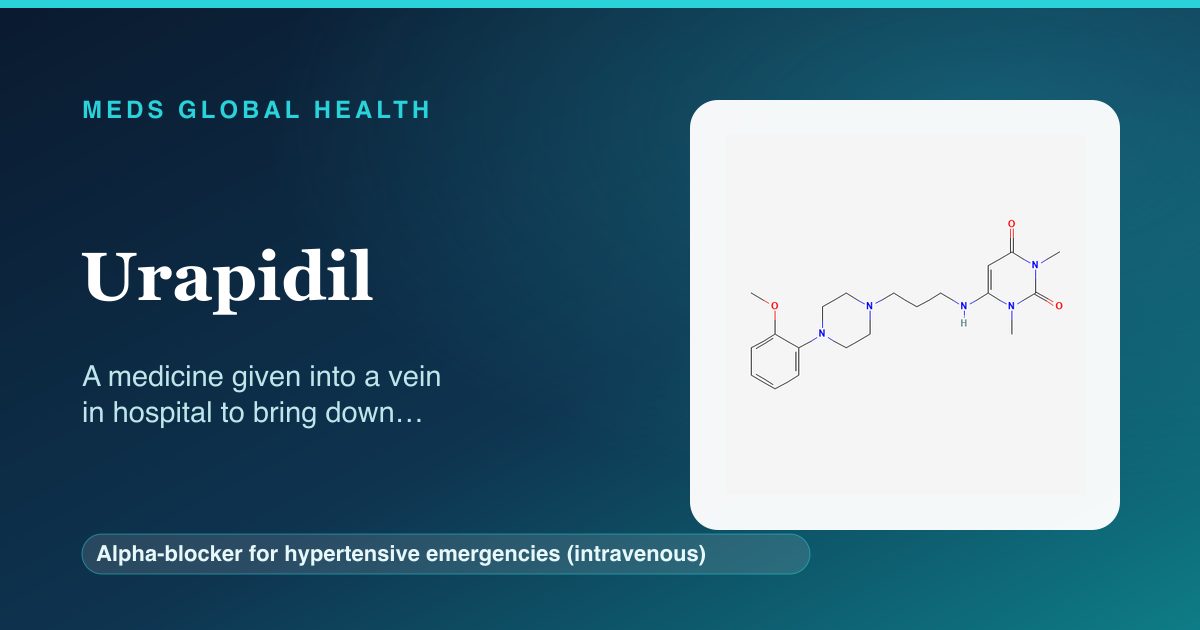
What it is
Urapidil is a specialist blood-pressure-lowering medicine of the alpha-blocker type, given into a vein in hospital. It is used when blood pressure is dangerously high and needs to be brought down in a controlled way, for example in a hypertensive emergency, or to manage blood pressure during and after some operations. It acts quickly and its effect can be adjusted, which is why it is used in closely supervised settings rather than at home. It is given and monitored by hospital staff, who watch blood pressure carefully throughout treatment.
How it works
Urapidil mainly works by blocking alpha-receptors on blood vessels, which lets the vessels relax and widen, so the resistance to blood flow falls and blood pressure comes down. It also has an effect within the brain that helps keep the heart rate from racing as the pressure drops. Because it acts quickly and can be adjusted, hospital staff can lower blood pressure in a controlled way and ease off if it falls too far. This need for careful adjustment and constant blood-pressure monitoring is why it is given into a vein in a supervised hospital setting.
Company & origin
A specialist medicine given into a vein in hospital in the UK to bring down dangerously high blood pressure quickly under close monitoring.
Practical use
How to take Urapidil
General, dose-free guidance — always follow your prescriber's and the leaflet's specific instructions.
- It is given into a vein by hospital staff, who control the rate and adjust it as needed.
- Expect continuous blood-pressure monitoring throughout treatment.
- Rest or stay lying down as advised, since blood pressure can drop and cause dizziness or faintness.
- Tell staff straight away if you feel dizzy, faint, weak or unwell during treatment.
- It is a hospital-only medicine and is not taken or managed at home.
Weighing it up
Advantages & disadvantages of Urapidil
Advantages
- Lowers dangerously high blood pressure quickly in a controlled, adjustable way.
- Useful in hypertensive emergencies and for managing blood pressure around surgery.
- Its effect can be eased off if blood pressure falls too far, under monitoring.
Disadvantages
- Can lower blood pressure too far or too fast, causing dizziness, faintness or low blood pressure.
- Must be given into a vein in hospital with continuous monitoring.
- Is not a treatment people can take or manage at home.
Practical use
Good to know
The most important point with urapidil is that it lowers blood pressure quickly and powerfully, so the main risk is that blood pressure can drop too far or too fast. This can cause dizziness, light-headedness, faintness, a feeling of weakness or, if severe, a dangerous fall in blood pressure, which is exactly why it is given in hospital with continuous monitoring of blood pressure so the rate can be adjusted. It is a hospital-only treatment given into a vein, not a medicine you take or manage yourself. Because of the risk of a sudden drop in blood pressure, people are usually kept lying down or resting during and shortly after treatment. The hospital team decides how fast and how far to bring the blood pressure down, aiming for a controlled, steady reduction rather than a sudden crash.
Who should not take it / use with caution
- People who have had a serious allergic reaction to urapidil should not be given it.
- It is used with great care, or avoided, in people with certain heart conditions such as some narrowed heart valves.
- It is only given in hospital under close blood-pressure monitoring by trained staff.
Monitoring
- Continuous monitoring of blood pressure throughout treatment.
- Watching for signs of blood pressure dropping too far, such as dizziness or faintness.
- Adjusting the rate to achieve a controlled, steady reduction in blood pressure.
Side effects
- A drop in blood pressure, with dizziness, light-headedness or faintness.
- Headache, palpitations, nausea or a feeling of restlessness.
- Less commonly, a more pronounced fall in blood pressure that needs the rate to be reduced.
Key interactions
- Other blood-pressure-lowering medicines can add to its effect and cause a larger drop in blood pressure.
- Alcohol and some other medicines may increase the risk of low blood pressure, so the team takes a full medicines history.
- The hospital team reviews all current medicines before and during treatment.
Available as: A solution given into a vein in hospital.
Answers
Urapidil: frequently asked questions
What is urapidil used for?
It is given into a vein in hospital to bring down dangerously high blood pressure quickly, such as in a hypertensive emergency or to control blood pressure around surgery.
Why is it only given in hospital?
It lowers blood pressure quickly and powerfully and needs continuous monitoring so staff can adjust the rate, which is why it is given into a vein under supervision rather than at home.
What is the main risk?
The main risk is that blood pressure can drop too far or too fast, causing dizziness, faintness or low blood pressure, which is why it is closely monitored.
Why am I asked to stay lying down?
Because your blood pressure can fall during treatment and make you feel dizzy or faint, resting or lying down helps keep you safe.
Can I take urapidil at home?
No. It is a hospital-only medicine given into a vein with constant monitoring; it is not something you take or manage yourself.
Authoritative sources
- BNF
- NICE CKS
Building a medicines information resource?
We create evidence-led, dose-free drug and formulary references for teams.