A once-daily capsule for tardive dyskinesia
Valbenazine
A once-daily capsule used to reduce the involuntary movements of tardive dyskinesia.
What is Valbenazine?
Valbenazine is a specialist medicine used to reduce the involuntary, uncontrolled movements of tardive dyskinesia, a condition of repetitive movements (often of the face and mouth) that can develop after taking some other medicines. It is taken by mouth, usually once a day, and works on a system in the brain that handles certain chemical messengers. The most important safety message is that it can cause or worsen depression and suicidal thoughts, so any low mood or such thoughts must be reported urgently. It can also cause drowsiness, slowed and stiff movements (parkinsonism) and, less commonly, affect the heart's rhythm (the QT interval). It controls the movements rather than curing the underlying problem.
Education and reference only. This is a plain-language guide to Valbenazine — it deliberately contains no doses. Doses depend on the person, the brand and the reason for treatment, and belong with your prescriber. Always check the BNF, the product labelling (SmPC) and follow medical advice.
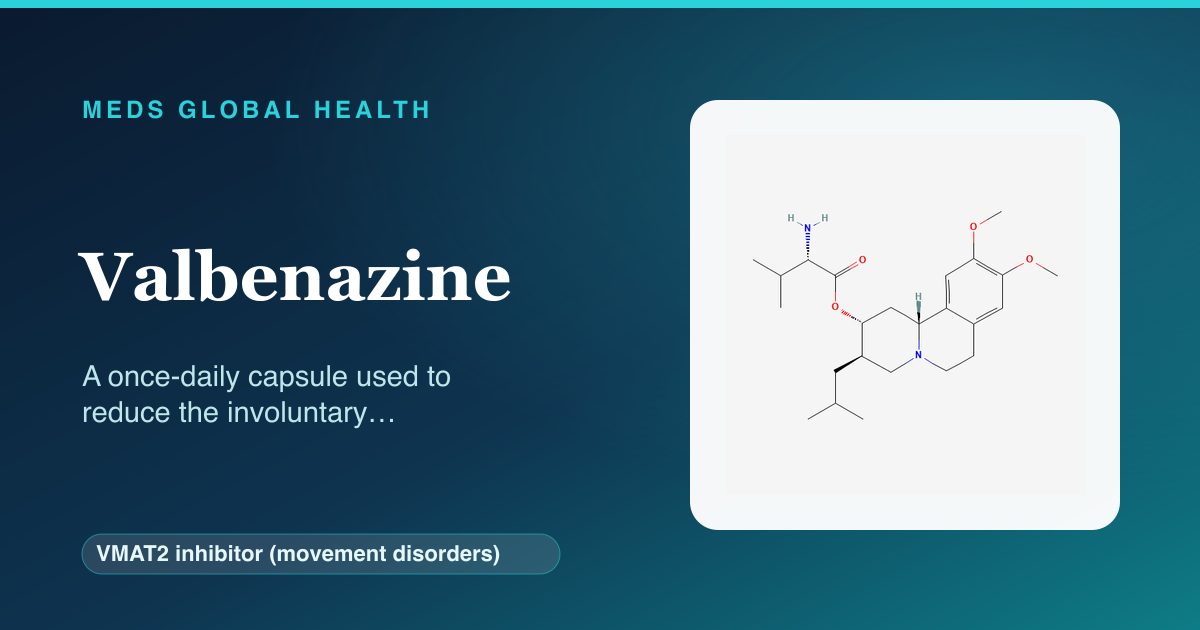
What it is
Valbenazine is a medicine used to control the involuntary movements of tardive dyskinesia, a condition of repetitive, uncontrolled movements (often affecting the face, mouth and tongue) that can develop after taking certain other medicines, particularly some used for mental-health conditions. It is taken by mouth as a once-daily capsule, which some people find convenient. It is closely related in how it works to other medicines used for these movements. It is a specialist medicine that needs careful supervision, especially because of its effects on mood, and is prescribed and reviewed by a specialist team.
How it works
Valbenazine works on a transporter in the brain called VMAT2, which is involved in packaging certain chemical messengers, including dopamine. By reducing the action of this transporter, it lowers how much of these messengers is released, which helps dampen down the excessive, involuntary movements of tardive dyskinesia. Because it changes the balance of these brain chemicals, it can also affect mood, alertness and movement more generally, which is why it needs careful use and monitoring. It controls the movements rather than altering the underlying cause.
Company & origin
A specialist oral medicine used to treat the involuntary movements of tardive dyskinesia.
Practical use
How to take Valbenazine
General, dose-free guidance — always follow your prescriber's and the leaflet's specific instructions.
- Take it by mouth as your specialist team directs, usually once a day.
- Seek help urgently if you notice low mood, hopelessness or any thoughts of harming yourself.
- Tell your team if you feel very drowsy, or develop slowed, stiff or shaky movements.
- Do not stop it suddenly without advice, and tell your prescriber about any heart-rhythm problems.
- Give a full list of your other medicines, as several can interact with valbenazine.
Weighing it up
Advantages & disadvantages of Valbenazine
Advantages
- Can reduce the involuntary movements of tardive dyskinesia, which can be distressing.
- Taken by mouth, usually as a once-daily capsule, which suits many people.
- A targeted option for movements that are otherwise hard to control.
Disadvantages
- Can cause or worsen depression and suicidal thoughts, so mood must be watched closely.
- Can cause drowsiness and parkinsonism (slowed, stiff movements), and may affect the heart's rhythm.
- Controls the movements but does not cure the underlying problem, and needs careful supervision.
Practical use
Good to know
The most important thing to understand about valbenazine is its effect on mood: it can cause or worsen depression and suicidal thoughts, so you, your family and your team should watch closely for any low mood, hopelessness or thoughts of self-harm, and seek help urgently if they occur. This is especially important because many people taking it have underlying mental-health conditions. Other key effects to know about are drowsiness and sleepiness, slowed, stiff or shaky movements like those of Parkinson's disease (parkinsonism), and, less commonly, an effect on the heart's electrical rhythm (the QT interval), which the team may check. It is usually taken once a day and controls movements rather than curing the condition, with the dose adjusted by the specialist team to balance benefit against side effects.
Who should not take it / use with caution
- It should be used with great caution, or avoided, in people who are actively suicidal or have untreated or poorly controlled depression.
- It is used with care in people with significant liver problems and where the heart's rhythm is a concern.
- It should not be combined with certain other medicines, including some used for depression (such as MAOIs) and similar movement-disorder medicines, under specialist guidance.
Monitoring
- Watching closely for depression, mood changes and suicidal thoughts.
- Reviewing for parkinsonism, drowsiness and how well movements are controlled.
- Checking the heart's rhythm where appropriate and reviewing other medicines for interactions.
Side effects
- Depression, low mood and, importantly, suicidal thoughts, which must be reported urgently.
- Drowsiness, tiredness and sleepiness.
- Slowed, stiff or shaky movements like those of Parkinson's disease (parkinsonism).
- Less commonly, changes in the heart's rhythm (the QT interval) and restlessness.
Key interactions
- It must not be combined with certain antidepressants called MAOIs, and is used carefully with other medicines affecting mood.
- Medicines that affect the heart's QT interval should be reviewed when taking it.
- Some medicines change valbenazine's levels in the body, and sedating medicines or alcohol can add to its effects, so a full medicines list is important.
Available as: Capsules taken by mouth.
Answers
Valbenazine: frequently asked questions
What is valbenazine used for?
It is used to reduce the involuntary movements of tardive dyskinesia, a condition of repetitive movements that can develop after taking some other medicines.
What is the most important safety concern?
It can cause or worsen depression and suicidal thoughts, so any low mood or such thoughts must be reported and acted on urgently.
How often is it taken?
It is usually taken by mouth once a day, which many people find convenient, as directed by your specialist team.
Can it make me sleepy or stiff?
Yes, it can cause drowsiness and slowed, stiff movements (parkinsonism); tell your team if these are troublesome so the dose can be reviewed.
Will it cure tardive dyskinesia?
No. It controls the unwanted movements but does not cure the underlying problem, so it is used under careful specialist supervision.
Authoritative sources
- BNF
- NICE CKS
Building a medicines information resource?
We create evidence-led, dose-free drug and formulary references for teams.