Also called antidiuretic hormone (ADH); a hospital medicine
Vasopressin
A hospital hormone medicine, given into a vein, used mainly to help support dangerously low blood pressure in critically ill patients.
What is Vasopressin?
Vasopressin, also called antidiuretic hormone (ADH), is a natural hormone that the body uses to control water balance and to tighten blood vessels. As a medicine, given into a vein in hospital, it is used mainly to help support blood pressure in critically ill patients, such as those with severe infection (sepsis), often alongside other drugs. It works by narrowing blood vessels and by helping the kidneys hold on to water. It is a powerful, closely monitored medicine used in intensive care and other specialist settings, where blood pressure, fluid balance and sodium are watched carefully.
Education and reference only. This is a plain-language guide to Vasopressin — it deliberately contains no doses. Doses depend on the person, the brand and the reason for treatment, and belong with your prescriber. Always check the BNF, the product labelling (SmPC) and follow medical advice.
What it is
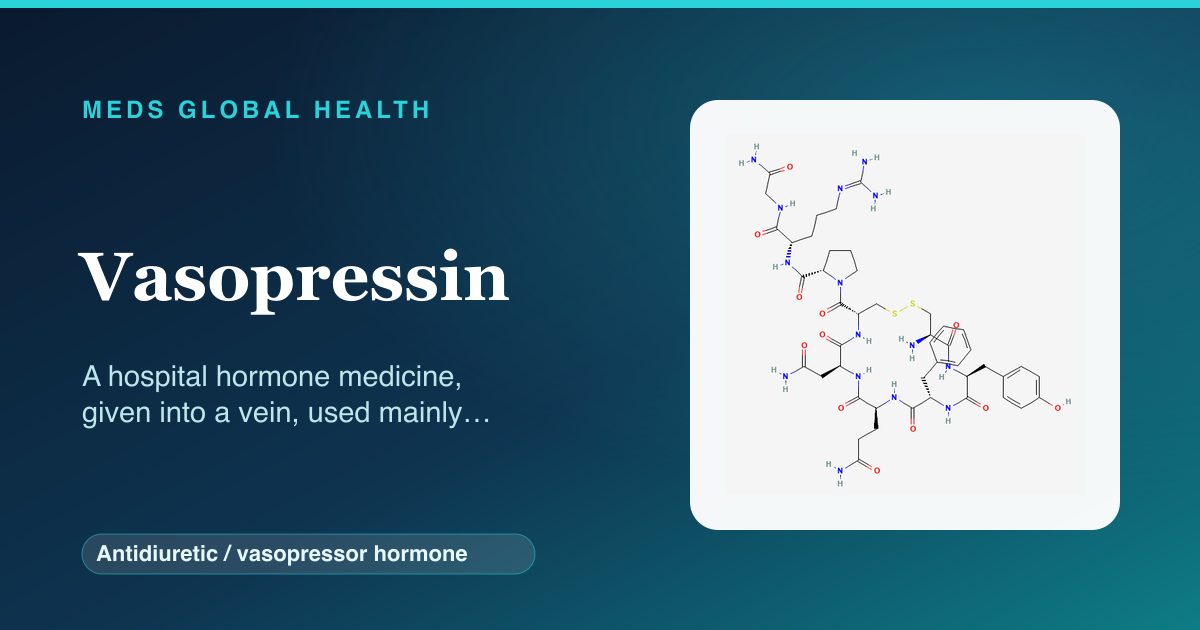
Vasopressin is a hormone the body makes naturally, also known as antidiuretic hormone or ADH, which helps control how much water the kidneys keep and helps tighten blood vessels. As a medicine it is given as an infusion into a vein, almost always in hospital, most often to help raise dangerously low blood pressure in critically ill patients, such as those with sepsis, usually in addition to other blood-pressure-supporting drugs. It has some other specialist uses too. It is a powerful treatment used under close monitoring in intensive care or similar settings, not something used at home.
How it works
Vasopressin works in two main ways. It acts on blood vessels to make them narrower, which raises blood pressure, and it acts on the kidneys to make them hold on to water, which is its antidiuretic effect. In critically ill patients whose blood pressure is dangerously low despite other treatments, the vessel-tightening action helps restore a safer blood pressure. Because it is so powerful and affects both blood pressure and water balance, it is given as a carefully controlled infusion with continuous monitoring, and the rate is adjusted to the patient's response.
Company & origin
A hospital medicine, given into a vein, used to support blood pressure in very ill patients and in some other specialist situations.
Practical use
How to take Vasopressin
General, dose-free guidance — always follow your prescriber's and the leaflet's specific instructions.
- It is given in hospital as a controlled infusion into a vein, not taken at home.
- It is given through a secure line, as leakage can damage the surrounding tissue.
- Blood pressure, heart rate and circulation are watched continuously while it is running.
- Sodium and fluid balance are checked, as it can make the body hold on to water.
- The infusion rate is adjusted by the specialist team according to the patient's response.
Weighing it up
Advantages & disadvantages of Vasopressin
Advantages
- Can help raise dangerously low blood pressure in critically ill patients.
- Works alongside other blood-pressure-supporting drugs in intensive care.
- Acts both on blood vessels and on the kidneys' handling of water.
Disadvantages
- Powerful effects that need continuous monitoring in hospital.
- Can reduce blood flow to the fingers, toes, gut or heart if too much is used.
- Can lower blood sodium and affect fluid balance, needing careful management.
Practical use
Good to know
Vasopressin is a potent hospital medicine, so the most important things to know are about how closely it is watched rather than how to take it yourself. Because it tightens blood vessels strongly, it can reduce blood flow to the fingers, toes, gut or heart if too much is used, so the team monitors the patient very carefully and adjusts the infusion. Because it also makes the kidneys hold on to water, it can lower the blood sodium, so sodium and fluid balance are checked; as with other treatments that affect sodium, any change has to be managed carefully to avoid correcting things too quickly. It is given into a vein, ideally through a secure line, because leakage can damage tissue. It is always used by specialist teams in intensive care or similar settings, who balance its strong effects against the patient's needs.
Who should not take it / use with caution
- People who have had a serious allergic reaction to vasopressin should not have it.
- It is used with great caution in people with certain heart or blood-vessel disease, under specialist judgement.
- It is given only by specialist teams who can monitor and manage its strong effects.
Monitoring
- Continuous monitoring of blood pressure, heart rate and circulation.
- Regular blood tests for sodium and checks of fluid balance.
- Watching for reduced blood flow to the fingers, toes, gut or heart.
Side effects
- Reduced blood flow causing pale or cold fingers and toes, or tummy upset.
- Changes in blood pressure, heart rhythm or chest symptoms.
- Low blood sodium and fluid retention, which monitoring is designed to catch.
Key interactions
- It can interact with other medicines that affect blood pressure or fluid and sodium balance.
- The intensive-care team reviews all the patient's medicines alongside it.
- Its effects are balanced against other blood-pressure-supporting drugs being used at the same time.
Available as: A solution given as a controlled infusion into a vein, in hospital.
Answers
Vasopressin: frequently asked questions
What is vasopressin used for?
As a medicine it is given in hospital, mainly to help support dangerously low blood pressure in critically ill patients, such as those with severe infection.
Is it the same as ADH?
Yes, vasopressin is also called antidiuretic hormone, or ADH; they are names for the same hormone, which the body uses to control water balance.
How does it work?
It tightens blood vessels, which raises blood pressure, and it makes the kidneys hold on to water, which is its antidiuretic effect.
Why is it only used in hospital?
It is very powerful and affects both blood pressure and water balance, so it needs continuous monitoring through a secure drip in a setting such as intensive care.
What is watched for during treatment?
The team watches blood pressure, circulation to the fingers, toes and gut, and checks sodium and fluid balance, adjusting the infusion as needed.
Authoritative sources
- BNF
- NICE CKS
Building a medicines information resource?
We create evidence-led, dose-free drug and formulary references for teams.