An into-the-vein medicine to restore normal heart rhythm in recent atrial fibrillation
Vernakalant
A medicine given into a vein in hospital to help return a recently started irregular heart rhythm (atrial fibrillation) to normal.
What is Vernakalant?
Vernakalant is a specialist antiarrhythmic medicine given into a vein in hospital to convert recent-onset atrial fibrillation, an irregular and often fast heart rhythm, back to a normal rhythm. It works on the heart's electrical activity to help restore a regular beat. The dominant safety concern is that it can cause a sudden drop in blood pressure and serious disturbances of the heart rhythm, so it is given only with continuous heart and blood-pressure monitoring and there must be facilities to treat such problems. It is not suitable for several heart conditions, such as very low blood pressure, severe heart failure, recent heart attack or certain valve and rhythm problems.
Education and reference only. This is a plain-language guide to Vernakalant — it deliberately contains no doses. Doses depend on the person, the brand and the reason for treatment, and belong with your prescriber. Always check the BNF, the product labelling (SmPC) and follow medical advice.
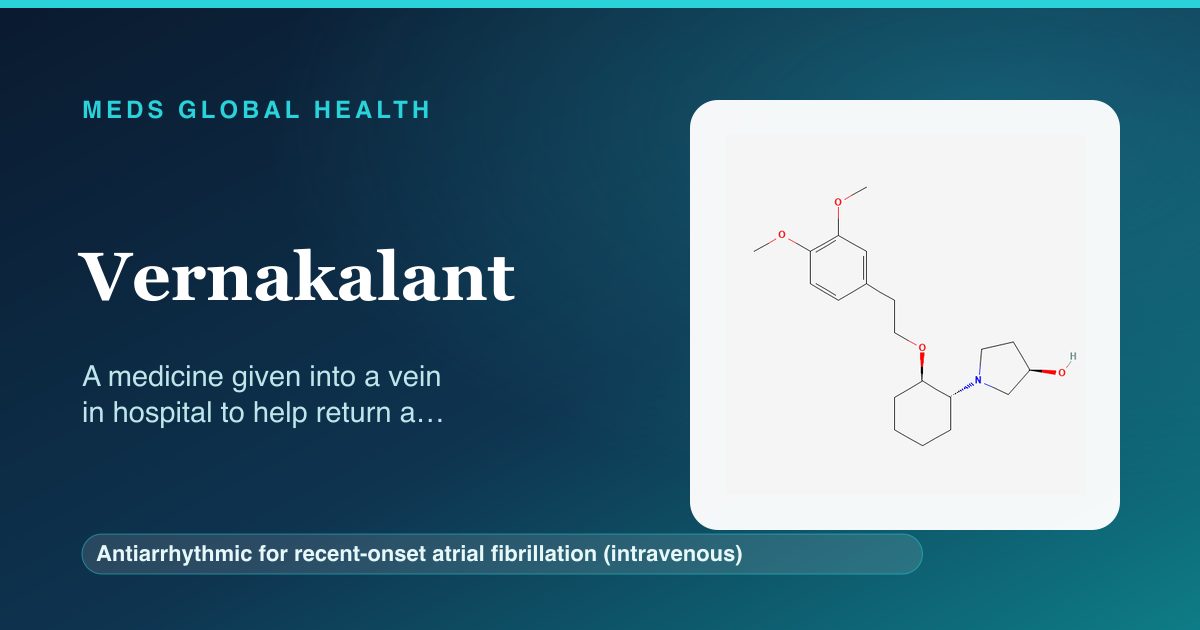
What it is
Vernakalant is a specialist medicine used to treat atrial fibrillation, an irregular and often fast heart rhythm that comes from the upper chambers of the heart, when it has started only recently. It is given as an infusion into a vein in hospital to try to convert the heart back to its normal regular rhythm. It is used in carefully selected people, under continuous monitoring, and is not a long-term medicine taken at home. It is given and supervised by hospital staff who watch the heart rhythm and blood pressure closely throughout and afterwards.
How it works
In atrial fibrillation the upper chambers of the heart beat in a fast, disorganised way because of abnormal electrical signals. Vernakalant acts mainly on the electrical channels in the heart's upper chambers, helping to interrupt the chaotic signals so a normal, regular rhythm can take over. Because it changes the heart's electrical activity, it can also affect blood pressure and occasionally trigger other rhythm problems, which is why it is given slowly into a vein with constant monitoring. It is used to convert a recently started episode, not to keep the rhythm normal over the long term.
Company & origin
A specialist medicine given into a vein in hospital in the UK to convert recent-onset atrial fibrillation back to a normal heart rhythm under close monitoring.
What it treats
Conditions Vernakalant is used for
Practical use
How to take Vernakalant
General, dose-free guidance — always follow your prescriber's and the leaflet's specific instructions.
- It is given as an infusion into a vein by hospital staff, who control the rate closely.
- Expect continuous heart-tracing (ECG) and blood-pressure monitoring during and after treatment.
- Tell staff straight away if you feel dizzy, faint, breathless or notice palpitations during treatment.
- The team will check your heart history first, as it is not suitable for several heart conditions.
- It is a hospital-only treatment and is not taken or managed at home.
Weighing it up
Advantages & disadvantages of Vernakalant
Advantages
- Can quickly return recent-onset atrial fibrillation to a normal rhythm in suitable people.
- Given as a short hospital infusion rather than a long-term medicine.
- Acts mainly on the upper chambers of the heart where this type of atrial fibrillation arises.
Disadvantages
- Can cause a sudden drop in blood pressure and serious disturbances of the heart rhythm.
- Can only be given in hospital with continuous heart and blood-pressure monitoring.
- Is unsuitable for several heart conditions and only for recently started atrial fibrillation.
Practical use
Good to know
The dominant safety point with vernakalant is that, while it is working on the heart's electrical activity, it can cause a sudden drop in blood pressure and can trigger serious disturbances of the heart rhythm, so it is given only in hospital with continuous heart-tracing (ECG) and blood-pressure monitoring, and where equipment and staff are ready to treat any rhythm or blood-pressure problem at once. It is only used for atrial fibrillation that has started recently, and it is not suitable for people with several heart conditions, including very low blood pressure, severe or recent heart failure, a recent heart attack, severely narrowed heart valves or certain existing rhythm abnormalities. The hospital team checks carefully that it is appropriate before giving it and keeps watching the heart for a period afterwards. It is not a tablet or a home treatment.
Who should not take it / use with caution
- People with very low blood pressure, severe or recent heart failure, or a recent heart attack should not be given it.
- People with severely narrowed heart valves or certain existing serious rhythm abnormalities should not be given it.
- People who have had a serious allergic reaction to vernakalant should not be given it, and it is used only under close monitoring.
Monitoring
- Continuous heart-tracing (ECG) and blood-pressure monitoring during and after treatment.
- Watching for a sudden drop in blood pressure or new rhythm disturbances.
- Checking the person remains stable for a period after the infusion.
Side effects
- A drop in blood pressure, with dizziness or faintness.
- Serious disturbances of the heart rhythm, which is why continuous monitoring is essential.
- An altered sense of taste, sneezing, tingling or nausea soon after it is given.
Key interactions
- Other antiarrhythmic and heart-rhythm medicines can add to its effects, so the team reviews them carefully.
- Medicines that lower blood pressure may increase the risk of a sudden drop in blood pressure.
- The hospital team takes a full medicines and heart history before deciding whether to use it.
Available as: A solution given as an infusion into a vein in hospital.
Answers
Vernakalant: frequently asked questions
What is vernakalant used for?
It is given into a vein in hospital to convert recent-onset atrial fibrillation, an irregular and often fast heart rhythm, back to a normal rhythm.
Why is it only used in hospital?
It can cause a sudden drop in blood pressure and serious rhythm disturbances, so it is given only with continuous heart and blood-pressure monitoring and ready access to treatment.
Can anyone with atrial fibrillation have it?
No. It is only for recently started atrial fibrillation and is not suitable for several heart conditions, such as very low blood pressure, severe heart failure or a recent heart attack.
What should I tell staff during treatment?
Tell staff straight away if you feel dizzy, faint, breathless or notice palpitations, as the team is monitoring your heart and blood pressure throughout.
Is it a long-term medicine?
No. It is used as a short hospital infusion to convert a recent episode, not to keep the rhythm normal over the long term.
Authoritative sources
- BNF
- NICE CKS
Building a medicines information resource?
We create evidence-led, dose-free drug and formulary references for teams.