A medicine for sickle cell disease that raises haemoglobin's oxygen affinity
Voxelotor
A medicine used in sickle cell disease that aims to stop red blood cells sickling by changing how haemoglobin holds oxygen.
What is Voxelotor?
Voxelotor is a specialist medicine for sickle cell disease, an inherited condition in which red blood cells change into a stiff, sickle shape and break down, causing anaemia and painful episodes. It works by binding to haemoglobin and increasing how tightly it holds on to oxygen, which helps stop the red cells changing shape and breaking down, raising the haemoglobin level. It is taken by mouth. Importantly, it has been the subject of a recent safety review, and its manufacturer withdrew it from some markets over concerns about its overall benefit and risks, so its availability and use should be checked with a specialist team.
Education and reference only. This is a plain-language guide to Voxelotor — it deliberately contains no doses. Doses depend on the person, the brand and the reason for treatment, and belong with your prescriber. Always check the BNF, the product labelling (SmPC) and follow medical advice.
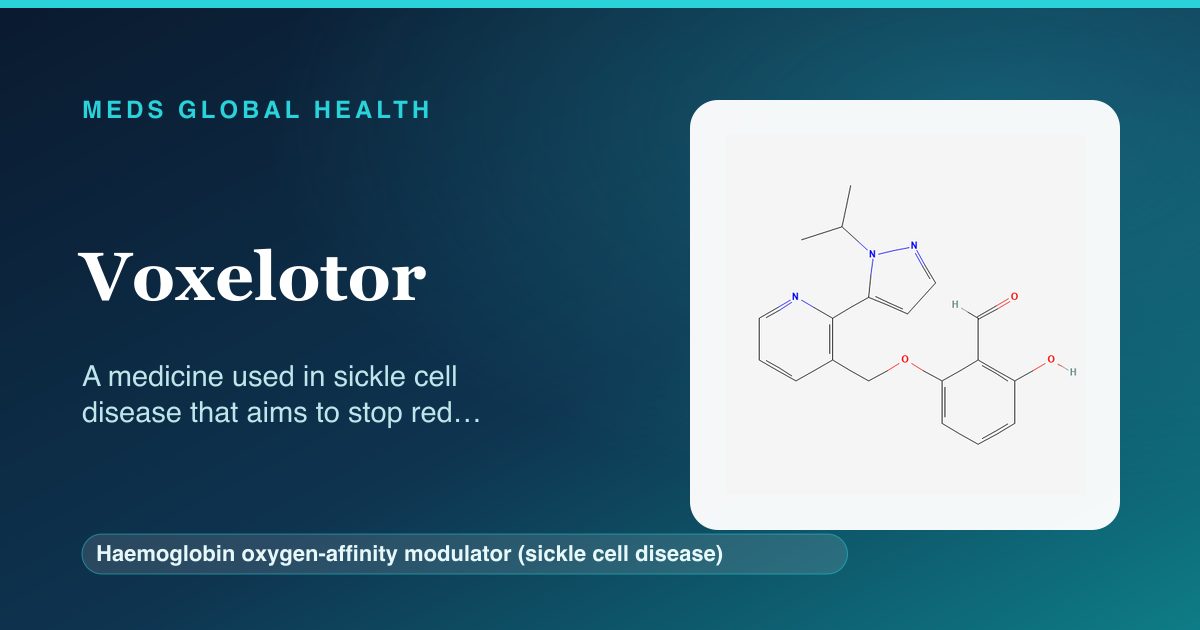
What it is
Voxelotor is a specialist medicine developed for sickle cell disease, an inherited blood condition in which an abnormal form of haemoglobin makes red blood cells change into a stiff, sickle shape. These cells break down more easily (causing anaemia) and can block small blood vessels (causing painful crises and organ damage). Voxelotor is taken by mouth and aims to reduce the sickling. It is important to know that voxelotor has been the subject of a recent safety review, and the manufacturer withdrew it from some markets, so whether it is available and appropriate must be discussed with a specialist sickle cell service.
How it works
In sickle cell disease, the abnormal haemoglobin tends to stick together and distort red blood cells into a sickle shape when it gives up its oxygen. Voxelotor binds to haemoglobin and increases its affinity for oxygen, meaning it holds on to oxygen more tightly. Because the haemoglobin stays in its oxygen-bound state for longer, it is less likely to clump and distort the cell, so fewer red cells sickle and break down, which raises the haemoglobin level. However, holding oxygen more tightly is also part of why its overall benefit has been questioned in the recent safety review, since the goal in sickle cell care is healthy, well-functioning blood overall, not just a higher haemoglobin number.
Company & origin
A specialist medicine used in sickle cell disease that has been the subject of a recent safety review and withdrawal in some regions.
Practical use
How to take Voxelotor
General, dose-free guidance — always follow your prescriber's and the leaflet's specific instructions.
- Take it by mouth as directed by your specialist, if it is still available and prescribed to you.
- Do not start or stop it on your own; check with your specialist sickle cell team for up-to-date advice.
- Be aware that it has been the subject of a recent safety review and withdrawn in some regions.
- Keep up with the rest of your sickle cell care, such as hydration, infection prevention and other treatments.
- Report any new or worsening symptoms to your specialist team promptly.
Weighing it up
Advantages & disadvantages of Voxelotor
Advantages
- Aims to reduce sickling of red blood cells by changing how haemoglobin holds oxygen.
- Can raise the haemoglobin level in people with sickle cell disease.
- Taken by mouth rather than by injection or transfusion.
Disadvantages
- Has been the subject of a recent safety review and withdrawn from some markets over benefit-versus-risk concerns.
- A higher haemoglobin number does not necessarily mean better oxygen delivery, which is part of the concern.
- Its availability and suitability must be checked with a specialist team.
Practical use
Good to know
The most important point about voxelotor is its status: it has been the subject of a recent safety review, and the manufacturer withdrew it from some markets because of concerns that its overall risks may outweigh its benefits, so its current availability and suitability must be checked with a specialist team rather than assumed. The way it works is by making haemoglobin hold on to oxygen more tightly, which raises the haemoglobin number, but a higher number on its own does not necessarily mean the blood is delivering oxygen better, which is part of why it has been re-examined. It is taken by mouth. Anyone who has been taking voxelotor should not stop suddenly on their own but should contact their specialist sickle cell team for up-to-date advice on what to do.
Who should not take it / use with caution
- People who have had a serious allergic reaction to voxelotor should not take it.
- Because of the recent safety review and withdrawal in some regions, its use should only be considered under a specialist sickle cell service with up-to-date advice.
- It is used with care, and under specialist guidance, in pregnancy and breastfeeding.
Monitoring
- Reviewing how the condition is responding and watching for side effects.
- Interpreting haemoglobin results carefully, as the medicine affects them.
- Keeping up to date with safety advice given the recent review and withdrawal in some regions.
Side effects
- Headache, diarrhoea, tummy pain or nausea in some people.
- Rash or tiredness.
- Concerns raised in the recent safety review about overall outcomes, which is why it has been re-examined.
Key interactions
- It can interact with medicines handled by the same liver enzymes, so these may need reviewing.
- Tell your team about all your medicines and supplements.
- Because it changes blood tests for haemoglobin, results should be interpreted with this in mind.
Available as: Tablets taken by mouth; note its availability has been affected by a recent safety withdrawal.
Answers
Voxelotor: frequently asked questions
What is voxelotor used for?
It is a specialist medicine for sickle cell disease that aims to stop red blood cells sickling by making haemoglobin hold on to oxygen more tightly, raising the haemoglobin level.
Is voxelotor still available?
It has been the subject of a recent safety review and was withdrawn from some markets, so you must check its current availability and suitability with your specialist team.
How does it work?
It binds to haemoglobin and increases how tightly it holds oxygen, so the haemoglobin is less likely to clump and distort red cells into a sickle shape.
Should I stop it on my own?
No. Do not stop it suddenly by yourself; contact your specialist sickle cell team for up-to-date advice on what to do.
Does a higher haemoglobin mean it is working well?
Not necessarily; a higher haemoglobin number does not always mean better oxygen delivery, which is part of why its overall benefit has been re-examined.
Authoritative sources
- BNF
- NICE CKS
Building a medicines information resource?
We create evidence-led, dose-free drug and formulary references for teams.