A copper-absorption blocker for Wilson's disease
Zinc acetate
A medicine used as maintenance treatment in Wilson's disease, which stops the gut absorbing copper from food.
What is Zinc acetate?
Zinc acetate is a specialist medicine used as a maintenance treatment in Wilson's disease, an inherited condition where copper builds up in the body and causes damage. It works by stopping the gut from absorbing copper in food, so less copper enters the body. It is taken on an empty stomach, away from food, and is a lifelong treatment that needs regular monitoring. The most common problem is stomach upset, especially when treatment is first started.
Education and reference only. This is a plain-language guide to Zinc acetate — it deliberately contains no doses. Doses depend on the person, the brand and the reason for treatment, and belong with your prescriber. Always check the BNF, the product labelling (SmPC) and follow medical advice.
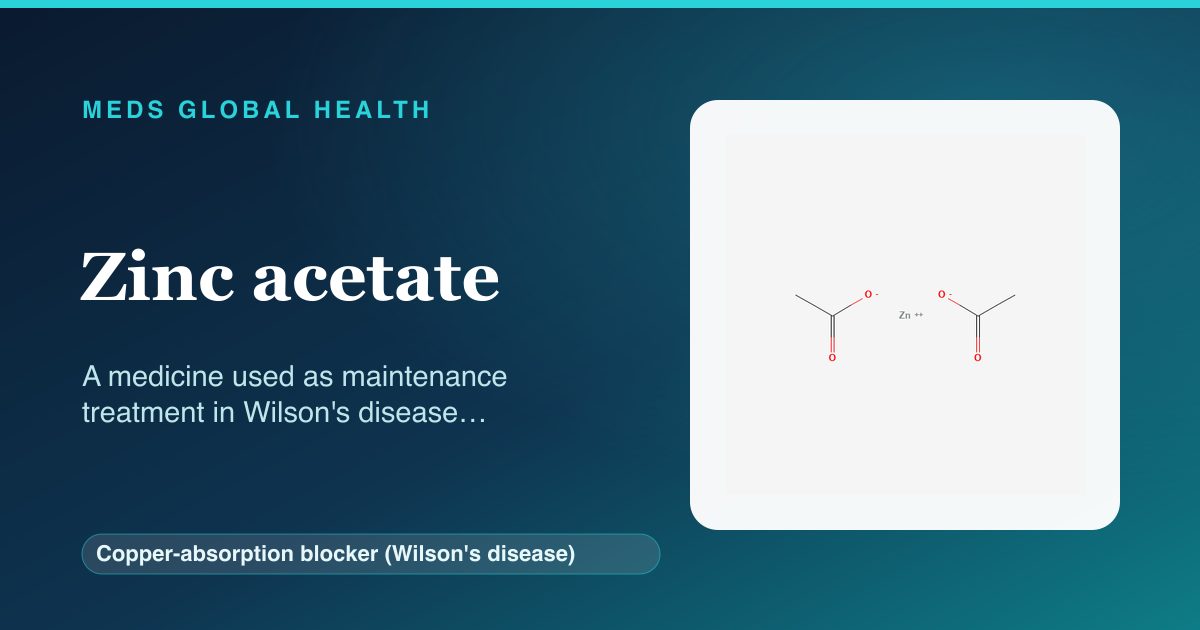
What it is
Zinc acetate is a medicine used to keep copper under control in Wilson's disease, a rare inherited condition in which copper builds up and damages the liver, brain and other organs. Unlike copper-chelating medicines, which pull copper out of the body, zinc acetate works in the gut to stop dietary copper being absorbed in the first place. It is mainly used as a maintenance treatment, often after copper has first been brought down by another medicine. It is taken by mouth as capsules, usually for life, under specialist care.
How it works
Zinc acetate prompts cells lining the gut to make a protein that traps copper from food. The trapped copper stays in the gut lining and is then lost when those cells are shed, so it never reaches the bloodstream. Over time this keeps the body's copper at a safe level. Because it works on the copper you eat rather than removing copper already stored, it is mostly used for maintenance once levels are controlled, and it needs to be taken consistently to keep working.
Company & origin
A specialist medicine used in the UK as maintenance treatment in Wilson's disease, working by blocking the gut from absorbing copper.
Practical use
How to take Zinc acetate
General, dose-free guidance — always follow your prescriber's and the leaflet's specific instructions.
- Take it on an empty stomach, away from food, usually spaced out across the day as advised.
- Leave time between zinc acetate and meals so that food and dietary copper do not reduce how well it works.
- Swallow the capsules whole with water; if stomach upset is a problem, your specialist may suggest taking it with a little food.
- Do not stop taking it without specialist advice, as copper can build up again.
- Follow the low-copper diet you are given, avoiding foods such as liver, shellfish, nuts and chocolate.
Weighing it up
Advantages & disadvantages of Zinc acetate
Advantages
- An effective maintenance treatment that keeps copper under control by blocking its absorption.
- Generally well tolerated over the long term once any early stomach upset settles.
- Works on the copper in food, offering a different approach to copper-removing medicines.
Disadvantages
- Must be taken on an empty stomach, away from food, which takes planning around meals.
- Can cause stomach upset, especially when treatment is first started.
- Mainly suits maintenance rather than quickly lowering high copper that is already stored.
Practical use
Good to know
Zinc acetate is a lifelong maintenance treatment, so taking it regularly is important; stopping it can let copper build up again. It must be taken on an empty stomach, away from food, because food (and copper in food) reduces how well it works, which can make timing around meals a little awkward. The most common side effect is stomach upset, particularly when treatment first starts, and taking it with a small amount of food may be suggested if this is troublesome, even though that is not ideal for absorption. A low-copper diet, avoiding foods such as liver, shellfish, nuts and chocolate, is usually advised alongside it. Regular blood and urine tests are used to check copper control and to make sure zinc is doing its job.
Who should not take it / use with caution
- People who have had a serious allergic reaction to zinc should not take it.
- It is used with care, and with monitoring, in pregnancy under specialist guidance.
- It should only be used under specialist supervision, with regular copper monitoring.
Monitoring
- Regular blood and urine tests to check copper control and zinc levels.
- Reviewing liver function and symptoms over time.
- Watching for signs of too much copper removal, such as anaemia, with long-term use.
Side effects
- Stomach upset, nausea or irritation, especially early in treatment.
- Occasionally, changes in blood tests linked to copper or other minerals.
- Rarely, over a long time, signs of too much copper removal such as anaemia.
Key interactions
- Food and dietary copper reduce how well zinc acetate works, so it is taken away from meals.
- It can reduce the absorption of some antibiotics, such as tetracyclines and quinolones, so separate the timing.
- Iron and other mineral supplements may need careful spacing, guided by the specialist team.
Available as: Capsules taken by mouth.
Answers
Zinc acetate: frequently asked questions
What is zinc acetate used for?
It is used as a maintenance treatment in Wilson's disease, stopping the gut from absorbing copper in food so that less copper builds up in the body.
How is it different from trientine or penicillamine?
Those medicines pull copper out of the body, while zinc acetate works in the gut to block copper from food being absorbed, which is why it mainly suits maintenance.
Why must I take it away from food?
Food, and the copper in food, reduces how well zinc acetate works, so it is taken on an empty stomach for the best effect.
What if it upsets my stomach?
Stomach upset is common early on; your specialist may suggest taking it with a small amount of food if needed, even though an empty stomach is preferred.
Can I stop it if I feel well?
No. Wilson's disease needs lifelong treatment, and stopping can let copper build up again, so only change it on specialist advice.
Authoritative sources
- BNF
- NICE CKS
Building a medicines information resource?
We create evidence-led, dose-free drug and formulary references for teams.