A triptan migraine medicine
Zolmitriptan
A triptan taken at the start of a migraine attack to ease the headache and the sickness, light and sound sensitivity that come with it.
What is Zolmitriptan?
Zolmitriptan is a triptan medicine used to treat migraine attacks once the headache has started. It eases the throbbing pain along with nausea and sensitivity to light and sound, and is taken as soon as the headache begins rather than to prevent attacks. It is not a painkiller for everyday headaches and should only be used for migraine.
Education and reference only. This is a plain-language guide to Zolmitriptan — it deliberately contains no doses. Doses depend on the person, the brand and the reason for treatment, and belong with your prescriber. Always check the BNF, the product labelling (SmPC) and follow medical advice.
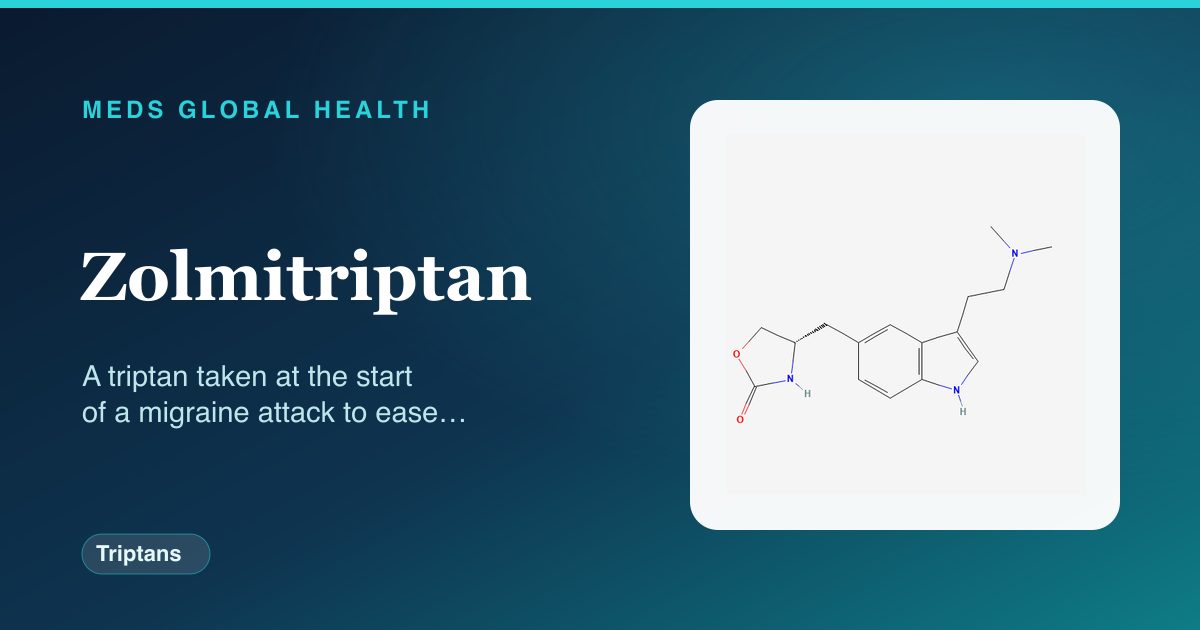
What it is
Zolmitriptan is one of several triptans used in the UK to treat migraine attacks. It is a 'specific' migraine treatment, meaning it targets the processes behind a migraine rather than acting as a general painkiller. It is taken when a migraine headache has already begun, and it can relieve not just the pain but also the nausea and the dislike of light and sound that often come with it. It comes as ordinary tablets, melt-in-the-mouth tablets and a nasal spray, which can be useful when sickness makes swallowing difficult. It is for treating attacks, not for preventing them.
How it works
During a migraine, blood vessels around the brain widen and nerves release chemicals that cause pain and inflammation. Zolmitriptan acts on serotonin (5-HT) receptors, helping to narrow these widened vessels and calm the release of those pain-signalling chemicals. This settles the migraine process and brings the attack to an end more quickly than waiting it out. Because it acts on the underlying mechanism, it works best when taken early in the headache.
Company & origin
Originated / developed by: AstraZeneca.
Developed by Zeneca (later AstraZeneca) in the UK and introduced in the late 1990s as one of the second-generation triptans designed to act on the brain as well as in the blood vessels.
What it treats
Conditions Zolmitriptan is used for
Practical use
How to take Zolmitriptan
General, dose-free guidance — always follow your prescriber's and the leaflet's specific instructions.
- Take it at the very start of the migraine headache, not during the aura and not to prevent an attack.
- Swallow ordinary tablets with water; melt tablets dissolve on the tongue without water and suit you if you feel sick.
- If the migraine eases and then comes back, you may take a further dose after the recommended interval — but do not go over the daily maximum.
- If the first dose does not help the attack at all, do not take a second dose for the same attack; treat the next attack as usual.
- Do not take it within 24 hours of another triptan or any ergotamine-type medicine.
- Try to keep triptan use to a limited number of days each month to avoid medication-overuse headache.
Weighing it up
Advantages & disadvantages of Zolmitriptan
Advantages
- Treats both the pain and the associated nausea, light and sound sensitivity of a migraine.
- Available as melt tablets and a nasal spray, useful when sickness makes swallowing hard.
- Acts on the migraine process itself, so it is more effective for migraine than ordinary painkillers.
- Can be repeated within an attack if the migraine returns, within daily limits.
Disadvantages
- Only treats attacks once started — it does not prevent migraines or work during the aura phase.
- Can cause chest or throat tightness and tingling, which is unsettling even when harmless.
- Not suitable for people with heart disease or uncontrolled high blood pressure.
- Overuse can lead to rebound medication-overuse headache.
Practical use
Good to know
Timing matters: zolmitriptan works best taken as soon as the migraine headache starts, not during the warning aura beforehand and not as a daily preventer. If the first dose helps but the migraine returns later, a repeat dose may be taken after the recommended gap, but the daily maximum should not be exceeded. The melt tablets and nasal spray suit people whose migraines bring on vomiting. Using any triptan or simple painkiller on too many days a month can cause 'medication-overuse headache', a rebound headache that needs the medicine to be cut back.
Who should not take it / use with caution
- People with heart disease, angina, a previous heart attack or stroke, or narrowed blood vessels.
- People with uncontrolled or markedly raised high blood pressure.
- Anyone who has taken another triptan or an ergotamine within the past 24 hours.
- People taking, or recently taking, certain antidepressants of the MAOI type — check with a pharmacist or prescriber.
- Tell your prescriber if you are pregnant, planning pregnancy or breastfeeding, as triptans are generally avoided or used with caution then.
Monitoring
- Blood pressure and heart-health risk should be reviewed before triptans are started.
- Keep track of how many days a month any migraine medicine is used to spot overuse early.
- Report chest tightness, a very fast heartbeat or any new neurological symptoms.
Side effects
- Tingling, warmth, heaviness or pressure in the chest, throat, neck, arms or jaw — usually short-lived but should be reported if severe.
- Drowsiness, dizziness, dry mouth or a feeling of weakness.
- Nausea, although it also helps the nausea of the migraine itself.
- Rarely, serotonin syndrome (agitation, sweating, shivering, fast heartbeat) when combined with certain antidepressants — seek urgent advice.
Key interactions
- Other triptans and ergotamine-type migraine medicines — do not combine or use within 24 hours of each other.
- SSRI and SNRI antidepressants raise the small risk of serotonin syndrome.
- MAOI antidepressants — zolmitriptan is generally avoided around their use.
- Tell a pharmacist about all other medicines, including those bought over the counter.
Available as: Ordinary tablets, melt-in-the-mouth (orodispersible) tablets and a nasal spray.
Answers
Zolmitriptan: frequently asked questions
When should I take zolmitriptan?
Take it as soon as the migraine headache begins. It does not help if taken during the aura (visual or sensory warning) before the pain, and it is not used as a daily preventer.
Can I take it if the migraine comes back later the same day?
Yes — if the attack eases and then returns, you can usually take another dose after the recommended gap, as long as you stay within the daily maximum. If the first dose did nothing at all, do not repeat it for that attack.
Why do I feel tightness in my chest after taking it?
A brief feeling of tightness or pressure in the chest or throat is a known triptan effect and is usually harmless. However, if it is severe, lasts a long time, or you have heart concerns, stop and seek medical advice.
Can I use zolmitriptan with my antidepressant?
Often yes, but some antidepressants (SSRIs, SNRIs and especially MAOIs) can interact, so always check with your pharmacist or prescriber first.
Can taking it too often make my headaches worse?
Yes. Using triptans or painkillers on too many days each month can cause medication-overuse (rebound) headache. If you are reaching for migraine treatment frequently, ask about preventive options.
The wider class
About Triptans
Zolmitriptan belongs to the triptans class. For how the class as a whole works, its shared safety principles and monitoring, see the full guide.
Browse by body system
Authoritative sources
- BNF
- NICE CKS
Building a medicines information resource?
We create evidence-led, dose-free drug and formulary references for teams.