An inhaled steroid (preventer)
Budesonide
An inhaled steroid "preventer" for asthma and COPD, used regularly to calm airway inflammation; rinse your mouth after using it.
What is Budesonide?
Budesonide is an inhaled corticosteroid, a preventer, used regularly to control asthma and, in combination, COPD. Rather than relieving symptoms in the moment, it calms inflammation in the airways over time to prevent flare-ups.
Education and reference only. This is a plain-language guide to Budesonide — it deliberately contains no doses. Doses depend on the person, the brand and the reason for treatment, and belong with your prescriber. Always check the BNF, the product labelling (SmPC) and follow medical advice.
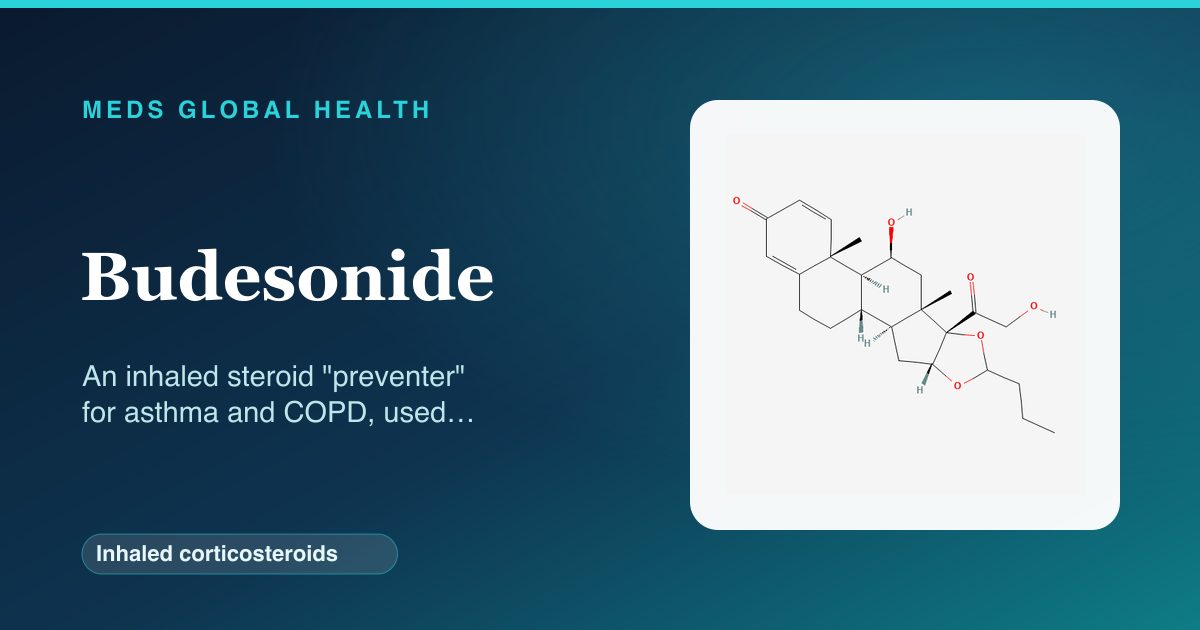
What it is
Budesonide is an inhaled corticosteroid — a "preventer" — used regularly to control asthma and, in combination, COPD. Rather than relieving symptoms in the moment, it works steadily in the background to reduce the inflammation and swelling inside the airways that make them twitchy and prone to flare-ups. It is taken every day, even when breathing feels fine, and is available as a single-ingredient inhaler and very commonly as a combination inhaler with the long-acting bronchodilator formoterol. Budesonide is also made in quite separate forms (such as capsules or foam) for bowel conditions like Crohn's disease and colitis — those are different products from the inhaler. In the UK and US the active ingredient is the same; familiar brands include Pulmicort and the combination inhaler Symbicort.
How it works
In asthma, the lining of the airways becomes inflamed, swollen and over-sensitive, so the airways narrow easily in response to triggers. Budesonide is a steroid that, delivered straight to the lungs by inhaler, calms this inflammation — reducing swelling, mucus and twitchiness over time. As the airways become less inflamed, they are less likely to tighten, so symptoms settle and flare-ups become less frequent. Because it acts on inflammation rather than relaxing the airway muscle, it builds its effect gradually and must be used regularly; it does not give instant relief of a sudden attack.
Company & origin
Originated / developed by: Bofors Nobel-Pharma / Astra AB (Draco).
Budesonide was developed in Sweden by researchers Arne Thalén and Ralph Brattsand (originating at Bofors Nobel-Pharma, later part of Astra AB/Draco), patented in the early 1970s, and launched as the inhaled corticosteroid Pulmicort in 1982.
What it treats
Conditions Budesonide is used for
Practical use
How to take Budesonide
General, dose-free guidance — always follow your prescriber's and the leaflet's specific instructions.
- Use budesonide every day as a preventer, even when you feel well, as it works by steadily reducing airway inflammation.
- It is not a reliever, so keep using your fast-acting inhaler for sudden breathlessness.
- Rinse your mouth with water and spit it out after each dose to lower the risk of a sore mouth or oral thrush.
- Learn and check your inhaler technique with your nurse or pharmacist so the medicine reaches your lungs.
- Do not stop it suddenly when you feel better; speak to your asthma team before making changes.
Weighing it up
Advantages & disadvantages of Budesonide
Advantages
- Effective preventer that reduces asthma attacks and improves long-term control.
- Acts locally in the airways, with limited effects on the rest of the body at usual inhaled use.
- Available alone and in combination inhalers for convenience.
- A cornerstone of asthma and COPD maintenance treatment.
Disadvantages
- Does not relieve sudden symptoms, so a separate reliever is still needed.
- Can cause oral thrush or a hoarse voice if the mouth is not rinsed after use.
- Needs to be taken regularly to work, which requires good adherence.
- Relies on correct inhaler technique to be effective.
Practical use
Good to know
The most important point is that it is a preventer: it must be used every day, even when you feel completely well, because its job is to keep inflammation down and stop attacks before they start. Rinsing your mouth (and spitting out) after each use helps prevent a hoarse voice and oral thrush. Good inhaler technique makes a big difference, and a spacer can help with some inhalers. At inhaled doses, effects on the rest of the body are much smaller than with steroid tablets, but very high long-term use can have wider effects, so the aim is the lowest dose that keeps control. Some combination inhalers containing budesonide and formoterol can be used both regularly and for relief under a specific plan — follow the plan you have been given.
Who should not take it / use with caution
- It is not a rescue treatment for a sudden attack, and should not be relied on to relieve acute breathlessness.
- Used with care in people with active or untreated airway infections such as tuberculosis, and where there are repeated bouts of oral thrush.
- Care in pregnancy and breastfeeding — keeping asthma well controlled is important — and the overall steroid load is reviewed if other steroids (tablets, creams, nasal sprays) are also used.
Monitoring
- Asthma or COPD control and flare-up frequency
- Inhaler technique; mouth for thrush or hoarseness
- In children, growth; with high long-term use, wider steroid effects
Side effects
- A hoarse or croaky voice and oral thrush (a sore, white-coated mouth) — much reduced by rinsing the mouth after use.
- A dry mouth, throat irritation or cough just after inhaling.
- Very high long-term inhaled use can have wider steroid effects (for example on bones, eyes or, in children, growth, which is monitored); these are uncommon at usual preventer doses.
Key interactions
- Certain medicines (some antifungals and HIV medicines) can raise its levels, increasing the chance of wider steroid effects.
- The overall steroid load adds up if it is used alongside steroid tablets, nasal sprays or creams.
- Generally few important interactions at usual inhaled doses, as little reaches the rest of the body.
Available as: Inhalers (dry-powder and metered-dose), a nebuliser solution, and combination inhalers with a long-acting bronchodilator. Budesonide is also made as separate capsules, granules or foam for bowel conditions — a different product from the inhaler.
Answers
Budesonide: frequently asked questions
Do I still need budesonide when my breathing is fine?
Yes — that is the whole point of a preventer. Budesonide works by keeping airway inflammation down so that attacks do not start, which only continues if you use it every day. Stopping when you feel well lets the inflammation creep back and makes flare-ups more likely.
Why do I need to rinse my mouth after using it?
A little of the inhaled steroid stays in the mouth and throat, where it can cause a hoarse voice or oral thrush (a sore, white-coated mouth). Rinsing with water and spitting it out after each use — and using a spacer where appropriate — washes this away and greatly reduces the chance of these effects.
Is the budesonide inhaler the same as the budesonide my friend takes for Crohn's?
They share the same active ingredient but they are quite different products. The inhaler delivers budesonide to the lungs for asthma or COPD; the Crohn's and colitis versions are capsules, granules or foam designed to act in the gut. They are not interchangeable.
Are inhaled steroids safe to use long-term?
For most people, yes. At usual preventer doses very little reaches the rest of the body, so the wider effects of steroid tablets are largely avoided, and keeping asthma controlled is itself protective. The aim is the lowest dose that keeps you well; very high long-term use is reviewed more closely, and in children growth is monitored.
What is the difference between budesonide, Pulmicort and Symbicort?
They all contain budesonide as the active ingredient. Pulmicort is a brand of the budesonide-only inhaler; Symbicort is a combination inhaler containing budesonide plus the long-acting bronchodilator formoterol. Generic budesonide contains the identical active ingredient.
The wider class
About Inhaled corticosteroids
Budesonide belongs to the inhaled corticosteroids class. For how the class as a whole works, its shared safety principles and monitoring, see the full guide.
Browse by body system
Authoritative sources
- BNF: Budesonide.
- electronic Medicines Compendium (SmPC): Budesonide (Pulmicort, Symbicort).
- NICE CKS: Budesonide inhalers.
Building a medicines information resource?
We create evidence-led, dose-free drug and formulary references for teams.