An inhaled steroid "preventer" (also a nasal spray)
Fluticasone
An inhaled steroid "preventer" that calms airway inflammation in asthma (and some COPD) when used regularly.
What is Fluticasone?
Fluticasone is an inhaled corticosteroid — a preventer inhaler that reduces the inflammation in the airways underlying asthma, and is also used as a nasal spray for allergic rhinitis. It is taken regularly to prevent symptoms rather than to relieve a sudden attack.
Education and reference only. This is a plain-language guide to Fluticasone — it deliberately contains no doses. Doses depend on the person, the brand and the reason for treatment, and belong with your prescriber. Always check the BNF, the product labelling (SmPC) and follow medical advice.
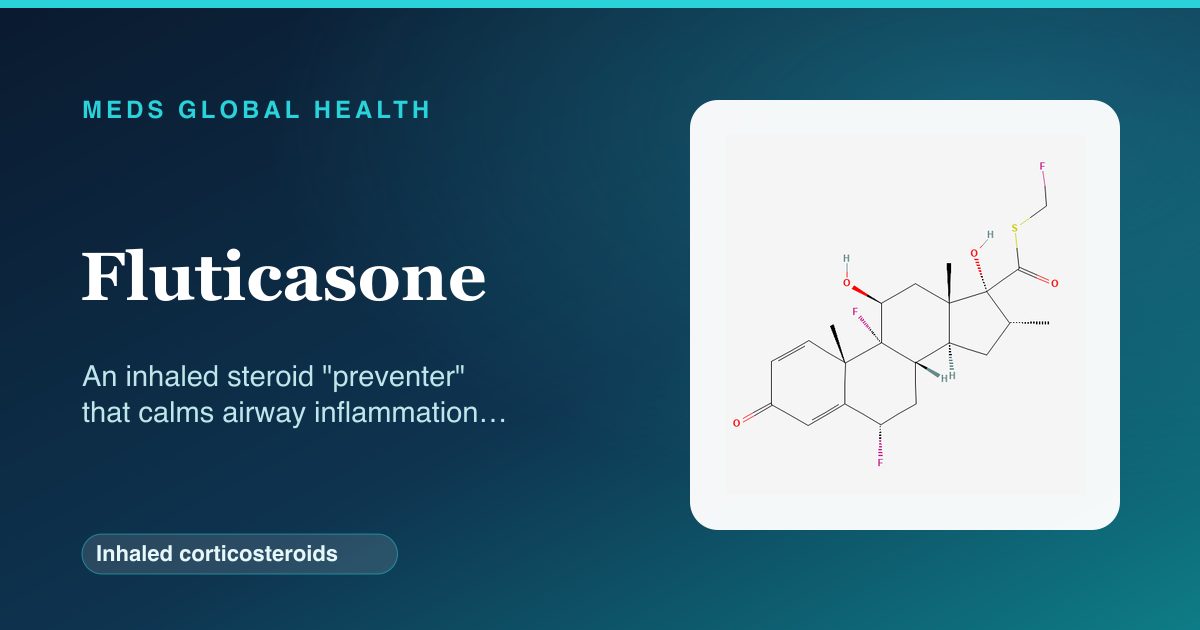
What it is
Fluticasone is an inhaled corticosteroid — a "preventer" inhaler that reduces the inflammation in the airways which underlies asthma, and is also used in some people with COPD (usually as part of a combination inhaler). In the UK the inhaler is widely known as Flixotide, and in the US the same medicine is sold as Flovent. It is taken regularly, every day, even when you feel completely well — its job is to keep the airways calm so that attacks and symptoms happen less often, not to relieve a sudden attack. Fluticasone is also made as a nasal spray for hay fever (brands such as Flonase and Avamys) — a different product from the inhaler.
How it works
Fluticasone is a corticosteroid that damps down the inflammation and swelling in the lining of the airways that makes them twitchy and prone to narrowing. Delivered straight into the lungs by inhaler, it acts where it is needed with very little absorbed into the rest of the body. Over days to weeks of regular use it makes the airways less inflamed and less reactive, so there are fewer symptoms and flare-ups. Because it works in the background, it does nothing for a sudden attack — a separate reliever inhaler is used for that.
Company & origin
Originated / developed by: Glaxo (now GSK).
Fluticasone propionate was discovered and developed by Glaxo in the United Kingdom in the 1980s and first marketed around 1990 as the inhaled corticosteroid Flixotide (Flovent in the US).
What it treats
Conditions Fluticasone is used for
Practical use
How to take Fluticasone
General, dose-free guidance — always follow your prescriber's and the leaflet's specific instructions.
- Use the inhaler every day as prescribed, even when you feel well, because it works by keeping airway inflammation down over time.
- It is a preventer, not a reliever — it will not quickly ease a sudden attack, for which a separate reliever inhaler is used.
- Use the correct inhaler technique, and a spacer if advised, to get the medicine into the lungs.
- Rinse your mouth and spit out after inhaling to reduce the risk of oral thrush and a hoarse voice.
- For the nasal spray, use it regularly and aim slightly away from the central wall of the nose.
- Do not stop it suddenly without advice, and seek help if your asthma control worsens.
Weighing it up
Advantages & disadvantages of Fluticasone
Advantages
- Effectively prevents asthma symptoms and flare-ups when used regularly.
- Acts mainly in the airways with limited whole-body effect.
- Available as a nasal spray as well for allergic rhinitis.
- Reduces reliance on rescue treatment when asthma is well controlled.
Disadvantages
- Can cause oral thrush and a hoarse voice if the mouth is not rinsed.
- Must be used regularly to work and will not relieve a sudden attack.
- Higher long-term use carries some risk of wider steroid effects.
- Requires good inhaler technique to be effective.
Practical use
Good to know
The single most important thing is to use it regularly every day, even when you feel fine — skipping it lets the inflammation, and the risk of an attack, creep back. It is a preventer, not a reliever, so it does not ease a sudden attack; keep your reliever inhaler for that. Rinse your mouth (and spit it out) after each use, and consider using a spacer with an aerosol inhaler — this reduces the small amount that lands in the mouth and throat, lowering the risk of oral thrush and a hoarse voice. Good inhaler technique makes a big difference, so ask to have it checked. The inhaler and the nasal spray versions are separate products for different problems.
Who should not take it / use with caution
- It is not a reliever and must not be relied on to treat a sudden asthma attack.
- Used with care, sometimes at higher amounts, where the risk of effects such as thrush, a hoarse voice or — at high long-term doses — wider steroid effects needs watching.
- People with an active chest infection such as tuberculosis, and children on long-term inhaled steroids (whose growth is occasionally monitored), need particular care.
Monitoring
- Asthma or COPD control, symptoms and flare-ups
- Inhaler technique, and checking the mouth for thrush or a hoarse voice
- In children on long-term inhaled steroids, growth is occasionally monitored
Side effects
- Oral thrush (a sore, white-coated mouth) and a hoarse voice — much reduced by rinsing the mouth after use and using a spacer.
- Sore throat or cough just after inhaling.
- At high long-term doses, wider steroid effects become possible (such as easier bruising, or in children some monitoring of growth); these are uncommon at usual doses.
Key interactions
- Few at usual doses, but certain strong medicines (such as some HIV medicines and antifungals) can raise its levels and the chance of steroid effects.
- It is often combined in a single inhaler with a long-acting bronchodilator — these are designed to work together.
- Tell your prescriber about any other steroids you take (nasal, skin, tablets or eye drops) so the total steroid load can be considered.
Available as: A "preventer" inhaler (a metered-dose aerosol, often used with a spacer, or a dry-powder device). A separate nasal spray version is available for hay fever.
Answers
Fluticasone: frequently asked questions
Do I need to use my fluticasone inhaler even when I feel well?
Yes — that is exactly the point of a preventer. It keeps the inflammation in your airways under control so attacks happen less often, and the benefit only lasts while you use it regularly. If you only use it when you feel wheezy, the inflammation builds back up and your asthma is more likely to flare.
Why should I rinse my mouth after using it?
A small amount of the steroid lands in your mouth and throat, where it can cause oral thrush (a sore, white-coated mouth) or a hoarse voice. Rinsing your mouth and spitting out after each use, and using a spacer with an aerosol inhaler, washes this away and greatly reduces the risk.
Can fluticasone stop a sudden asthma attack?
No. Fluticasone is a preventer that works in the background — it does nothing for a sudden attack. For that you need your reliever inhaler (a separate, usually blue, inhaler). If you are needing your reliever often, tell your asthma team, as it may mean your preventer treatment needs reviewing.
Is the fluticasone nasal spray the same as the inhaler?
They contain the same active ingredient but are different products for different problems — the inhaler delivers it to the lungs for asthma, while the nasal spray (such as Flonase or Avamys) treats nasal allergy like hay fever. They are not interchangeable; use the one prescribed for your condition.
What is the difference between fluticasone, Flixotide and Flovent?
They are the same medicine — fluticasone is the generic (active-ingredient) name, Flixotide is the UK inhaler brand and Flovent is the US brand. The active ingredient is identical; the main difference is the brand name used in each country.
The wider class
About Inhaled corticosteroids
Fluticasone belongs to the inhaled corticosteroids class. For how the class as a whole works, its shared safety principles and monitoring, see the full guide.
Browse by body system
Authoritative sources
- BNF: Fluticasone.
- NICE/BTS/SIGN: Asthma — diagnosis, monitoring and chronic asthma management.
- NICE CKS: Fluticasone inhalers; Steroid inhalers.
Building a medicines information resource?
We create evidence-led, dose-free drug and formulary references for teams.