A fast-acting blood-pressure drip used in hospital
Clevidipine
A fast-acting, short-lived drip used in hospital to lower dangerously high blood pressure.
What is Clevidipine?
Clevidipine is a specialist medicine used in hospital to bring down dangerously high blood pressure quickly. It is a calcium-channel blocker given as a drip into a vein, and it acts fast but wears off quickly, so the dose can be fine-tuned minute by minute under close monitoring. Because it can lower blood pressure sharply and speed up the heartbeat, it is only used where the team can watch blood pressure and heart rate continuously. It is carried in a fatty (lipid) emulsion, so it is avoided in people with egg or soya allergy, and fat levels in the blood are monitored.
Education and reference only. This is a plain-language guide to Clevidipine — it deliberately contains no doses. Doses depend on the person, the brand and the reason for treatment, and belong with your prescriber. Always check the BNF, the product labelling (SmPC) and follow medical advice.
What it is
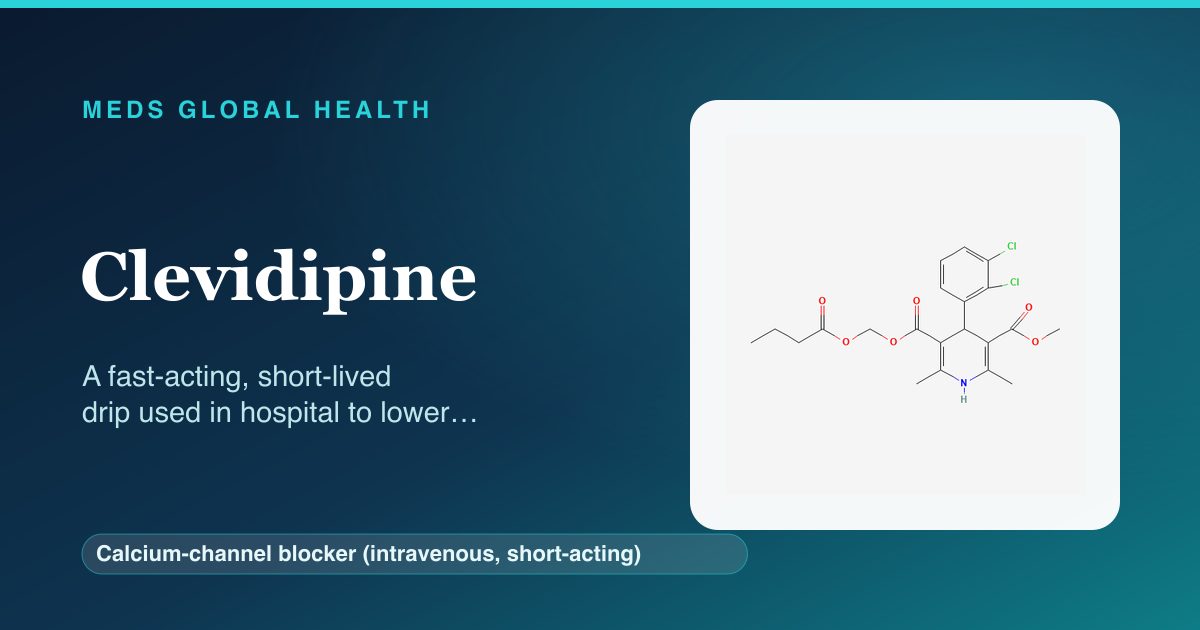
Clevidipine is a calcium-channel blocker used in hospital to treat dangerously high blood pressure when it needs to be lowered quickly and carefully, for example in an emergency or around surgery. It is given as a drip into a vein rather than as a tablet. Its key feature is that it works fast and is also broken down quickly, so its effect can be adjusted from one minute to the next. It is carried in a fatty (lipid) emulsion, similar to some nutrition fluids, which is why egg and soya allergy matter. It is used only in monitored settings such as intensive care or theatres.
How it works
Clevidipine relaxes the muscle in the walls of small arteries by blocking calcium from entering those muscle cells. When these arteries widen, the pressure inside them falls, which lowers blood pressure. Because the body breaks clevidipine down very quickly, its effect appears soon after the drip is started and fades soon after it is slowed or stopped, allowing very precise control. As the blood pressure drops, the heart can beat faster in response (a reflex), which is one reason heart rate is watched alongside blood pressure.
Company & origin
A specialist medicine used in hospital in the UK to bring down dangerously high blood pressure quickly through a drip into a vein.
Practical use
How to take Clevidipine
General, dose-free guidance — always follow your prescriber's and the leaflet's specific instructions.
- It is given only in hospital as a drip into a vein, with blood pressure and heart rate watched continuously.
- Expect the dose to be adjusted frequently, as it acts and wears off quickly.
- Tell the team about any egg or soya allergy before it is used, as it is carried in a fatty emulsion.
- Mention any history of severe fat-handling problems in the blood, as fat levels are monitored.
- It is for short-term use in an emergency or around surgery, not a tablet to take at home.
Weighing it up
Advantages & disadvantages of Clevidipine
Advantages
- Acts quickly to bring down dangerously high blood pressure in an emergency or around surgery.
- Wears off fast, so its effect can be fine-tuned minute by minute.
- Allows precise, closely controlled lowering of blood pressure in a monitored setting.
Disadvantages
- Can lower blood pressure too sharply and may speed up the heartbeat as a reflex.
- Carried in a fatty emulsion, so it cannot be used in people with egg or soya allergy.
- Hospital-only and short-acting, requiring continuous monitoring and a drip into a vein.
Practical use
Good to know
The main thing to understand about clevidipine is that it is a hospital-only drip for lowering dangerously high blood pressure quickly, used where the team can watch blood pressure and heart rate continuously. Its strength is that it acts fast and wears off fast, so the dose is fine-tuned moment to moment; the flip side is that blood pressure can drop too far or the heart can beat faster in response, which is why monitoring is constant. An important practical point is that it is carried in a fatty (lipid) emulsion, so it must not be used in people with egg or soya allergy, and the fat content means triglyceride (blood-fat) levels are watched during longer use. The drip line is handled carefully because the fatty fluid can support germ growth if not managed properly. It is a short-term emergency or peri-operative treatment, not a long-term blood-pressure medicine.
Who should not take it / use with caution
- People allergic to eggs or soya must not be given it, as it is carried in a fatty emulsion containing these.
- People who have had a serious allergic reaction to clevidipine should not be given it.
- It is avoided in people with certain severe problems handling fats in the blood, and used only with continuous monitoring.
Monitoring
- Continuous monitoring of blood pressure and heart rate while the drip runs.
- Watching for blood pressure falling too far or the heart beating too fast.
- Checking blood-fat (triglyceride) levels during longer infusions.
Side effects
- A blood pressure that falls too far, with dizziness or faintness.
- A faster heartbeat as a reflex to the falling blood pressure.
- Headache or nausea.
- With longer use, a rise in fat (triglyceride) levels in the blood, which monitoring is designed to catch.
Key interactions
- Other blood-pressure-lowering medicines can add to its effect, so blood pressure is watched closely.
- Other medicines that affect heart rate may need to be reviewed alongside it.
- The team accounts for the fat content of the drip when other fatty fluids or nutrition are being given.
Available as: A fatty (lipid) emulsion given as a drip into a vein in hospital.
Answers
Clevidipine: frequently asked questions
What is clevidipine used for?
It is used in hospital to bring down dangerously high blood pressure quickly, for example in an emergency or around surgery, given as a drip into a vein.
Why is it given as a drip and not a tablet?
It acts fast and wears off fast, so giving it as a drip lets the team fine-tune the dose minute by minute and lower blood pressure in a controlled way.
Why does egg or soya allergy matter?
Clevidipine is carried in a fatty emulsion that contains egg and soya ingredients, so it must not be used in people allergic to either.
Can my heart beat faster on it?
Yes, as the blood pressure falls the heart can beat faster as a reflex, which is one reason heart rate is monitored alongside blood pressure.
Is it a long-term blood-pressure medicine?
No, it is a short-term hospital treatment for emergencies or around surgery, not a tablet for everyday blood-pressure control at home.
The wider class
About Calcium-channel blocker (intravenous, short-acting)
Clevidipine belongs to the calcium-channel blocker (intravenous, short-acting) class. For how the class as a whole works, its shared safety principles and monitoring, see the full guide.
Browse by body system
Authoritative sources
- BNF
- NICE CKS
Building a medicines information resource?
We create evidence-led, dose-free drug and formulary references for teams.