An H2-receptor antagonist (acid-reducing medicine)
Famotidine
An acid-reducing medicine (H2 blocker) for heartburn, reflux and ulcers; gentler than a PPI and available over the counter.
What is Famotidine?
Famotidine is an H2-receptor antagonist, a medicine that reduces how much acid the stomach makes. It is used for heartburn and acid reflux (GORD) and to help heal and prevent stomach and gut ulcers.
Education and reference only. This is a plain-language guide to Famotidine — it deliberately contains no doses. Doses depend on the person, the brand and the reason for treatment, and belong with your prescriber. Always check the BNF, the product labelling (SmPC) and follow medical advice.
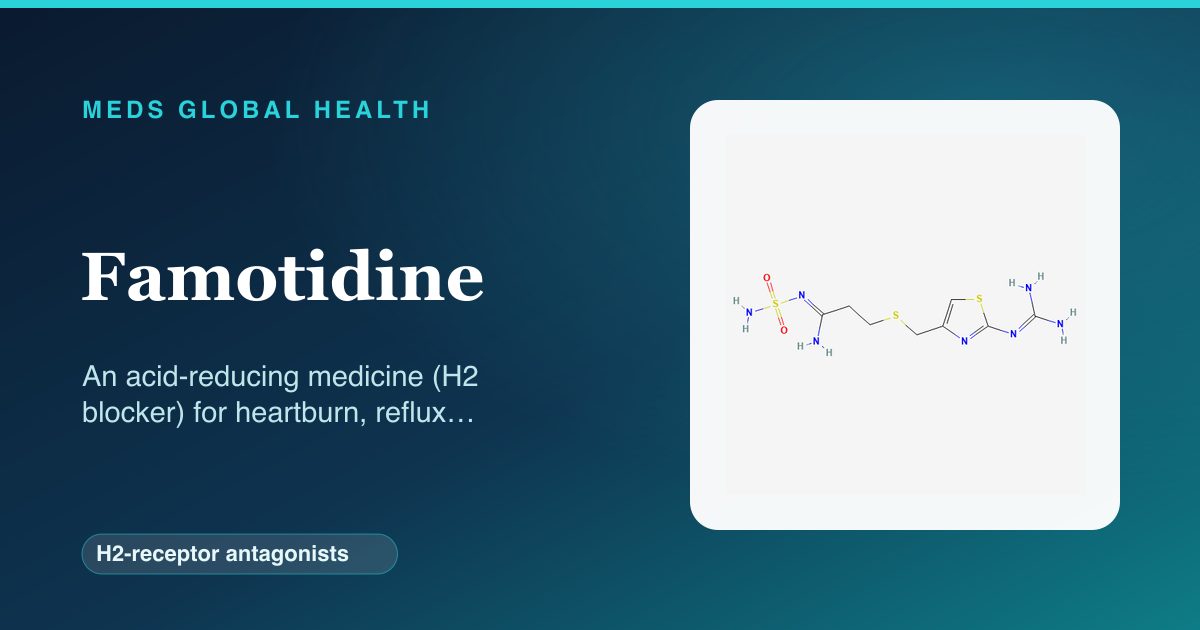
What it is
Famotidine is an H2-receptor antagonist — a medicine that reduces the amount of acid the stomach makes. It is used for heartburn and acid reflux (GORD) and to help treat and prevent stomach and duodenal ulcers. It is less potent than the proton pump inhibitors (PPIs) such as omeprazole, but it is well tolerated and useful for milder symptoms or as an add-on. Famotidine became the go-to H2 blocker after ranitidine was withdrawn, and lower strengths are available to buy over the counter for occasional heartburn.
How it works
The stomach lining has cells that release acid when stimulated by histamine acting on their H2 receptors. Famotidine blocks these H2 receptors, so the cells release less acid. With less acid in the stomach, the burning of heartburn eases and the gut lining is given a calmer environment in which ulcers and inflamed tissue can heal. Because it works on just one of several acid-triggering pathways, it reduces acid less completely than a PPI, which switches off the acid pump itself.
Company & origin
Originated / developed by: Yamanouchi Pharmaceutical (now Astellas).
Famotidine was discovered by Yamanouchi Pharmaceutical of Japan in the early 1980s. The H2-receptor antagonist was first approved in the US in 1986 and marketed (by Merck under licence) as Pepcid.
What it treats
Conditions Famotidine is used for
Practical use
How to take Famotidine
General, dose-free guidance — always follow your prescriber's and the leaflet's specific instructions.
- Take it as advised, with or without food; for night-time symptoms it is often taken in the evening.
- Take it regularly for the time recommended, even if symptoms ease early.
- If using it occasionally for heartburn, it can be taken when symptoms are expected.
- Tell your doctor if symptoms persist, worsen, or you have trouble swallowing or unexplained weight loss.
- Mention any kidney problems, as the amount may need adjusting.
Weighing it up
Advantages & disadvantages of Famotidine
Advantages
- Effectively reduces stomach acid and eases heartburn and reflux.
- Helps stomach and gut ulcers heal.
- Generally well tolerated with few side effects.
- Can be a useful alternative for people who cannot take or do not need a proton pump inhibitor.
Disadvantages
- Usually less powerful at suppressing acid than proton pump inhibitors.
- The body can become less responsive to it over continued use.
- May cause headache, dizziness, constipation or diarrhoea.
- Can mask the symptoms of a more serious stomach problem that needs investigation.
- May need adjusting in people with reduced kidney function.
Practical use
Good to know
It can be taken when symptoms are expected — for example before a meal known to trigger heartburn — or regularly for a set period to allow healing. Lower-strength famotidine can be bought from pharmacies for short-term, occasional heartburn, while higher strengths and ulcer treatment are prescribed. It is generally very well tolerated. It was widely adopted as a safe alternative after ranitidine (Zantac) was removed from the market. If heartburn is frequent, persistent or comes with alarm symptoms such as difficulty swallowing or unexplained weight loss, that needs medical review rather than ongoing self-treatment.
Who should not take it / use with caution
- People with a known sensitivity to famotidine or other H2 blockers.
- Used with care in significant kidney impairment, where a gentler approach is taken.
- Persistent, severe or alarm symptoms (trouble swallowing, vomiting blood, black stools, unexplained weight loss) need assessment before self-treating.
Monitoring
- Symptom response
- Review if symptoms persist or alarm features appear
- Kidney function where relevant
Side effects
- Usually very well tolerated; sometimes headache, dizziness or constipation or diarrhoea.
- Occasional tiredness.
- Rarely, confusion (more likely in older people or with kidney impairment) or a rash.
Key interactions
- By reducing stomach acid it can affect how well some medicines are absorbed — for example certain antifungals and HIV medicines that need acid to dissolve.
- Generally has fewer interactions than the older H2 blocker cimetidine, which interfered with many drugs.
- Tell your pharmacist about other medicines so absorption and timing can be checked.
Available as: Tablets (including lower-strength versions sold over the counter) and a liquid for those who cannot swallow tablets.
Answers
Famotidine: frequently asked questions
Is famotidine as strong as omeprazole?
No — famotidine reduces stomach acid less completely than a proton pump inhibitor (PPI) such as omeprazole, because it blocks only one of the acid-triggering pathways. It is a good choice for milder or occasional symptoms, while a PPI is usually preferred for more severe reflux or for healing ulcers.
Can I buy famotidine without a prescription?
Yes — lower-strength famotidine can be bought from pharmacies for short-term relief of occasional heartburn and indigestion. Higher strengths, and treatment of ulcers, are prescribed. If you need it often or for a long time, see your pharmacist or GP for review.
Is famotidine the replacement for ranitidine (Zantac)?
In practice, yes. Ranitidine was withdrawn from the market over an impurity concern, and famotidine — another H2 blocker that was not affected — became the usual alternative. It works in a very similar way and is well tolerated.
When should I take famotidine?
It can be taken regularly for a set period to allow healing, or taken ahead of a situation you know triggers heartburn, such as a heavy or late meal. Follow the directions on the packet or from your prescriber. If symptoms persist, get it reviewed.
What is the difference between famotidine and Pepcid?
They are the same medicine — famotidine is the generic (active-ingredient) name and Pepcid (and Pepcid AC for the over-the-counter version) is a brand name. The active ingredient is identical.
The wider class
About H2-receptor antagonists
Famotidine belongs to the h2-receptor antagonists class. For how the class as a whole works, its shared safety principles and monitoring, see the full guide.
Browse by body system
Authoritative sources
- BNF: Famotidine.
- NICE CKS: Dyspepsia and GORD.
- NICE CKS: Famotidine.
Building a medicines information resource?
We create evidence-led, dose-free drug and formulary references for teams.