An H2 blocker for acid reflux
Nizatidine
An H2 blocker that reduces stomach acid to ease heartburn, reflux and indigestion.
What is Nizatidine?
Nizatidine is an H2 blocker that reduces the amount of acid the stomach makes, easing heartburn, acid reflux and indigestion. It can be taken at night to help overnight symptoms. It tends to work more gently than a proton pump inhibitor (PPI), so a PPI may be preferred when stronger acid suppression is needed.
Education and reference only. This is a plain-language guide to Nizatidine — it deliberately contains no doses. Doses depend on the person, the brand and the reason for treatment, and belong with your prescriber. Always check the BNF, the product labelling (SmPC) and follow medical advice.
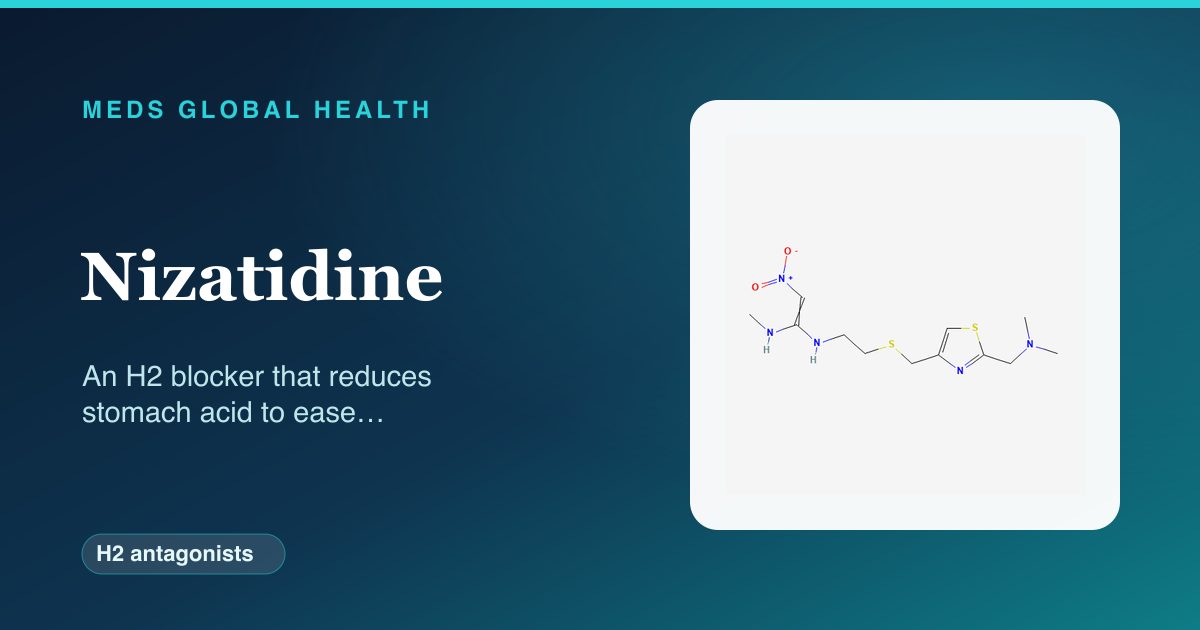
What it is
Nizatidine is an H2-receptor antagonist (often called an H2 blocker), a group of medicines that lower stomach acid. It is used for heartburn, acid reflux (GORD) and indigestion, and to help heal and prevent acid-related ulcers. It is one of the older approaches to reducing acid and is generally milder than the newer proton pump inhibitors.
How it works
Nizatidine blocks histamine H2 receptors on the acid-producing cells in the stomach lining. Histamine is one of the main signals that tells these cells to release acid, so blocking it reduces how much acid is made. With less acid, symptoms such as heartburn ease and the gullet and stomach lining have a chance to heal.
What it treats
Conditions Nizatidine is used for
Practical use
How to take Nizatidine
General, dose-free guidance — always follow your prescriber's and the leaflet's specific instructions.
- Take it as directed; an evening or bedtime dose can help with night-time symptoms.
- Swallow with water, with or without food.
- For occasional symptoms it may be used as needed; for healing it is usually taken regularly for a set period.
- Avoid known triggers such as large, fatty or late meals, and reduce alcohol where it makes symptoms worse.
- See your prescriber if symptoms persist, return quickly, or are accompanied by warning signs.
Weighing it up
Advantages & disadvantages of Nizatidine
Advantages
- Reduces stomach acid to ease heartburn and reflux, often working fairly quickly.
- Can be taken at night to target overnight and early-morning symptoms.
- A useful, generally well-tolerated option for milder acid-related symptoms.
Disadvantages
- Less powerful at suppressing acid than a proton pump inhibitor.
- May be less suitable for more severe reflux or for healing ulcers.
- The body can become less responsive to H2 blockers with continuous use over time.
Practical use
Good to know
Because acid production tends to rise overnight, a dose can be taken in the evening to help night-time and early-morning symptoms. It generally works more gently and a little faster than a PPI but with less powerful acid suppression, so for more troublesome reflux or ulcers a PPI is often chosen instead. Persistent heartburn, difficulty swallowing, unintended weight loss or black stools should always be reviewed rather than just self-treated.
Who should not take it / use with caution
- People who have had a reaction to nizatidine or other H2 blockers.
- Symptoms suggesting something more serious — difficulty swallowing, unintended weight loss, persistent vomiting or black stools — need assessment first.
- Used with a review of the level in people with significant kidney problems.
Monitoring
- Symptom relief and whether stronger treatment is needed
- For any alarm symptoms that need investigation
- Kidney function where relevant
Side effects
- Usually well tolerated; sometimes headache, dizziness, or digestive changes such as constipation or diarrhoea.
- Tiredness.
- Uncommonly, rash or other reactions; tell your prescriber if anything unexpected develops.
Key interactions
- Has fewer drug interactions than some older H2 blockers, but check new medicines with your pharmacist.
- Reducing stomach acid can affect medicines that need acid to be absorbed.
- Tell your prescriber about all your medicines and supplements before starting.
Available as: Capsules; a liquid may be available in some settings.
Answers
Nizatidine: frequently asked questions
Is nizatidine as strong as a PPI like omeprazole?
No. H2 blockers such as nizatidine reduce stomach acid more gently than proton pump inhibitors. They suit milder symptoms, while a PPI is usually preferred for more troublesome reflux or for healing ulcers.
Can I take it at night for heartburn that wakes me up?
Yes. Because acid production tends to rise overnight, an evening or bedtime dose can be helpful for night-time and early-morning symptoms. Follow the timing your prescriber or pharmacist advises.
How quickly does it work?
H2 blockers often ease symptoms reasonably quickly compared with a PPI, which builds up over a few days. For ongoing relief, though, it is usually taken regularly rather than only when symptoms flare.
When should heartburn be checked by a doctor rather than self-treated?
See your prescriber if heartburn is frequent or persistent, or if you have difficulty swallowing, unintended weight loss, persistent vomiting, or black, tarry stools. These warning signs need proper assessment.
Is Axid the same as nizatidine?
Yes. Nizatidine is the active-ingredient (generic) name and Axid is a brand name; they contain the same medicine.
The wider class
About H2 antagonists
Nizatidine belongs to the h2 antagonists class. For how the class as a whole works, its shared safety principles and monitoring, see the full guide.
Browse by body system
Authoritative sources
- BNF: Nizatidine.
- NICE CKS: H2 blockers.
- NICE: Gastro-oesophageal reflux disease.
Building a medicines information resource?
We create evidence-led, dose-free drug and formulary references for teams.