An injectable medicine used in hospital for prolonged or repeated seizures
Fosphenytoin
An injectable medicine used in hospital for prolonged or repeated seizures, which the body turns into phenytoin.
What is Fosphenytoin?
Fosphenytoin is a medicine given by injection in hospital to treat prolonged or repeated seizures (a state called status epilepticus), and to control or prevent seizures when phenytoin tablets cannot be used. It is a prodrug, meaning the body converts it into phenytoin once given. It is given into a vein or a muscle. The main safety points are that, given too quickly into a vein, it can lower blood pressure and disturb the heart's rhythm, so heart monitoring is used, and it can cause skin and tissue reactions around the drip site.
Education and reference only. This is a plain-language guide to Fosphenytoin — it deliberately contains no doses. Doses depend on the person, the brand and the reason for treatment, and belong with your prescriber. Always check the BNF, the product labelling (SmPC) and follow medical advice.
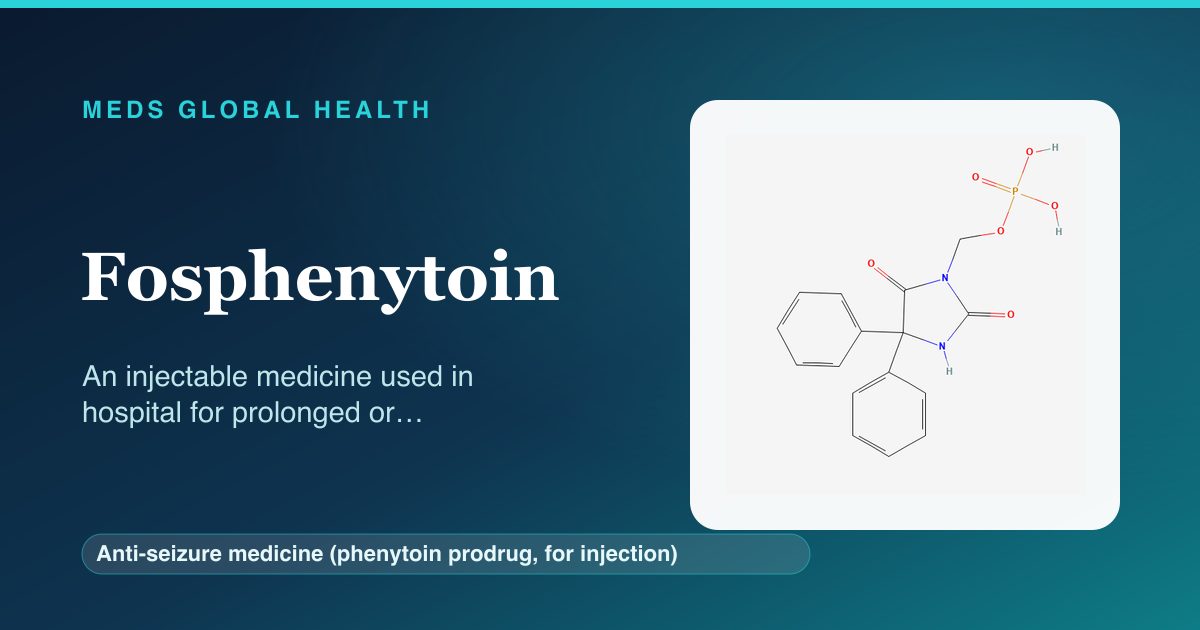
What it is
Fosphenytoin is an anti-seizure medicine used in hospital. It is what is known as a prodrug of phenytoin: after it is given, the body rapidly converts it into phenytoin, the active medicine that calms seizures. It was developed as a more convenient injectable form than phenytoin itself, gentler on the veins and able to be given into a muscle as well as a vein. It is used mainly for emergencies, to treat prolonged or repeated seizures called status epilepticus, and to keep seizures under control in people who cannot take their usual phenytoin by mouth. It is always given by trained hospital staff.
How it works
Seizures happen when groups of nerve cells in the brain fire in a sudden, excessive and uncontrolled way. Once given, fosphenytoin is converted by the body into phenytoin, which calms this overexcited electrical activity by steadying the channels that nerve cells use to fire. This helps stop a seizure that is going on and helps prevent further seizures. Because it is given by injection, it acts quickly, which is important in an emergency such as status epilepticus. The conversion to phenytoin and the rate of injection both matter, which is why it is given carefully with monitoring.
Company & origin
A hospital injectable medicine used in the UK to treat prolonged or repeated seizures (status epilepticus) and to control seizures when tablets cannot be used.
What it treats
Conditions Fosphenytoin is used for
Practical use
How to take Fosphenytoin
General, dose-free guidance — always follow your prescriber's and the leaflet's specific instructions.
- It is given by trained hospital staff as an injection into a vein or a muscle, never by yourself.
- When given into a vein it is given slowly, with continuous heart, blood-pressure and breathing monitoring.
- Staff watch the injection site for swelling, discolouration or pain, which need prompt attention.
- Blood levels of phenytoin may be checked, but only after enough time for the medicine to convert.
- Tell the team about all your other medicines, as it shares phenytoin's many interactions.
Weighing it up
Advantages & disadvantages of Fosphenytoin
Advantages
- Acts quickly by injection to treat prolonged or repeated seizures in an emergency.
- Gentler on the veins than phenytoin itself and can also be given into a muscle.
- A useful way to control seizures when the usual tablets cannot be taken.
Disadvantages
- Given too quickly into a vein, it can drop blood pressure and disturb the heart's rhythm, needing monitoring.
- Can cause skin and tissue reactions around the injection site, including rare serious ones.
- Shares phenytoin's many drug interactions and is a hospital-only treatment.
Practical use
Good to know
The dominant safety issue with fosphenytoin is what can happen if it is given too quickly into a vein: it can cause a sharp drop in blood pressure and disturbances of the heart's rhythm, so it is given at a controlled rate with continuous heart, blood-pressure and breathing monitoring, and for a period afterwards. It can also cause reactions in the skin and tissues around the injection site; a rare but serious example is a 'purple glove'-type reaction, where the hand or limb becomes swollen, discoloured and painful, which needs urgent attention. Because it becomes phenytoin in the body, blood levels of phenytoin are checked, but only after enough time has passed for the conversion to finish. It is a hospital-only medicine used under close supervision, and it shares phenytoin's many interactions with other medicines.
Who should not take it / use with caution
- People who have had a serious allergic reaction to fosphenytoin or phenytoin should not have it.
- It is avoided in people with certain slow heart rhythms or serious heart-conduction problems.
- It is used with care, and with close monitoring, in people with heart, liver or blood-pressure problems.
Monitoring
- Continuous heart, blood-pressure and breathing monitoring during and after the injection.
- Watching the injection site for swelling, discolouration or pain.
- Checking phenytoin blood levels once enough time has passed for conversion.
Side effects
- A drop in blood pressure and disturbances of the heart's rhythm, especially if given too quickly.
- Reactions around the injection site, including rarely a painful, swollen, discoloured limb.
- Dizziness, drowsiness, unsteadiness, tingling or itching during or after the injection.
Key interactions
- It shares phenytoin's many interactions, affecting and being affected by numerous medicines.
- Other medicines that lower blood pressure or affect the heart rhythm can add to its effects.
- Tell the team about all medicines, including bought ones and supplements such as St John's wort.
Available as: A solution given as an injection into a vein or a muscle, in hospital.
Answers
Fosphenytoin: frequently asked questions
What is fosphenytoin used for?
It is given by injection in hospital to treat prolonged or repeated seizures (status epilepticus) and to control seizures when phenytoin tablets cannot be used.
How is it different from phenytoin?
It is a prodrug that the body converts into phenytoin after it is given; it is gentler on the veins and can also be given into a muscle.
Why does my heart need monitoring?
Given too quickly into a vein it can drop blood pressure and disturb the heart's rhythm, so it is given slowly with continuous heart and blood-pressure monitoring.
What is a 'purple glove' reaction?
It is a rare but serious reaction where the hand or limb becomes swollen, discoloured and painful around the injection site, and it needs urgent attention.
Can I have it at home?
No. It is a hospital-only injectable medicine given by trained staff under close monitoring, not something used at home.
The wider class
About Anti-seizure medicine (phenytoin prodrug, for injection)
Fosphenytoin belongs to the anti-seizure medicine (phenytoin prodrug, for injection) class. For how the class as a whole works, its shared safety principles and monitoring, see the full guide.
Browse by body system
Authoritative sources
- BNF
- NICE CKS
Building a medicines information resource?
We create evidence-led, dose-free drug and formulary references for teams.