A loop diuretic ("water tablet")
Furosemide
A strong "water tablet" (loop diuretic) used to relieve fluid overload in heart failure and kidney disease.
What is Furosemide?
Furosemide is a strong 'water tablet', or loop diuretic, that helps the body clear excess fluid through the kidneys. It is used to relieve fluid build-up and breathlessness in heart failure, and to treat swelling (oedema) caused by heart, kidney or liver problems.
Education and reference only. This is a plain-language guide to Furosemide — it deliberately contains no doses. Doses depend on the person, the brand and the reason for treatment, and belong with your prescriber. Always check the BNF, the product labelling (SmPC) and follow medical advice.
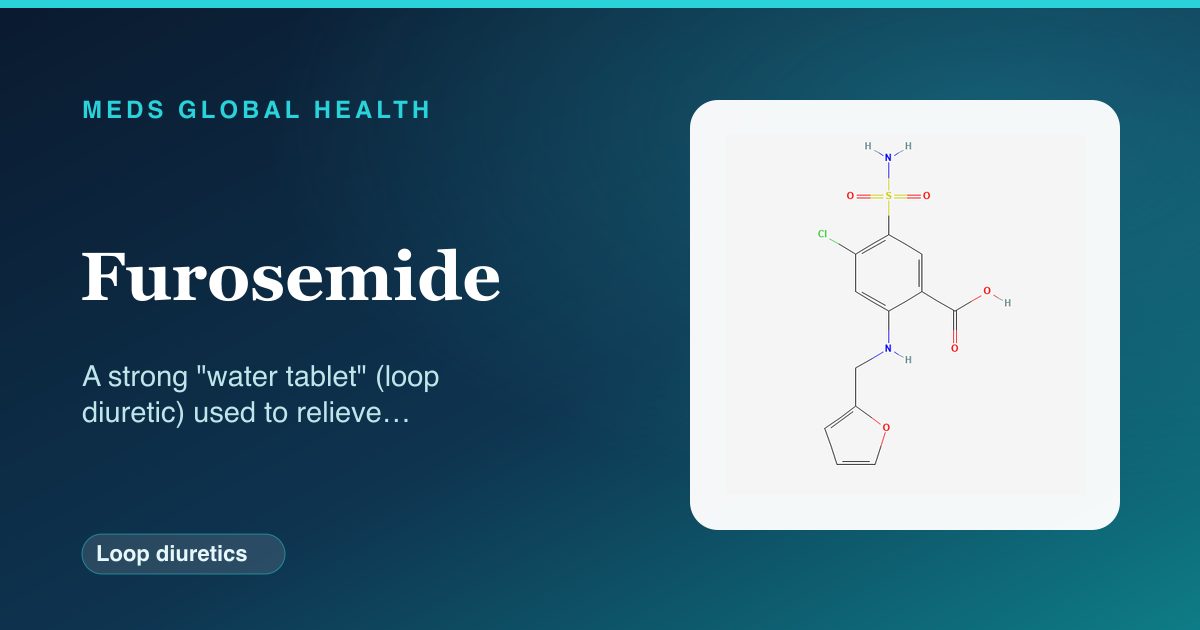
What it is
Furosemide is a strong "water tablet", or loop diuretic. It helps the body get rid of excess fluid through the kidneys, which relieves the breathlessness and ankle, leg or abdominal swelling caused by fluid overload. It is widely used in heart failure and in kidney disease, and for fluid build-up from other causes. It is important to understand that furosemide treats the symptoms of fluid overload — it makes people feel and breathe better — but it is not a medicine that, on its own, improves long-term survival.
How it works
Furosemide acts on a specific part of the kidney's filtering tubes (the "loop") and blocks the reabsorption of salt back into the body. Because water follows salt, blocking this step means more salt and water are passed out as urine. Removing this excess fluid lowers the volume of fluid in the circulation and tissues, which is how furosemide eases the breathlessness of heart failure and the swelling of fluid overload in kidney disease.
Company & origin
Originated / developed by: Sanofi (originated at Hoechst).
Furosemide is a loop diuretic discovered by the German company Hoechst (now part of Sanofi) in the late 1950s. It was first marketed in the 1960s (FDA approval in 1966) and is sold as Lasix.
What it treats
Conditions Furosemide is used for
Practical use
How to take Furosemide
General, dose-free guidance — always follow your prescriber's and the leaflet's specific instructions.
- Usually taken in the morning so the increased need to pass urine does not disturb your sleep.
- If a second dose is needed, it is often taken in the early afternoon rather than at night.
- Swallow the tablet with water, with or without food.
- If you miss a dose, take it when you remember unless it is late in the day, then skip it to avoid being up at night.
- Drink and weigh yourself as advised, and report dizziness, cramps or feeling very dehydrated.
- Do not stop or change the dose yourself if you have heart failure without speaking to your team.
Weighing it up
Advantages & disadvantages of Furosemide
Advantages
- Powerful and fast-acting relief of fluid overload and breathlessness.
- Helps relieve troublesome swelling quickly.
- Cheap, well-established generic.
- Effective even when kidney function is reduced.
Disadvantages
- Can cause dehydration and disturb salts such as potassium and sodium, needing blood tests.
- Increases the need to pass urine, which can be inconvenient or worsen incontinence.
- May cause dizziness or low blood pressure, especially on standing.
- Can affect kidney function and hearing if used very intensively.
Practical use
Good to know
Because it increases the amount of urine you pass, it is usually best taken earlier in the day so that it does not disturb sleep with night-time trips to the toilet. People are often shown how to recognise their own signs of fluid building up (such as weight gain or worsening swelling) so the dose can be adjusted. As it removes fluid and salts, furosemide can cause dehydration, low potassium or sodium, dizziness, gout flares and changes in kidney function — which is why blood tests are used to keep an eye on things.
Who should not take it / use with caution
- People who are severely dehydrated, or who have very low blood pressure, very low potassium or sodium, or who are passing little or no urine — assessed carefully first.
- Used with caution in people prone to gout, in significant liver disease, and in those with an enlarged prostate or difficulty passing urine.
- Care in pregnancy and breastfeeding, and a need to balance fluid removal against kidney function in advanced kidney disease.
Monitoring
- Kidney function and blood salts (potassium, sodium) before and during treatment
- Blood pressure, weight and signs of fluid overload or dehydration
- Symptoms such as breathlessness, swelling, dizziness or cramps
Side effects
- Passing more urine (expected), and dizziness or light-headedness, especially on standing, if too much fluid is removed.
- Low potassium, sodium or other salts, which can cause cramps, weakness or feeling unwell; dehydration and a temporary change in kidney function.
- Gout flares in those prone to it; less commonly, hearing disturbance, and effects on blood sugar or cholesterol.
Key interactions
- NSAID painkillers can reduce furosemide's effect and, alongside other heart or blood-pressure medicines, stress the kidneys.
- Other blood-pressure-lowering medicines (including ACE inhibitors and ARBs) add to the drop in blood pressure and can affect the kidneys and potassium.
- Medicines whose effect or safety depends on potassium levels (such as digoxin and some heart-rhythm medicines) need care, as does lithium.
Available as: Tablets and an oral liquid; an injectable form is used in hospital when a rapid effect is needed.
Answers
Furosemide: frequently asked questions
When is the best time to take furosemide?
It is usually best taken earlier in the day, because it makes you pass more urine and taking it later can mean getting up in the night to use the toilet. If a second dose is needed, it is generally taken by the afternoon rather than the evening — follow your prescriber's advice.
Does furosemide treat the cause of heart failure?
No — furosemide relieves the fluid overload, easing breathlessness and swelling and helping you feel better, but it does not by itself improve long-term survival. It is used alongside other heart-failure medicines that do protect the heart over time.
Why do I need regular blood tests on furosemide?
Removing fluid also removes salts and can affect the kidneys, so blood tests check your kidney function and levels of potassium and sodium. This helps catch problems such as a low potassium or dehydration early, so the dose can be adjusted.
I feel dizzy or have leg cramps — could it be the water tablet?
Possibly. Dizziness (especially on standing) can mean too much fluid has been removed, and cramps can reflect low salts such as potassium. Tell your prescriber, who can check your blood tests and adjust the dose rather than you stopping it on your own.
Is Lasix the same as furosemide?
Yes — furosemide is the generic (active-ingredient) name and Lasix is a brand name. Generic furosemide contains the identical active ingredient.
The wider class
About Loop diuretics
Furosemide belongs to the loop diuretics class. For how the class as a whole works, its shared safety principles and monitoring, see the full guide.
Browse by body system
Authoritative sources
- BNF: Furosemide.
- electronic Medicines Compendium (SmPC): Furosemide.
- NICE CKS: Furosemide.
Building a medicines information resource?
We create evidence-led, dose-free drug and formulary references for teams.