A loop diuretic (water tablet)
Torasemide
A loop diuretic ('water tablet') taken in the morning to remove excess fluid in heart failure, easing breathlessness and ankle swelling but needing care with hydration, salts and gout.
What is Torasemide?
Torasemide is a loop diuretic, often called a water tablet, used to remove excess fluid from the body in heart failure and other conditions. It is usually taken in the morning to avoid disturbed sleep from extra trips to the toilet, and it needs monitoring of hydration, kidney function and blood salts such as potassium.
Education and reference only. This is a plain-language guide to Torasemide — it deliberately contains no doses. Doses depend on the person, the brand and the reason for treatment, and belong with your prescriber. Always check the BNF, the product labelling (SmPC) and follow medical advice.
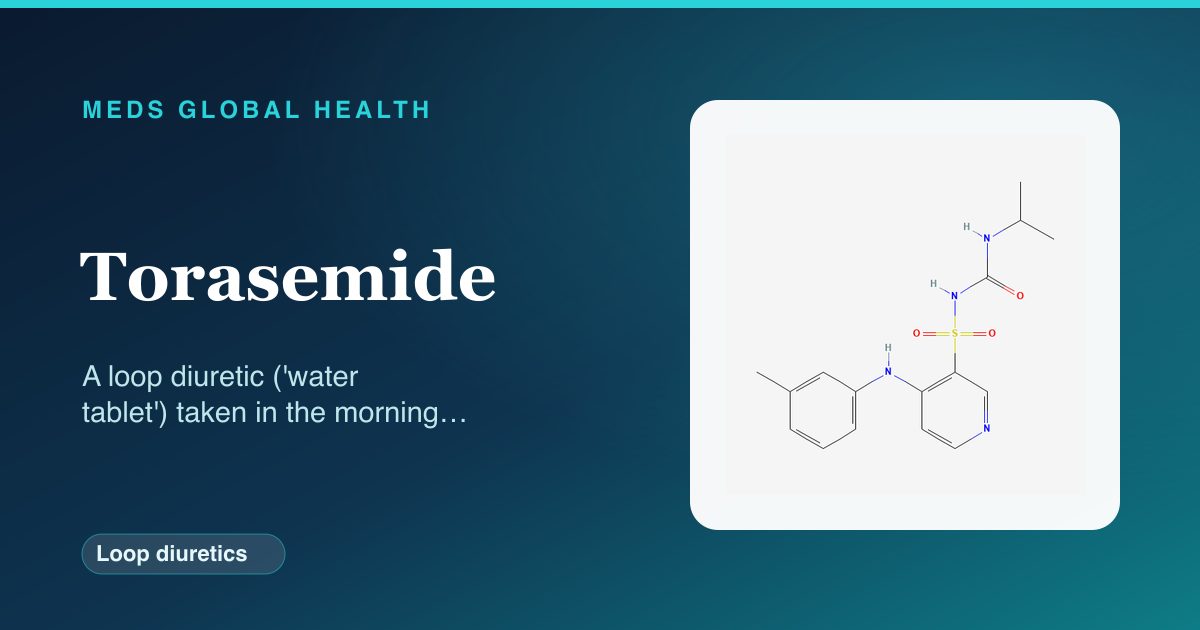
What it is
Torasemide is a loop diuretic, sometimes called a water tablet. It helps the body get rid of excess salt and water through the urine, which reduces fluid build-up. It is mainly used in heart failure to ease swelling and breathlessness, and it is sold in the UK as Torem and as a generic medicine.
How it works
Torasemide acts on a part of the kidney called the loop of Henle, blocking the reabsorption of salt and water back into the body. This makes the kidneys pass more urine, reducing the fluid that collects in the lungs, legs and ankles in conditions such as heart failure.
Company & origin
Originated / developed by: Marketed in the UK as Torem and as generic torasemide..
Torasemide is a loop diuretic introduced in the 1990s and used in the UK to remove excess fluid in heart failure and other conditions.
What it treats
Conditions Torasemide is used for
Practical use
How to take Torasemide
General, dose-free guidance — always follow your prescriber's and the leaflet's specific instructions.
- Take it in the morning so you are not woken at night needing the toilet.
- If a second daily dose is prescribed, take it in the early afternoon rather than the evening.
- It can be taken with or without food.
- Try to take it at the same time each day to keep a routine.
- If you miss your morning dose, take it as soon as you remember that morning; if it is later in the day, skip it to avoid night-time toilet trips.
- Do not stop taking it suddenly without advice, as fluid can build up again.
Weighing it up
Advantages & disadvantages of Torasemide
Advantages
- Effectively clears excess fluid, easing breathlessness and ankle swelling.
- Long-acting, often allowing once-daily morning dosing.
- Useful in heart failure and in fluid overload from kidney or liver conditions.
- Well-absorbed and reliable even when the gut is congested with fluid.
Disadvantages
- Causes frequent urination, which can be inconvenient.
- Can lead to dehydration and low blood salts such as potassium and sodium.
- May trigger or worsen gout and can raise blood sugar.
- Needs regular blood tests to monitor kidney function and electrolytes.
- Can cause dizziness from low blood pressure, especially in hot weather or with illness.
Practical use
Good to know
Torasemide is best taken in the morning so the extra urination does not disturb your sleep. It can lower your blood salts and fluid levels, so you may have regular blood tests, and it is important to mention symptoms like cramps, severe thirst or feeling faint.
Who should not take it / use with caution
- People who are severely dehydrated or have very low blood salts.
- Anyone unable to pass urine due to kidney failure.
- People with a known allergy to torasemide or to sulfonamide medicines.
- Those with gout or diabetes, who need extra monitoring.
- People who are pregnant or breastfeeding should discuss it with their doctor.
Monitoring
- Kidney function and blood salts (potassium, sodium) before and during treatment.
- Blood pressure and weight, to judge fluid balance.
- Blood sugar in people with diabetes and urate levels in those prone to gout.
- Signs of dehydration, particularly during illness with vomiting or diarrhoea.
Side effects
- Passing urine more often, especially soon after a dose.
- Dizziness or light-headedness from lowered blood pressure or fluid loss.
- Muscle cramps, thirst or weakness from low blood salts.
- A flare of gout, or raised blood sugar in people with diabetes.
- Seek advice for severe thirst, confusion, fainting, an irregular heartbeat or signs of dehydration.
Key interactions
- Other blood-pressure medicines, which add to the lowering effect.
- ACE inhibitors and ARBs, where the combination can cause a sharp drop in blood pressure or affect the kidneys.
- NSAIDs such as ibuprofen, which reduce the diuretic effect and can harm the kidneys.
- Lithium and digoxin, whose levels or effects can change with shifting salt levels.
- Other medicines that lower potassium, which add to the risk of low potassium.
Available as: Tablets.
Answers
Torasemide: frequently asked questions
Why should I take torasemide in the morning?
It makes you pass more urine for several hours, so taking it in the morning helps you avoid being woken during the night to go to the toilet.
What is a water tablet?
It is a common name for a diuretic. Torasemide is a loop diuretic that helps your body get rid of excess salt and water, reducing fluid build-up.
Can torasemide affect my blood salts?
Yes. It can lower levels of potassium and sodium, so you will have blood tests, and you should report cramps, weakness or feeling unwell.
Can I take ibuprofen with torasemide?
It is best avoided where possible, as anti-inflammatory painkillers can blunt the diuretic effect and increase the risk of kidney problems. Ask your pharmacist about safer painkillers.
What should I do if I am ill with vomiting or diarrhoea?
These can cause dehydration that, with torasemide, may harm the kidneys. Contact your doctor, as the tablet may need to be paused until you recover.
The wider class
About Loop diuretics
Torasemide belongs to the loop diuretics class. For how the class as a whole works, its shared safety principles and monitoring, see the full guide.
Browse by body system
Authoritative sources
- BNF
- NICE CKS
Building a medicines information resource?
We create evidence-led, dose-free drug and formulary references for teams.