A stimulant medicine for ADHD
Methylphenidate
A stimulant medicine used to treat attention deficit hyperactivity disorder (ADHD) in children and adults.
What is Methylphenidate?
Methylphenidate is a stimulant medicine and one of the first-choice treatments for attention deficit hyperactivity disorder (ADHD). It improves attention and reduces impulsiveness and restlessness, and in the UK it is a controlled drug.
Education and reference only. This is a plain-language guide to Methylphenidate — it deliberately contains no doses. Doses depend on the person, the brand and the reason for treatment, and belong with your prescriber. Always check the BNF, the product labelling (SmPC) and follow medical advice.
What it is
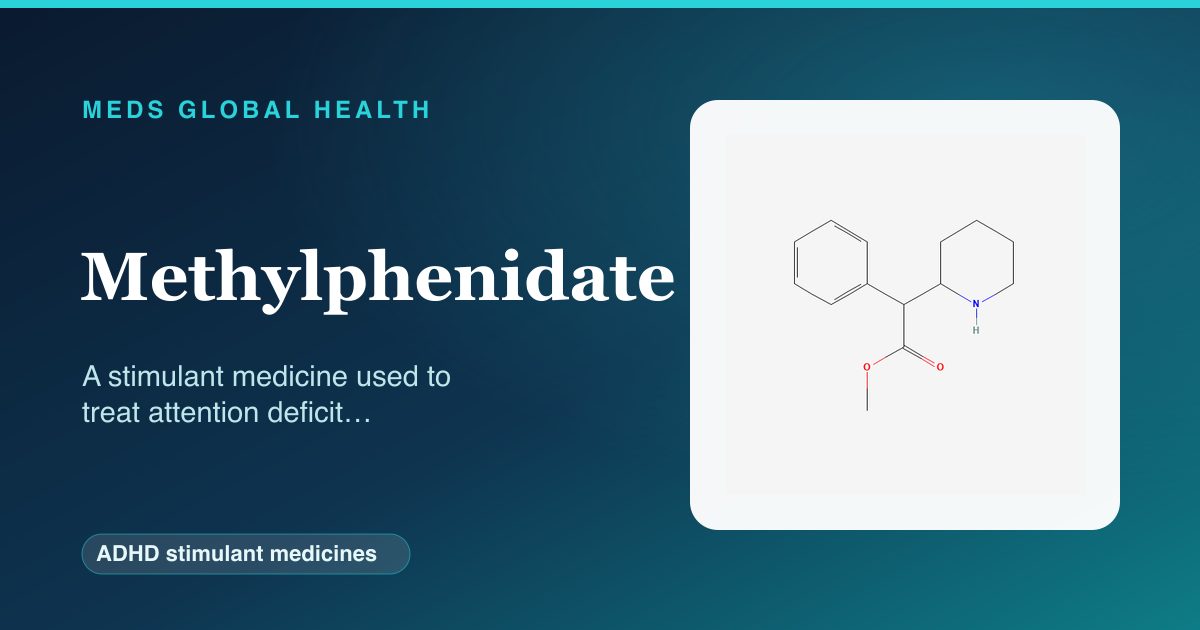
Methylphenidate is a stimulant medicine and one of the first-choice treatments for attention deficit hyperactivity disorder (ADHD). It improves attention and reduces impulsiveness and over-activity, helping people focus, organise and function in daily life. It comes as both immediate-release tablets (such as Ritalin and Medikinet) that act for a short time and modified-release ("XL") forms (such as Concerta XL, Equasym XL and Medikinet XL) that work through the day from a single morning dose. It is a controlled drug — kept and prescribed under stricter rules because of its potential for misuse — and is usually started and overseen by a specialist before shared care with the GP.
How it works
Methylphenidate boosts the activity of two brain chemical messengers — dopamine and noradrenaline — in the parts of the brain that govern attention, focus and self-control. In ADHD these signalling systems are under-active, and lifting their activity helps the brain filter distractions, stay on task and pause before acting. The modified-release versions release the medicine gradually so the effect lasts through the school or working day.
Company & origin
Originated / developed by: Ciba (now Novartis).
Methylphenidate was first synthesized in 1944 by chemist Leandro Panizzon at Ciba in Switzerland and marketed as the stimulant Ritalin from 1954.
Practical use
How to take Methylphenidate
General, dose-free guidance — always follow your prescriber's and the leaflet's specific instructions.
- It is used as part of a wider ADHD treatment plan and started under specialist guidance.
- Take it earlier in the day; taking it too late can interfere with sleep.
- As a controlled drug, keep it securely stored, do not share it, and follow prescription rules closely.
- Regular monitoring is needed — including height, weight, appetite, blood pressure and heart rate.
- Tell the prescriber about heart problems, mental health symptoms or a family history of sudden cardiac death before starting.
- Do not stop or change it without advice, and report any chest pain, fainting or marked mood changes.
Weighing it up
Advantages & disadvantages of Methylphenidate
Advantages
- Effective at improving focus and reducing impulsivity in ADHD.
- Available in shorter- and longer-acting forms to suit the day.
- Well-established treatment with decades of clinical experience.
- Benefits can support school, work and relationships.
Disadvantages
- A controlled drug with potential for misuse and strict prescribing rules.
- Commonly reduces appetite and can affect growth, sleep and mood.
- Can raise heart rate and blood pressure, so the heart is monitored.
- Needs ongoing specialist review and is not a cure for ADHD.
Practical use
Good to know
Modified-release brands release the medicine in different ways and over different lengths of time, so they are NOT freely interchangeable — they should be prescribed and dispensed by brand to keep the effect consistent. In children, appetite, weight, height, sleep, mood, heart rate and blood pressure are checked before and during treatment, with regular reviews. It works while it is in the system rather than building up over weeks, so some families use planned breaks under guidance; it is not stopped abruptly for everyone, and any change should be a shared decision with the specialist. Taking later doses too close to bedtime can disturb sleep.
Who should not take it / use with caution
- People with certain serious heart conditions, very high blood pressure, or some heart-rhythm or blood-vessel problems.
- People with severe agitation, certain serious mental-health conditions, an overactive thyroid, or a history of substance misuse need careful specialist assessment.
- It is not used alongside, or close to, a type of older antidepressant called a monoamine oxidase inhibitor (MAOI).
Monitoring
- Height, weight and appetite in children
- Heart rate and blood pressure before and during treatment
- Mood, sleep, tics and overall benefit, with regular specialist review
Side effects
- Reduced appetite, difficulty sleeping, headache, dry mouth, and feeling anxious or irritable.
- A rise in heart rate and blood pressure; in children, slowing of growth, which is watched and managed.
- Less commonly, mood changes, tics, or — rarely — chest pain, fainting or signs of a circulation problem in the fingers and toes, which should be reported.
Key interactions
- Must not be combined with, or used close to, MAOI antidepressants because of a dangerous rise in blood pressure.
- Care with other medicines that raise blood pressure or heart rate, including some decongestants.
- Care alongside certain antidepressants, antipsychotics and blood-pressure medicines; alcohol and recreational stimulants should be avoided.
Available as: Immediate-release tablets, and several modified-release ("XL") capsules and tablets that work through the day. The modified-release brands are not interchangeable and are prescribed by brand.
Answers
Methylphenidate: frequently asked questions
Why does my prescription say a specific brand like Concerta XL?
The modified-release brands of methylphenidate release the medicine in different ways and over different lengths of time, so swapping brands can change how it works through the day. To keep the effect steady, the specific brand is written on the prescription and should be dispensed exactly — tell your pharmacist if you are offered a different one.
Is methylphenidate addictive?
When taken as prescribed for ADHD it is an effective, well-monitored treatment and the risk of dependence is low. It is a controlled drug because it can be misused, which is why it is prescribed and supplied under stricter rules and overseen by a specialist. Used correctly, it actually helps many people manage impulsive behaviour better.
Will it stunt my child's growth?
Methylphenidate can slightly slow growth in some children, which is why height, weight and appetite are checked regularly. Any slowing is monitored and managed — for example with planned breaks or dietary support — and growth often catches up. Your specialist will track this at reviews.
Can methylphenidate be stopped suddenly?
It works while it is in the body rather than building up over time, so it does not need a long taper in the way some medicines do. However, stopping or changing it should always be a shared decision with the specialist, who will review whether it is still needed — some people benefit from planned breaks, while others do better continuing.
What is the difference between methylphenidate and Ritalin?
They are the same medicine — methylphenidate is the generic (active-ingredient) name and Ritalin is a brand name. Other brands such as Concerta XL, Equasym XL and Medikinet also contain methylphenidate, but the modified-release ones are not interchangeable and are prescribed by brand.
The wider class
About ADHD stimulant medicines
Methylphenidate belongs to the adhd stimulant medicines class. For how the class as a whole works, its shared safety principles and monitoring, see the full guide.
Browse by body system
Authoritative sources
- BNF: Methylphenidate hydrochloride.
- NICE NG87: Attention deficit hyperactivity disorder — diagnosis and management.
- NICE CKS: Methylphenidate.
Building a medicines information resource?
We create evidence-led, dose-free drug and formulary references for teams.