A long-lasting nasal decongestant spray
Oxymetazoline
A fast, longer-lasting nasal decongestant spray for a blocked nose, which — like other decongestant sprays — must not be used for more than about a week.
What is Oxymetazoline?
Oxymetazoline is a nasal spray that quickly clears a blocked nose by shrinking swollen blood vessels in the lining, and its effect tends to last a little longer than some other decongestant sprays. As with all such sprays, it must not be used for more than about a week because longer use causes rebound congestion (rhinitis medicamentosa).
Education and reference only. This is a plain-language guide to Oxymetazoline — it deliberately contains no doses. Doses depend on the person, the brand and the reason for treatment, and belong with your prescriber. Always check the BNF, the product labelling (SmPC) and follow medical advice.
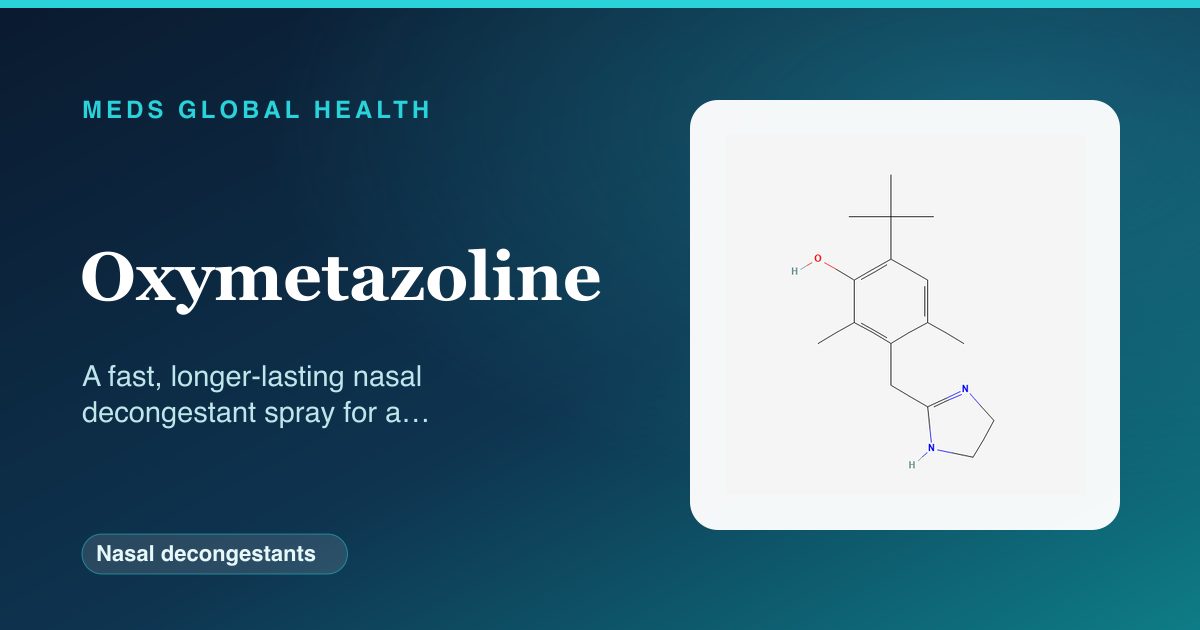
What it is
Oxymetazoline is a fast-acting nasal decongestant, sold over the counter as a spray. It is used for short-term relief of a blocked nose from colds, sinusitis or hay fever, and tends to last a little longer than some other decongestant sprays. Like its relatives, it relieves the symptom of blockage but does not treat what is causing it.
How it works
Oxymetazoline tightens the swollen blood vessels in the lining of the nose. As these vessels shrink, the swelling settles and the nasal passages open up, usually within a few minutes. The relief is local and temporary, so the spray needs repeating and is only meant for brief use.
Company & origin
Originated / developed by: Originally developed by Merck (E. Merck)..
Oxymetazoline is a well-established nasal decongestant that has been available over the counter in the UK for many years.
Practical use
How to take Oxymetazoline
General, dose-free guidance — always follow your prescriber's and the leaflet's specific instructions.
- Blow your nose gently before use.
- Insert the nozzle just inside the nostril, keep your head upright and give a spray into each nostril.
- Breathe in gently as you spray rather than sniffing hard.
- Limit use to a short course — no more than about a week — to avoid rebound congestion.
- Wipe the nozzle clean afterwards and do not share the spray.
Weighing it up
Advantages & disadvantages of Oxymetazoline
Advantages
- Fast relief of a blocked nose, often feeling longer-lasting than some sprays.
- Available over the counter for short-term self-care.
- Acts locally with few whole-body effects when used briefly.
Disadvantages
- Must not be used beyond about a week because of rebound congestion.
- Relieves the blockage only — it does not treat the underlying cause.
- Not generally suitable for young children except on advice.
Practical use
Good to know
Oxymetazoline works fast and can feel longer-lasting than some sprays, but the same key rule applies: do not use it for more than about a week. Longer use leads to rebound congestion (rhinitis medicamentosa), where the nose becomes more blocked between doses and people are drawn into using it repeatedly. It is not generally recommended for young children except on advice, and for ongoing allergic blockage a steroid nasal spray is the better long-term choice.
Who should not take it / use with caution
- Young children, unless specifically advised by a pharmacist or doctor.
- People who already have rebound congestion from over-using a decongestant spray.
- People with certain heart, blood-pressure or thyroid conditions should check with a pharmacist first.
Monitoring
- How many days you have used it — stay within about a week
- Whether the blockage is settling or rebounding
- Any palpitations or symptoms that do not improve
Side effects
- Brief stinging, dryness or sneezing after spraying.
- Rebound congestion if used for too long.
- Occasionally a dry mouth, headache or, rarely, a fast heartbeat.
Key interactions
- Caution alongside certain antidepressants, including MAOIs — check with a pharmacist.
- Avoid combining with other decongestants, as the effects can add up.
- Mention any heart, blood-pressure or thyroid medicines to a pharmacist before use.
Available as: Nasal spray.
Answers
Oxymetazoline: frequently asked questions
How is oxymetazoline different from xylometazoline?
Both are fast decongestant sprays that work the same way; oxymetazoline's effect tends to last a little longer for some people. Importantly, both carry the same rule — no more than about a week of use — to avoid rebound congestion.
Can I use it for more than a week?
No. Like other decongestant sprays, using it for longer than about a week can cause rebound congestion, where the nose becomes more blocked when the spray wears off. If your symptoms last longer, see a pharmacist about a different approach.
Is it safe for my child?
Decongestant sprays are not generally recommended for young children except on the advice of a pharmacist or doctor. Always check first.
My nose is more blocked since I started — why?
This may be rebound congestion from using the spray too long. Stopping it lets the lining recover, though the nose can be stuffy for a while; a pharmacist can suggest a steroid nasal spray or antihistamine to help during that time.
What is the difference between oxymetazoline and Vicks Sinex?
They are the same medicine — oxymetazoline is the active-ingredient name and Vicks Sinex is one brand. Both contain the same decongestant.
The wider class
About Nasal decongestants
Oxymetazoline belongs to the nasal decongestants class. For how the class as a whole works, its shared safety principles and monitoring, see the full guide.
Browse by body system
Authoritative sources
- BNF: Oxymetazoline.
- NICE CKS: Decongestants.
Building a medicines information resource?
We create evidence-led, dose-free drug and formulary references for teams.