A blood-pressure support and decongestant medicine
Ephedrine
A medicine used to raise blood pressure during anaesthesia and, as drops or spray, to relieve a blocked nose.
What is Ephedrine?
Ephedrine is a long-established medicine with two main uses: in hospital it is given to raise blood pressure that has dropped during anaesthesia, and as nasal drops or spray it is used as a decongestant to relieve a blocked nose. It stimulates the circulation, so it raises the heart rate and blood pressure and can cause palpitations, restlessness and difficulty sleeping. It is used with caution in people with heart disease, high blood pressure or an overactive thyroid, and it has a potential for misuse. Nasal decongestant forms should only be used for a few days to avoid rebound congestion.
Education and reference only. This is a plain-language guide to Ephedrine — it deliberately contains no doses. Doses depend on the person, the brand and the reason for treatment, and belong with your prescriber. Always check the BNF, the product labelling (SmPC) and follow medical advice.
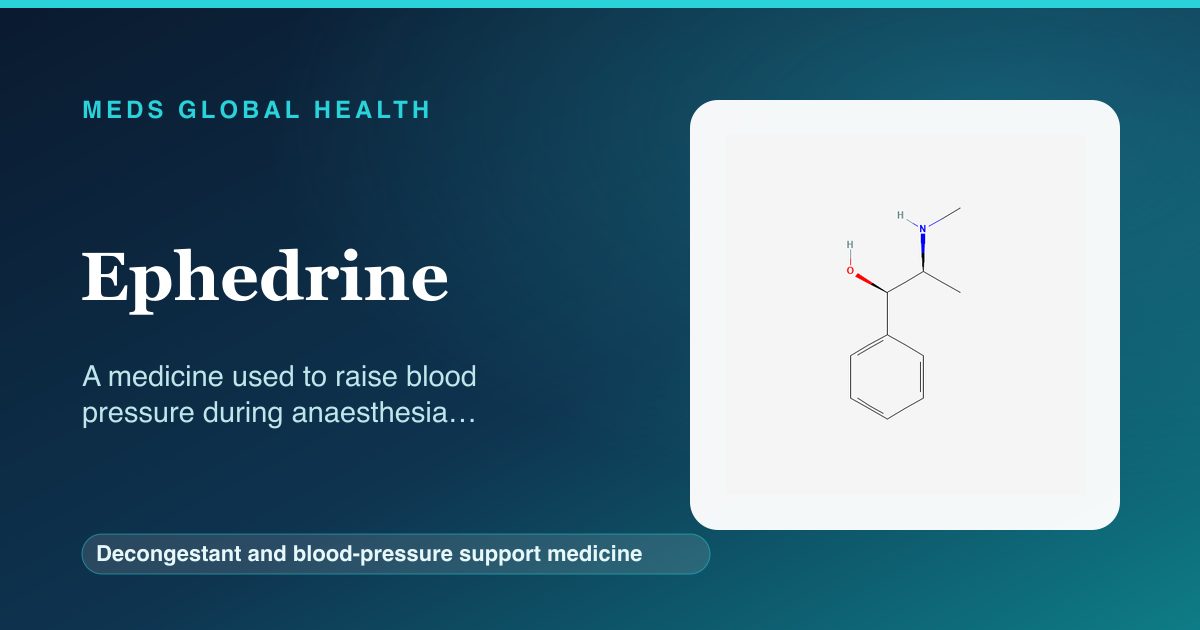
What it is
Ephedrine is a medicine that stimulates the circulation. It has been used for many years in two quite different ways. In hospital, it is given by injection to raise blood pressure when it falls during an anaesthetic. Separately, in the form of nasal drops or a spray, it is used as a decongestant to shrink swollen blood vessels in the nose and ease a blocked nose. Because it stimulates the body, it can speed up the heart and raise blood pressure, and it is used with care in people with certain conditions.
How it works
Ephedrine acts on the body's sympathetic ('fight or flight') system. It causes blood vessels to tighten and stimulates the heart, which raises blood pressure and heart rate. When given during anaesthesia, this tightening of blood vessels and support of the heart helps bring a low blood pressure back up. When used in the nose, the tightening of the small blood vessels in the lining reduces swelling and congestion, so the nose feels clearer. The same stimulating action explains its side effects, such as a racing heart, restlessness and trouble sleeping.
Company & origin
A long-established medicine used in the UK to raise blood pressure during anaesthesia and, in nasal form, as a decongestant.
What it treats
Conditions Ephedrine is used for
Practical use
How to take Ephedrine
General, dose-free guidance — always follow your prescriber's and the leaflet's specific instructions.
- When used in hospital to support blood pressure, it is given by injection by trained staff who monitor closely.
- When used as a nasal decongestant, use the drops or spray exactly as directed and only for a few days at a time.
- Avoid using nasal decongestant forms for longer than advised, to prevent rebound congestion when you stop.
- Tell your prescriber or pharmacist if you have heart disease, high blood pressure, an overactive thyroid or diabetes.
- Avoid taking it close to bedtime where possible, as it can make it hard to sleep.
Weighing it up
Advantages & disadvantages of Ephedrine
Advantages
- A quick and effective way to raise blood pressure that has dropped during anaesthesia.
- As a nasal form, it can relieve a blocked nose effectively.
- A long-established medicine with decades of experience behind its use.
Disadvantages
- Raises heart rate and blood pressure and can cause palpitations, restlessness and difficulty sleeping.
- Nasal forms used for too long can cause rebound congestion.
- Used with caution in heart disease and has a potential for misuse.
Practical use
Good to know
It helps to know that ephedrine has two distinct roles, and the way it is used and the cautions differ between them. In hospital it is a quick way to lift blood pressure during anaesthesia, used by the anaesthetist who is monitoring closely. As a nasal decongestant, the important practical point is that it should only be used for a few days at a time: using nasal decongestants for too long can cause the congestion to come back worse when you stop, a 'rebound' effect. Because it stimulates the heart and circulation, it can cause palpitations, a fast heartbeat, restlessness, tremor and difficulty sleeping, and it is used with caution in people with heart disease, high blood pressure, an overactive thyroid or diabetes. It also has a potential for misuse, which is why its supply is controlled.
Who should not take it / use with caution
- People who have had a serious allergic reaction to ephedrine should not use it.
- It is used with caution, or avoided, in people with heart disease, high blood pressure or an overactive thyroid.
- It can interact dangerously with a group of antidepressants called MAOIs, so it must not be used with or soon after them.
Monitoring
- When given for blood pressure during anaesthesia, the heart rate and blood pressure are monitored closely.
- Watching for a fast heartbeat, palpitations or restlessness.
- Reviewing nasal decongestant use so it is not continued for too long.
Side effects
- A fast heartbeat or palpitations.
- Restlessness, anxiety, tremor or difficulty sleeping.
- A rise in blood pressure, headache or, with nasal forms used too long, rebound congestion.
Key interactions
- It can cause a dangerous rise in blood pressure if used with or soon after MAOI antidepressants.
- It may interact with other medicines that raise blood pressure or affect the heart, so tell your prescriber what you take.
- Its effects on the heart and blood pressure are considered alongside any blood-pressure or heart medicines.
Available as: A solution for injection in hospital, and nasal drops or spray.
Answers
Ephedrine: frequently asked questions
What is ephedrine used for?
It has two main uses: in hospital it is given to raise blood pressure that has dropped during anaesthesia, and as nasal drops or spray it is used as a decongestant to relieve a blocked nose.
Why can I only use the nasal form for a few days?
Using nasal decongestants for too long can cause rebound congestion, where the blocked nose comes back worse when you stop, so they should be used only for a few days at a time.
Does it affect the heart?
Yes, it stimulates the circulation and can raise the heart rate and blood pressure and cause palpitations, which is why it is used with caution in people with heart disease or high blood pressure.
Why must it not be used with certain antidepressants?
It can cause a dangerous rise in blood pressure if used with or soon after MAOI antidepressants, so this combination must be avoided.
Why is its supply controlled?
Ephedrine has a potential for misuse, so its supply is controlled to reduce that risk.
The wider class
About Decongestant and blood-pressure support medicine
Ephedrine belongs to the decongestant and blood-pressure support medicine class. For how the class as a whole works, its shared safety principles and monitoring, see the full guide.
Browse by body system
Authoritative sources
- BNF
- NICE CKS
Building a medicines information resource?
We create evidence-led, dose-free drug and formulary references for teams.